Brain Tumour Trust Dinner

Fundraising doesn’t have to be a huge great event or even a test of your physical powers.  Tonight I was invited to attend a dinner in aid of the Brain Tumour Trust Charity.  The friends arranging it had spoken to the proprietors of a local cafe/restaurant.  It was suggested that a set dinner could be served for up to 30 people at a cost of £20.  Tickets for the dinner would be sold at £35 ie £15 from each ticket sold going to charity.  There would also be a small raffle with a dozen donated prizes and tickets to be sold at a cost of £10 each.

About 25 people, mostly friends and family, turned up for a fabulous evening meal out.  (25x£15).  We all bought at least one raffle ticket and some many more (25+ x£10).  My friends did a short speech about the charity, why the charity was so important to them and why they were organising this event and raising funds.

The dinner was a great laugh, good times with friends (new and old), good food, great wine and all in aid of a good cause.

Not an outrageously costly event to attend but a nice little sum of fundraising for a charity close to my friend’s heart.

Could you organise something like this for a cause close to your heart?

International Clinical Trials Day

Each year, International Clinical Trials Day is celebrated around the world on or near the 20th May to commemorate the day that James Lind started his famous trial.

Tonight I’ve been a guest of Cancer Research UK at their Imperial Cancer Research UK Centre in West London. The purpose of tonight’s celebration is to launch a series of short films which feature key research programmes currently being undertaken. These films will be displayed in public areas within partner hospitals and for use by the teams on websites and during public and patient involvement events.

As you know I’m passionate about the improvement and advancement of cancer care. I have spent time to try to understand what clinical trials really involve. What is being undertaken and where. Why people should get involved (greater good and personal good). I can’t stress enough that without patient and carer involvement, medical advancements will be slow or in some cases not exist at all!

Clinical trials used to fill me with fear. I thought, as I think many do, that being involved in a clinical trial would mean being injected with drugs, high levels of danger and perhaps ending up like the Elephant Man case or worse.

What my investigations and questions have led me is truly a very different understanding. There is so much more to clinical trials and a great deal of it non-invasive. Participation can be as little as completing surveys or questionnaires during your treatment or whilst caring for someone else. It may be changing your diet slightly. It may be helping with the wording on a funding application from a patient/carer perspective. It might be the occasional blood sample. It may be speaking to researchers about your experience first hand. It may be donating part of a excised tumour. It may be regular scans. It may also be changes to your chemotherapy regimen, radiotherapy frequency or taking new drugs.

However with all patient/carer involvement there is a huge duty of care to ensure you understand your involvement, the level of involvement. Continued support and, if you’re participating in drugs trials, constant access to the clinical and research team.

They can’t do their work without us!

Personally, I’ve authorised for tumour samples from my excised Phyllodes to a tissue bank for a clinical trial relating to Phyllodes. Sadly due to the small number diagnosed the trial remains on hold whilst new samples are slowly collected.

I’ve also authorised for tumour samples from my excised DCIS to be used in a trial. This trial is known as the ICICLE trial and there is a brief explanation from Cancer Research about what it is researching.

As part of the Patient Participation Group at Imperial, I’ve also helped out with the wording of funding applications, trial designs and patient/carer leaflets. I’ve participated in discussions and provided feedback at meetings to researchers and clinicians. I’ve also been fortunate enough to have a tour of the research centre and see exactly where the work is carried out, the scans performed, the ward for inpatients and consultation rooms. Amazing facility. Incredible work.

So I guess it’ll come as no surprise to anyone that I’ve been involved in another project at Imperial. The only surprise is that I’ve put myself in front of a camera – I so hate myself on film! But needs must.

As I mentioned earlier, tonight saw the launch of a number of films. Well yours truly appears in a couple of them! Even more so, I was presented with a lovely gift from the team at Imperial to thank me for my involvement and all that I contribute to the group.

I hope the films make a difference and encourage people to get involved in clinical trials… remember they’re not scary!

Here are a few films that explain what taking part in a clinical trial involves and below there are more specific trial information films.….

Link to films – I may well appear in them so don’t be scared!

Marsden March

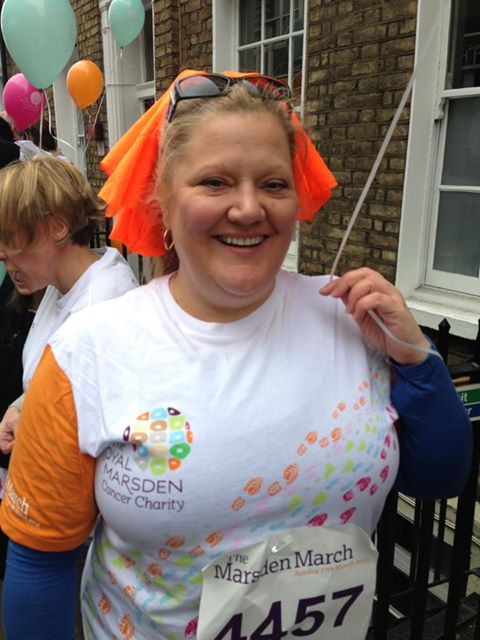
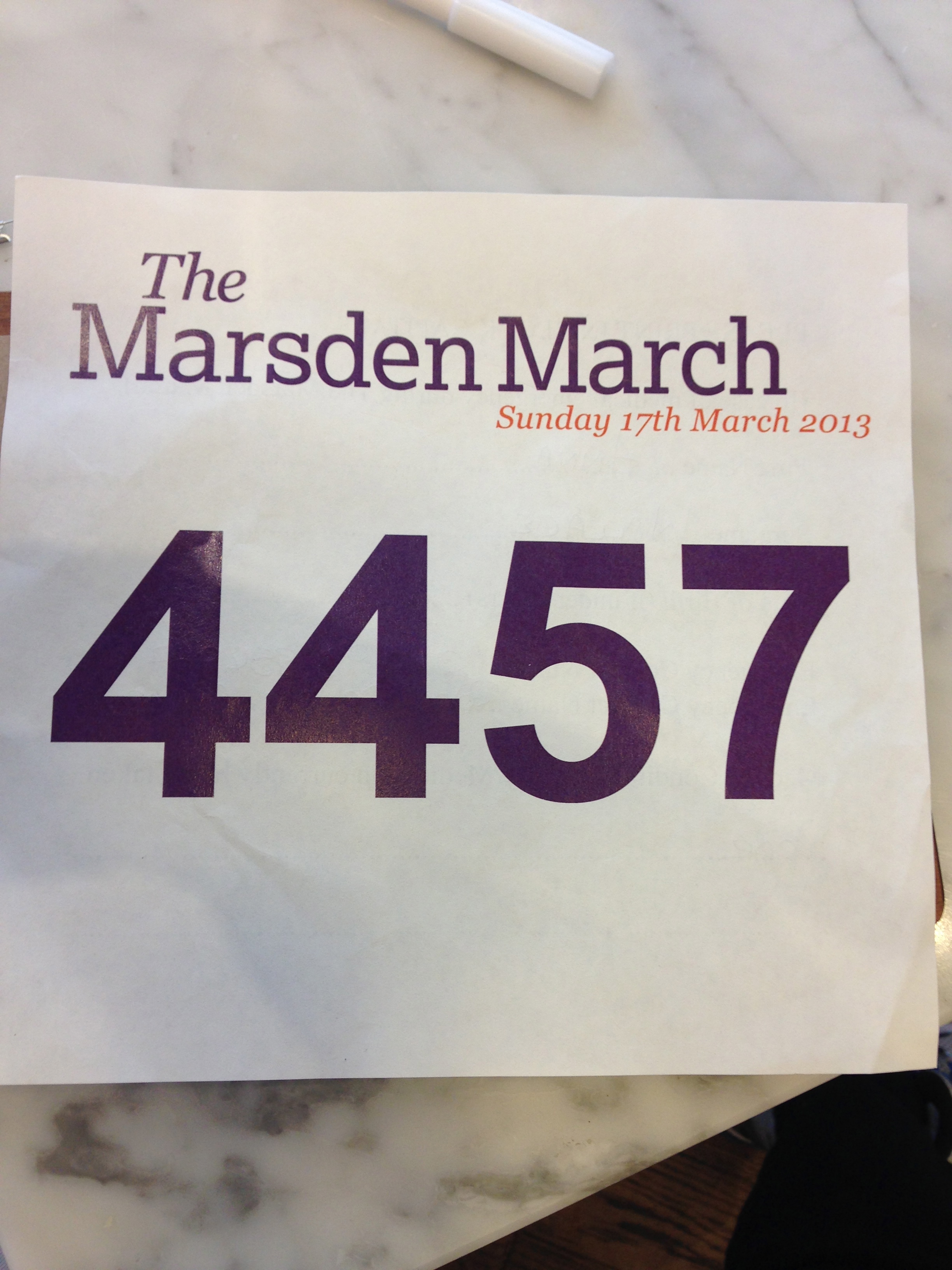
4,500 people signed up and took part in the Marsden March today.  Some chose to walk the 5 mile option and others walked 14 miles.  Eeek I had signed up for the 14 miles and managed to coerce a few friends into walking with me too.  Double eek when I tell you that it was utterly pouring with rain, the parks muddy, biting wind, squishy underfoot and pretty cold too!  Oh joy.

625610_10151346796686003_327505639_n
IMG_3270


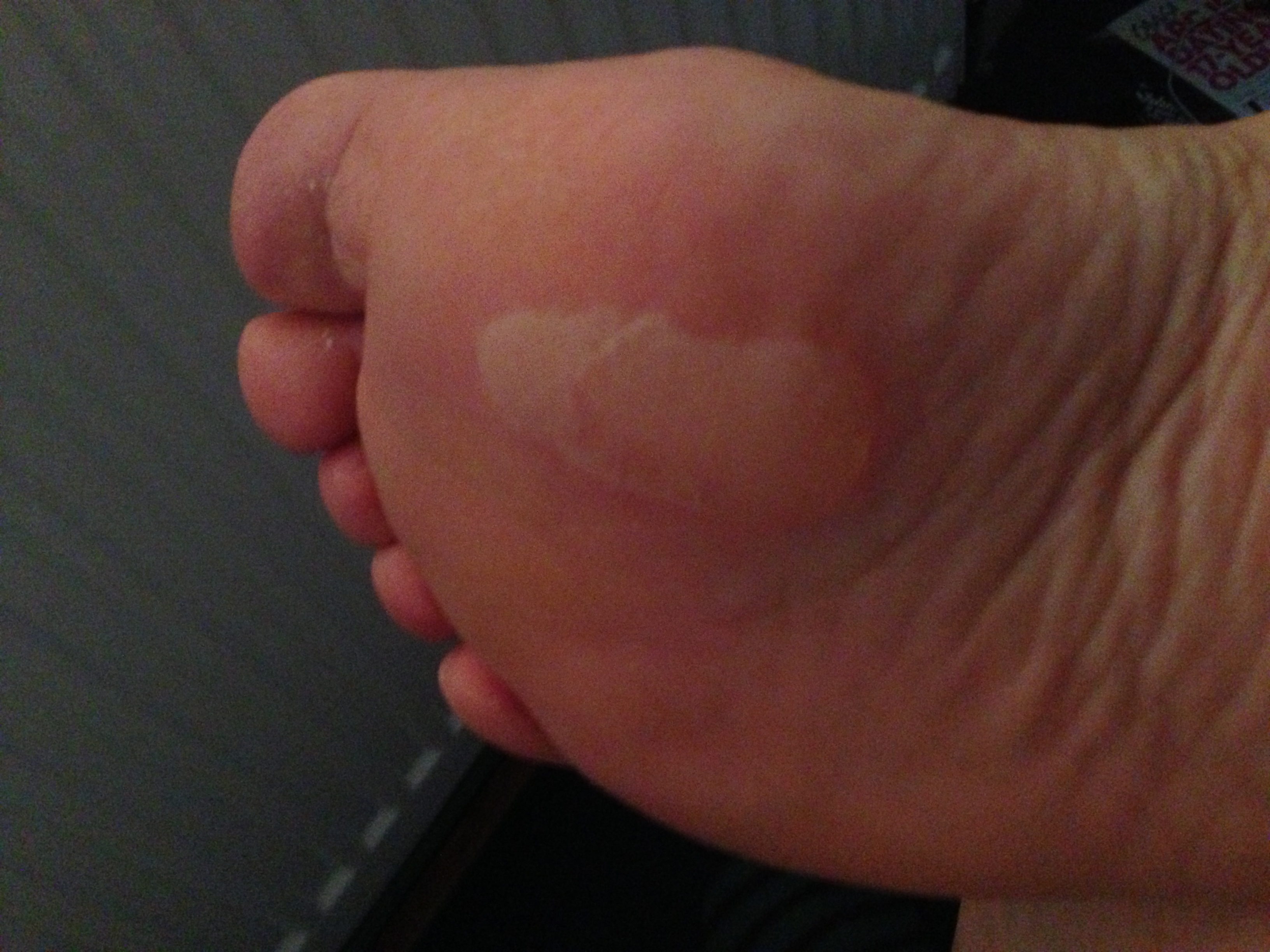
I had thought that my calves/shinsplints/ankles would have played up but they behaved.. my blisters however didn’t.  The final few miles I was walking on my heels through the rain and mud!

IMG_3279

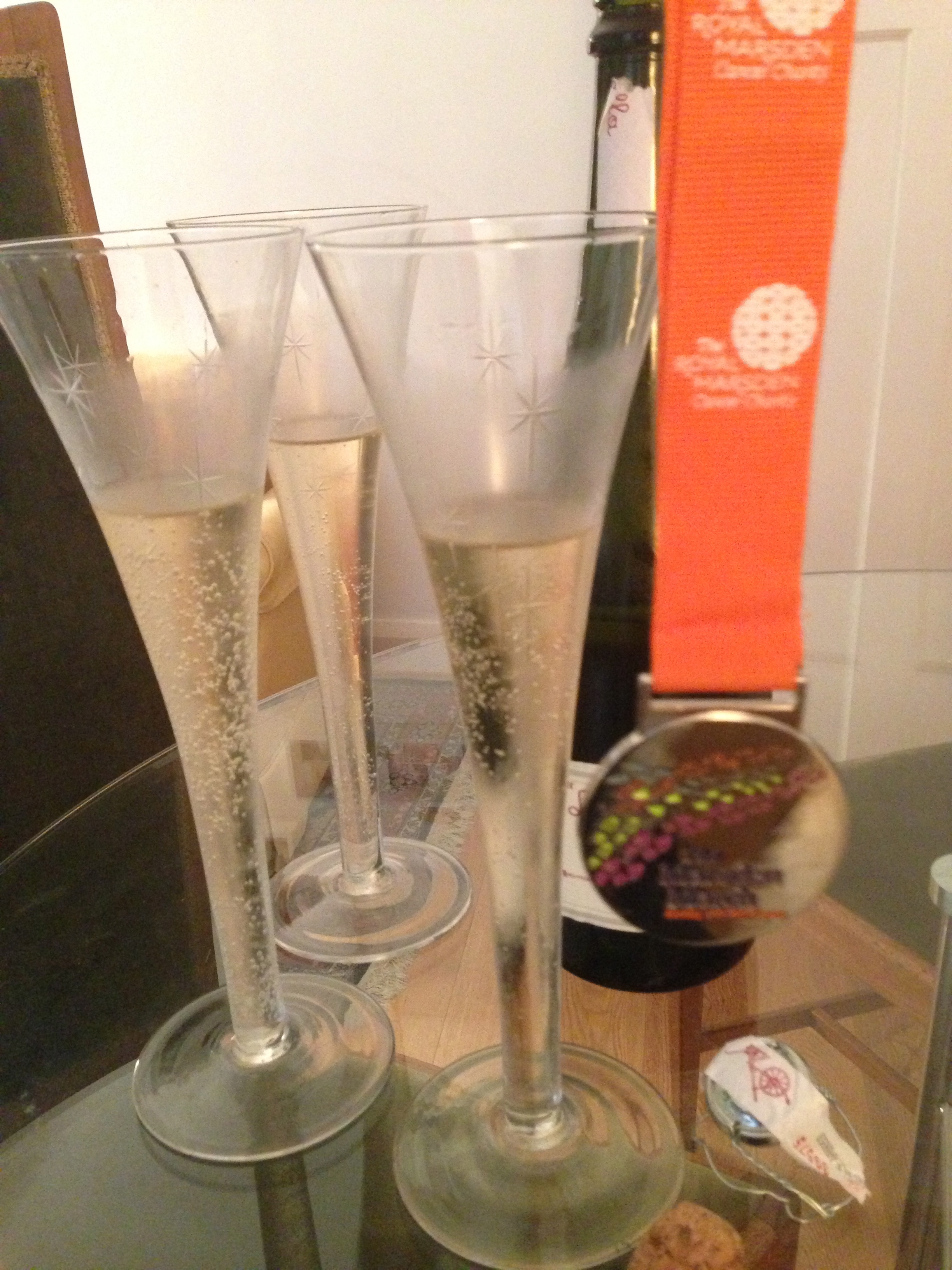
But we did it… and more importantly we raised (the 4,500 of us) over £1.18 million for Royal Marsden Cancer Charity.

IMG_3274


So… what do you say?  Will you do the Marsden March in 2014?  Click here to sign up.

Text to a friend

Whilst away at the European Sarcoma Conference I knew something wasn’t right.  I think I knew that Tish would be protecting me whilst I was overseas.  She fully supported my being involved in conferences, boards, cancer networks etc so wouldn’t want to burden me whilst I was abroad.  But I’ve had this dreadful feeling all day.  Below is a (long) text message I sent to a friend:

“I need to run something by you. I don’t know that you’ll understand nor that I’ll be able to tell you all I need to say but I need to know I’ve tried and need to know you’ve listened.

You may remember me talking about the ‘champagne and shoe’ girls. A little band of cancer warriors, Kerry, Letitia and I. Kerry and Tish had ovarian cancer and I was introduced to them quite some time ago but we hit a chord and just ‘got it’, ‘got each other’. No matter how bleak a prognosis or indeed how bleak we felt, we’ve been able to spark each other, support one another, have a laugh and look beyond.

This time last year Kerry passed away. I had the call from Tish at this conference in Berlin and my heart broke just a little bit more. Kerry was always so strong. We had a giggle. We both enjoyed bubbles and we also enjoyed the same shoe collection and spent an hour or several trying on new pairs.

But Kerry was truly Tish’s support. They both had the same diagnosis and a similar prognosis. Tish and I have been close this last year and there have been many times when she’s been feeling down or I have, we’ve met up, put the world to rights and left back in our positive places. Some times we’ve not managed to meet but talk by text. Tish has been very poorly but after living her life and going to Australia embraced life once more and foiled the experts with a change in her prognosis once again.

She’s recently taken a turn for the worst and I saw her last a few weeks ago when she was a shadow of her former self but still had a smile and a hug for me.

She was admitted again to hospital a week or so ago and we’ve texted. The last texts written by her 22yo daughter last night.

I don’t know what to do. I’m being told by text that she’s weak but ok. But I fear the worst. Selfishly. Wonder how I’m going to cope without my rock to meet with at my bench or text or talk with. Somehow the world is so much better when Tish makes it better.

I’m so scared and don’t want to be the last champagne and shoe girl here. They both had a husband or daughter in their lives and I don’t. It makes no sense.

I’ve got a couple of missed calls and voicemails on my mobile but my PIN number doesn’t work so can’t pick them up… Please tell me they’re from you?

Not really sure if I’ll send this or if you’ll read it… Or what I want from writing it. I just know I want Tish to prove them all wrong and grow old being cantankerous and naughty with me.”

Launch of Penny Brohn’s National ‘Living Well’ courses

A few months ago I was invited to write a small piece to appear in the Sunday Telegraph. The focus was to be nutritional information following a cancer diagnosis.  A hot topic and one that can be confusing.

Specific nutritional advice should, of course, be sought from your medical teams and indeed is tailored to each person and their specific cancer diagnosis.  For example advice given to a bowel cancer survivor would be different to that given to a lymphoma survivor, at least in part.  In addition, some treatments and particularly some chemotherapy drugs are extremely sensitive to some foods and incorrect advice could be very damaging.

My piece therefore was written on the basis of an overview and enabled me to signpost to some smaller specialist charities and also to organisations that offer nutritional workshops for cancer survivors.  Often these smaller organisations don’t have large media or marketing budgets and rely on word of mouth referrals or editorial similar to that which I was asked to write.  The submitted piece with links is below:

————————————————————

Submitted to the Telegraph:

As a cancer patient diagnosed with a rare soft tissue sarcoma, Phyllodes, in 2009, I am always seeking information and guidance with regard to lifestyle, health and wellbeing. There is often information that appears to contradictory or conflicting in the media and also an overwhelming amount of ‘advice’ from well meaning friends, colleagues and acquaintances. What I have learnt with regard to balancing and increasing my intake of fruit and vegetables is actually quite simple.

· The well known guidance of ‘5 a day’ is a good place to start.
· Divide your plate into imaginary slices so that 50% of the meal is fruit and vegetables.
· Balance the colour of fruit and vegetables you eat. If, for nothing else, it looks more attractive to eat and means you get less ‘bored’ with the healthier choice.
· Experiment and try new fruits and vegetables. Even the ‘oddest’ looking vegetable can taste scrummy and be good for you!
· Snack on fruit (strategically placed fruit bowls help with this).
· When chopping up vegetables for dinner, julienne an extra carrot, celery, pepper or similar. Pop them into a small foodbag. You can then take this out with you or have in the fridge ready for those ‘picking’ moments.

In my role as moderator for a Phyllodes Support Group and also my work with Living Beyond Diagnosis, I am often asked for advice regarding healthy eating or lifestyle choices. I know from conversation with others diagnosed with different cancers and at different stages of treatment or wellness, that some fruits and vegetables can have different effects on the person and therefore professional advice should be sought together with a sensible approach. I am cautious about giving any specific nutrition advice as I’m not qualified to do so but I signpost them to specific charities and organizations specializing in their cancer type and urge them to speak with their oncology consultant and/or cancer care specialist.

There are some fantastic charities and organisations offering dietary information online, nutrition workshops and even cookery classes. Why not make the discovery and incorporation of new fruits and vegetables fun and easy?

NHS Choices has a number of links to healthier eating. They also have a link to 5 a day on a budget.

The Teenage Cancer Trust  make the point ‘Young people with cancer often face rare and difficult to treat disease that requires aggressive chemotherapy and radiotherapy. Being as fit as they can and eating well is critical to helping them fight both the disease and the debilitating treatment. This can be particularly challenging with side effects like severe mouth ulcers, nausea and changes to taste and appetite. It is vital that health services focus on nutrition during treatment and research foods that can add value in a young persons fight against cancer’.  Simon Davies, CEO, Teenage Cancer Trust

The Haven, a national breast cancer charity, provides centres which offer free emotional support and healthy lifestyle advice to anyone before, during or after, breast cancer treatment. Their professional team include experts in nutrition, counselling, exercise and mindfulness to help anyone with and beyond breast cancer. Their research has proven the benefits of its in-depth programme.

The charity provides a healthy eating guide as well as DVDs and CDs to help people who can’t get to one of their centres.

Maggie’s Cancer Caring Centres  offer free comprehensive support for anyone affected by cancer. In addition to the many support groups, emotional and psychological support, benefits advice and practical support, they also run Nutrition Workshops.

The sessions are aimed to promote a healthy, balanced and varied diet and comprise in an informal setting:

  • The importance of good nutrition to overall well-being
  • An overview of what is a healthy diet
  • The role of antioxidants, phytochemicals and essential fatty acids in the prevention and protection from cancer
  • Making the most of the diet in simple and easy to achieve ways

Many people who come to the workshops may have read books on nutrition or sourced information from the internet and the sessions can help to clarify what people have discovered, plus they are an opportunity to explore and share.

Beating Bowel Cancer  have produced a booklet entitled Living With Bowel Cancer: Eating Well which can be downloaded. The booklet outlines dietary advice specifically for bowel cancer patients following treatment or surgery.

Advice is also available via their specialist nurse helpline 08450 719301.

Penny Brohn Cancer Centre provides a unique combination of physical, emotional and spiritual support designed to help anyone affected by cancer at any stage of their illness. Information and advice on healthy eating is one of the many services we offer to support people to live well with the impact of cancer.

Our range of services, which are available to cancer patients and their supporters, include one to one sessions with a qualified Nutritional Therapist, residential courses and a choice of one day courses covering; healthy cooking options and demonstrations, menu planning, how to combine and cook foods and the theory and science behind our guidelines.

Penny Brohn have also produced a guide to maintain a healthy, balanced diet whilst living with cancer “The Bristol Approach to Healthy Eating

Further information can be found at www.pennybrohncancercare.org/eating-well

Anna Wallace
http://www.annawallace.co.uk
Founder of Living Beyond Diagnosis

————————————————————

During my research and conversations with Penny Brohn Cancer Care for the Telegraph piece, I was told about a very exciting development in their programmes.  I was aware of the residential courses in Bristol from friends who have benefitted hugely from attending.  The new news is that they were launching their ‘Living Well’ programme nationally later this year.  It’s been hard not to tell you all before now, such wonderful news.

Tonight, I was honoured to have been invited to attend the launch at a reception hosted by The Rt Hon Dr Liam Fox MP at the Houses of Parliament and hear in full about the exciting project.

————————————————————

What does Penny Brohn Cancer Care do?

Penny Brohn Cancer Care supports people living with the impact of cancer through our unique combination of physical, emotional and spiritual support.  This is designed to support the individual and work alongside their medical treatment.

We provide our services free of charge, thanks entirely to the charitable donationsl and voluntary contributions which fund our work.

Our services are open to everybody over the age of 18 with a cancer diagnosis and their supporters.

For information and support contact our Helpline on 0845 1232310 or email helpline@pennybrohn.org or visit http://www.pennybrohncancercare.org.

What is ‘Living Well’?

Led by experienced, trained facilitators, Penny Brohn Cancer Care’s Living Well course provides people with a tool kit of techniques that can help support physical, emotional and spiritual health.

Information is provided on healthy eating, exercise and understanding the impact of cancer on emotions and relationships.  In addition participants experience different methods of stress management.

People are encouraged to share their experiences with others in similar situations, and think about what future steps they could take to “live well”.

The Living Well course is part of a wider pathway of care at Penny Brohn Cancer Care.  This approach includes ongoing support and other courses are available.

How is ‘Living Well’ delivered?

We have a choice of delivery models:

  1. Partnership with NHS cancer services
  2. Partnership with charitable and independent organisations
  3. Delivery as an independent course

Living Well can be delivered in both residential and non-residential formats and can be tailored to the needs of individual client groups.

————————————————————

Over the past years Penny Brohn have been refining the programme to ensure the content is current, required and flexible to the needs of those attending.

Penny Brohn have created the Living Well programme taking a holistic view of treating the whole person.  Supporting people living with the impact of cancer through a combination of physical, emotional and spiritual support.  They have conducted extensive (and continued) research and evaluations of attendees and supporters from attendance to date to see assess the impact and value of each aspect of the course.  This research and evaluations allow them to continue to support the individuals after attending the courses by keeping the dialogue open and a way to come back for further support or attend courses.

I have been truly encouraged by their approach that the impact of cancer can affect people at different times and in different ways.  I’m also encouraged that this is not only on the ‘heresay’ of a cancer patient but on substantiated research.  We hear a great deal about ‘survivorship’ but often this isn’t backed up with real hard evidence and research.  I’m concerned that when more budget cuts are made within NHS healthcare that cuts will be made in areas without substantiated research underpinning it.  Well done Penny Brohn and the University of Westminster for this continued research and evaluation of need.

I was also excited to hear that as a charity they wanted to share their expertise and work collaboratively with other charities to host Living Well courses around the UK.  Instead of setting up new Penny Brohn Cancer Care centres themselves, costing millions and then servicing people local to their new Centres, they acknowledged that by working with other organisations they can not only reach more people but can also educate and inform of the need for survivorship support of this kind.

In attendance tonight were a large number of representatives from other charities who, I’m pleased to say, seemed agreeable to working WITH Penny Brohn in the national launch of Living Well.

Already organised are a number of regional non-residential courses:

26-28 Nov 2012    National Star College     Cheltenham
3-5 Dec 2012        Willow Lodge      Sheffield
21-23 Jan 2013    The Octagon     Hull
21&28 Jan 2013    Norman Power Centre     Birmingham
4 Feb -18 Mar 2013   Cancerwise    Chichester
5-7 Feb 2013        Penny Brohn Cancer Care   Bristol
18-20 Feb 2013    Great Oaks Hospice    Forest of Dean
19-21 Feb 2013    The Octagon     Hull

Perhaps you know someone who might benefit from attending one of these non-residential courses or indeed a course in Bristol at their HQ.

Perhaps you know an organisation/charity that could co-host a course.

Perhaps you could fundraise for them or propose a corporate donation to your employer.  They run these courses free of charge with voluntary donations.

A link to the BBC news about the launch and services – click here
I did it!!

Wow.  Wow.  OMG Wow!  I did it!

This morning I was a touch apprehensive.  Why the blinkety blink was I getting up early, heading out into the cold with the intention of launching myself over the edge of a wall 100ft from the ground?

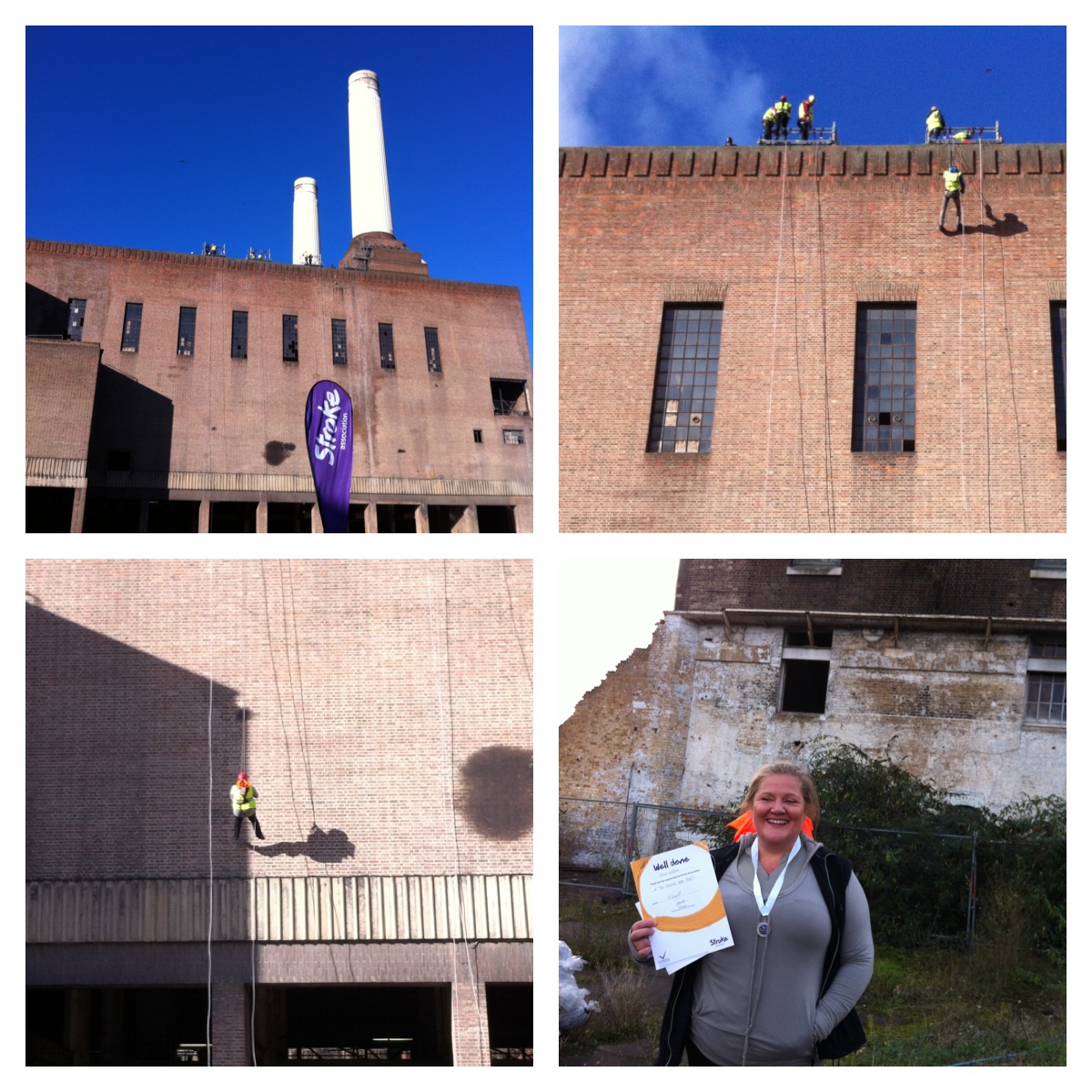
I think perhaps I was more worried than I thought… I managed to get off the train at Clapham Junction, a stop too early!  I could see Battersea Power Station from the platform as I waited for the next train… today instead of looking majestic, the towers looked exceptionally tall and imposing.

Although there’s a little bit of a November chill in the air, the light is beautiful and the sky an azure blue.  If we were dressed in T-shirts and shorts you might actually believe it was summer!

My lovely Godmother was there and was able to keep my mind off what I was about to do whilst I registered, swapped trainers for ‘sensible boots’, reflective jacket, hard hat and got strapped into a harness.

A group of 8 anxious abseilers followed a Stroke Association volunteer into the Power Station.  From the outside of the building, although we know it’s crumbling, I sort of believed there was still a belly to the building but what we saw was a void, fallen pieces of masonry, trenches of mud and debris.   And a lot of light… there’s not much by way of a roof or top to it.  One of my fellow abseilers bought her camera with her and I’m hoping to be emailed pictures of the inside of the building, so will update this when/if I receive them. I’ve said before how I love this building and I truly truly hope that the new owners will be able to restore some of the building whilst finding and developing a new use and love for the site.

After quite a climb up the stairwell we reached the top.  We were ushered along and asked to walk close to interior wall (which apparently was safe to walk on!).  After a few minutes four of us stepped up to the scaffolding stations.  Final checks of our safety equipment were made.  I was asked my name (can’t remember what I said).  Introduced to the lovely man from the Mile End Climbing Wall who kindly said to keep looking into his eyes!  Every time I sneaked a look down (big mistake) he would remind me “Look into my eyes, look into my eyes”…

My carabiners were clipped on to some very thin looking ropes… one that was mine to pass through my hands in order to lower myself ‘gracefully’ to the ground.  The second was secured to my lovely Mile End man.  After reassuring me that I’d be OK, he told me to  step back!

I think it was at that point that my fear really kicked in.  Both feet were precariously balanced on the edge.  A wide stance but I was firmly staying on the top of the Power Station…  I remember saying “I can’t do this”…  I remember repeating it again.

Then in a split second decision I remembered why I was doing it.  I wasn’t doing it for me.  Well OK may be a little bit – after all I  hate heights.  I was thinking of all the amazingly generous people who have sponsored me.  Supported me.  Encouraged me.  Laughed at me.  I was thinking about all of you who have facebooked, messaged, texted, tweeted and called me to support me today and since I signed up for this stupidity!  I was also thinking about the incredible sum of over £600 that has been donated by you all.  I was thinking about how that money will be spent and the people who will benefit.

And I went over the edge….

Then it was fun.  It didn’t occur to me then that I was only attached by a thin rope nor that the ground was quite a distance below.  I loved it.

I did a few Tigger bounces (much to the admiration of “Look into my eyes” at the top, who shouted down to congratulate me on my technique!

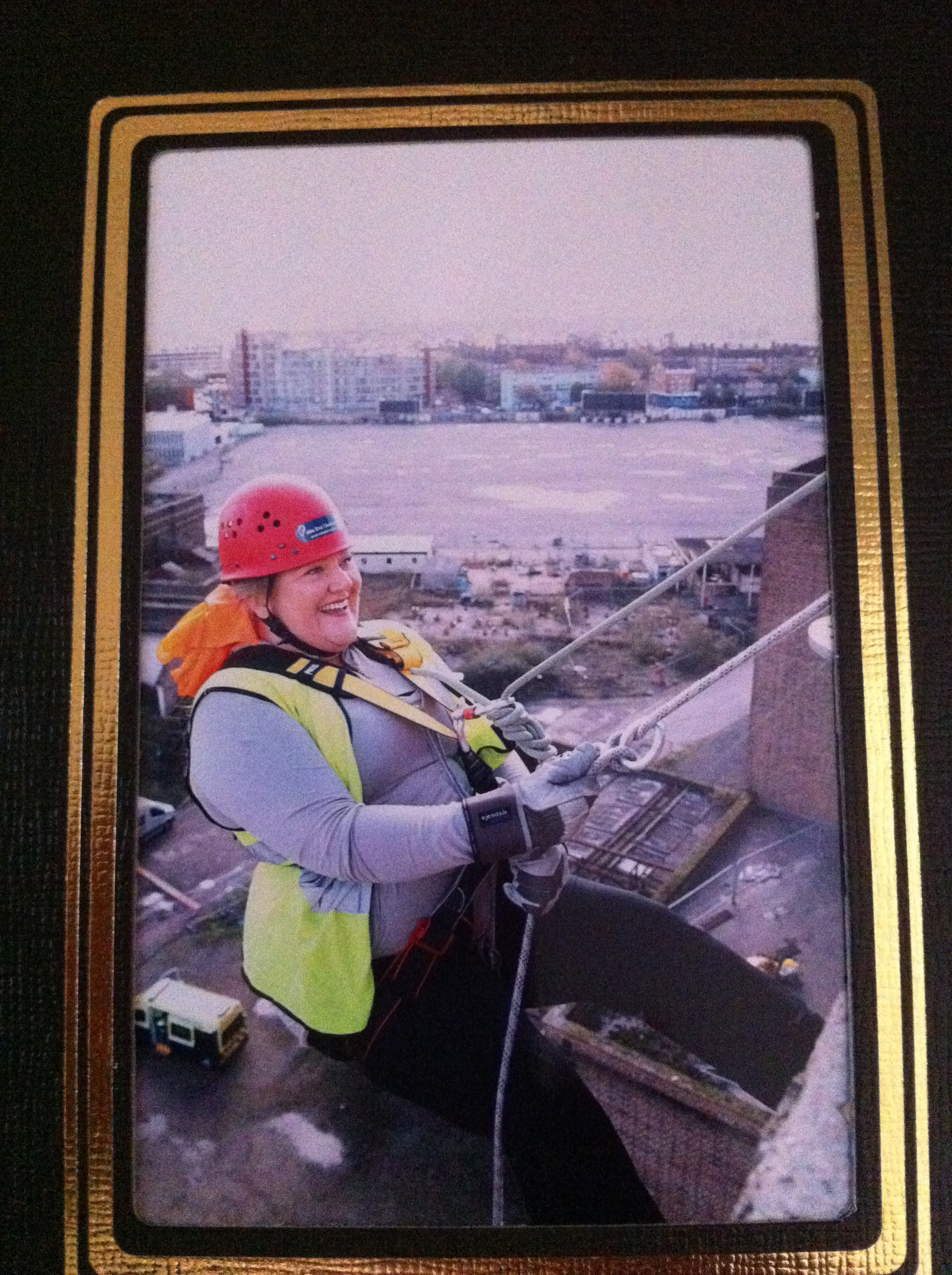
Cleverly I had thought that apart from having a rather larger backside than many of the abseilers, it might be difficult to spot who was who on the descent and tied a fluorescent orange scarf around my hair!  No excuse for not spotting me now…

And the ‘official’ picture… forget me in the foreground… check out how far down the ambulance is!!!

Hey all I did was get up early (struggle), head out into the cold (struggle), look into a man’s eyes (weird), step off the top of a wall (crazy), bounce on the end of  a rope (no comment) and then remember to breathe when my feet were back on terra firma.

What you all did was support me, encourage me, donate your hard earned cash, the kids raided piggy banks and more importantly you believed that I could do it and that the cause I was doing it for was worth digging deep.

Thank you from The Stroke Association

Thank you from all the people affected by a stroke that your money will help.

And

THANK YOU from me.  xxx

Small c Coffee & Cocktails

I figured it was about time I wrote about Shine London and Small c Coffee & Cocktails and why I’ve been attending.

A while ago I was contacted about a new charity ‘Shine Cancer Support‘ – A Network for Younger Adults Affected by Cancer.  The organisation was created by people who found themselves diagnosed with a cancer in their 20s, 30s and 40s and in many cases with little information or support for their age group.  Or diagnosed with a ‘rare’ cancer, there isn’t a specific support group to attend and certainly not for your age group.  Issues such as fertility, dating, childcare or returning to work are critical to a young adult but often overlooked with cancers predominantly diagnosed in the older person.  In addition, many support groups take place during the day and this timing in itself lends itself to attendees being older or no longer working.

Many people will tell of how peer support has been incredibly valuable in their ‘journey’ and that a shared experience or a tip or trick can be crucially important at a vulnerable time.

Shine offer a number of activities in Bournemouth, Dorset.  They have had walks on the beach, balls, drinks evenings and new members lunches.  They have arranged pamper days and Christmas and Halloween parties.

A summer holiday took place this year and it is hoped to be an annual event.  Camping in Swanage with members and their families.  This weekend away allowed family members to also network with others and share their own experiences.

In London, there are regular Coffee & Cocktail evenings.  The venue is changed regularly and meet up every 6-8 weeks.  It’s a good mixed group of men and women, age range is literally 20-40(ish!), different and varied diagnoses, some still in treatment, some between treatments and some counting the years of survivorship.

What I love about it is that we’re in a pub, bar or private club.  We drink wine, beer, juice, coffee or bubbles!  We chat as a group but also as small groups.  We talk about living.  We talk about dying.  We talk about cancer.  We talk about where we’ve recently eaten or holidayed.  We talk about aspirations.  We share experiences.  We talk about inspirations.  We talk about each other.  We talk about our families and friends.  For the most part we talk about all the ‘normal’ stuff that you talk about with your friends in the pub… and probably talk more and faster as the wine/beer is consumed.

What we don’t do is sit around in a circle going over our medical history, latest operation or graphic side affects.  But if they’re mentioned, it’s OK too.

Tonight’s meeting was made all the more amusing when early on we were joined by a gentleman who was probably in his 40s and clearly had had too much of something… perhaps booze but I suspect it may have been combined with other substances!  He bounced over to our table informing us that he was meant to be at a wedding reception.  The bride shouldn’t be marrying that &^%(*.  Then he described their whole relationship.  A while was spent on his asking if what he was wearing was suitable or should he have his scarf on or off, should the jacket be on or off – each ‘idea’ being modelled by his strutting across the bar and back to our tables.  We then heard all about his life.  His wife (or ex-wife).  His lover.  And so much more.  It was hysterical and I have to say that as a group we were all crying with laughter and fuelling his drunken rants!  After quite some time we managed to persuade him to head off to the wedding reception… I would so love to have been a fly on the wall when he turned up!

We were joined by two new group members.  Twin men in their 20s.  One with cancer, the other supporting his twin brother.  They were fun and we had a laugh.  We also heard his/their story.  They also shared moments together when something was said and the other realised that they’d not heard it before.  I believe the group environment allowed them to talk about issues that they’d previously skirted around too.  But mostly, I hope, they felt supported.  I do hope they’ll be back to the next evening.

There are many support groups.  There are many different support environments.  One is not necessarily the right one for all.  I’m excited by Shine and what it has the ability to do – support people diagnosed with cancer in their 20s, 30s and 40s.  I’m also very pleased to count these new people in my group of friends.  Just sometimes I need people who understand… and sometimes I just need people to have a glass of bubbles with!

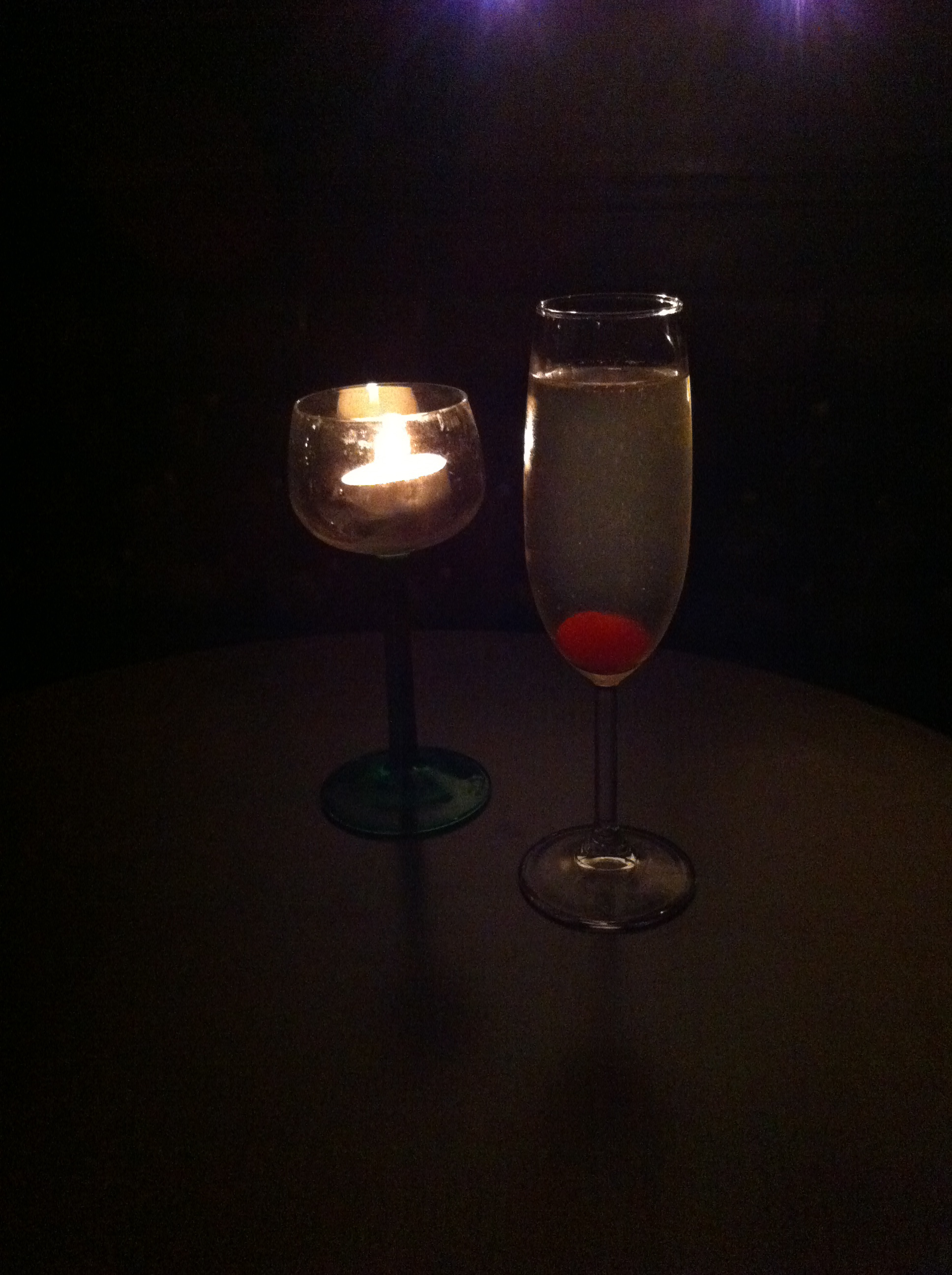
French 75 cocktail… combining two faves… gin and champagne!


World Stroke Day, 29 October 2012 + my crazy abseil!

Did you know that today is World Stroke Day?

Several months ago a friend forwarded an email from The Stroke Association.  They were  looking for volunteers to abseil down Battersea Power Station and raise some valuable funds for their organisation.  It piqued my interest for quite a number of reasons.  Moments later I had replied and signed up for the event.

Firstly, I’m not a fan of heights.  In fact, I get queasy going up in some lifts and can’t go to the edge of buildings with floor to ceiling glass.  However those of you who know me well, will also know that I’ll reframe this fear and create it into a challenge.  Scared of the sea, I learnt to scuba dive.  Fearful of being out of control, I did a skydive.  Logically, I can do this too – eeek!

Secondly, Battersea Power Station is an iconic building that has been part of my landscape for many years.  Since first moving to London 26 years ago, the silhouette has been a part of train or road journeys from North to South of the Thames.  Before much of the new London developments built over the last 26 years, it was always there unused and unloved but proud of his history and heritage.

The building was once a power station and decommissioned in 1983.  The building was Grade II protected against demolition and has been searching for a new owner and purpose ever since.  Wikipedia’s entry.

I understand the power station has been sold and that the new owners are working and reworking planning applications to redevelop the land.  I’m not sure what it will become or when the work will start.  There are many stories written of it crumbling.  I’ve no doubt however that the view that I’ve loved will change but am hoping that this ‘Cathedral of Industry’ will still retain much of it’s original character and beauty.

Thirdly, The Stroke Association is an organisation close to my heart (pun intended!).  They do incredible work supporting people and their family who have been affected by stroke.  They believe strongly in survivorship and ‘Life after Stroke’.

Many people think that a stroke only happens to older generations or perhaps those with an unfit lifestyle or that they aren’t as bad as many other illnesses or diseases.  Sadly in many cases this isn’t true.  A few facts below:

• An estimated 150,000 people have a stroke in the UK each year
• Stroke accounts for around 53,000 deaths each year in the UK
• 10,000 people under the age of 30 will have a stroke each year
Stroke is the third most common cause of death in England and Wales, after heart disease and cancer
• Stroke accounts for 9 per cent of all deaths in men and 13 per cent of deaths in women in the UK
• Stroke has a greater disability impact than any other chronic disease. Over 300,000 people are living with moderate to severe disabilities as a result of stroke
Three times more women die from stroke than breast cancer

A few of the reasons why I feel passionate about raising some funds for the Stroke Association and why I’m abseiling this coming Saturday.

My friend’s father, a fit and active retiree, who passed away suddenly.

Rob who had a stroke earlier this year which led to the discovery of bowel cancer.

And two little munchkins who are both very close to my heart.  Both were born with different diagnoses but devastatingly both sets of parents were warned that they will probably be affected by strokes throughout their lives.  Sadly for one child the strokes have recently started.  She doesn’t understand them nor understand what they are or why they’re happening.  So far they’ve not been bad strokes.

This Saturday is the date of my abseil.  You can only imagine how my palms go sweaty at the very thought of launching myself over the edge.  Genuinely I feel sick.  Genuinely I’ve questioned why I’m doing such a crazy thing when I hate heights.  Genuinely I’ve thought of backing out.  Then I remember the faces of those I’m doing this for.

I set myself a target fundraising figure of £425.00 and I’m chuffed to say that I’ve exceeded that.  BUT I also know that any pounds and pennies that can be raised over and above my own fundraising figure are needed.  I’m also keen that you know exactly how the Stroke Association use donated funds.

For every £1 donated:
79p goes to directly to supporting their work to fight stroke.
20p is invested to generate future revenue.
AND only 1p goes toward running the charity.

Find out more about the Stroke Association here or donate directly to the charity.

AND if you want to sponsor me and my insanity on Saturday 3 November 2012 please donate via my justgiving page at https://www.justgiving.com/annagoanna

PS Any donations over £500 and we’ll use my bottom as an advertising hoarding – well let’s face it that’ll be in most of the pictures and it’s large enough!


Pilot Study/Clinical Trial – your input please

As many of you know I volunteer my time for a number of health/cancer related organisations and projects. One of these relates to clinical trials, pilots and medical research.

Today I was invited to attend a meeting relating to pilot research project for a gynaecological cancer. For confidentiality reasons I can’t go into too much detail about the pilot so forgive the slightly ambiguous detail.

Previous papers and an outline of the project had been sent to me by email for review and comment prior to the meeting. However today’s meeting was with one a lead clinician and a surgeon to understand in more depth the pilot, the background and also their previous findings.

My input, together with a couple of other volunteers, will then be to review the documentation further, advise on the patient information aspect of the documentation and also to voice any concerns that we may have about the pilot, improvements or other care considerations that we believe necessary to include, as if we are patients ourselves. Once this round of paperwork is complete the project will then be presented for grant funding.

If funding is found, this pilot will, if successful, lead to a full European clinical trial, which again, will require further funding to be obtained.

The process is lengthy and time consuming and is driven by otherwise already busy clinicians. However to see their passion at getting this pilot off the ground and hearing about the study itself and the ‘prospective’ benefits to future patients diagnosed with this cancer is incredible, inspiring and has to be admired.

The study aims to show that by having these additional and specific scans, they are able to identify potential spread, metastases or recurrence of this cancer at a much earlier and specific stage, as well as determine if there are specific nodes that need removal (ie without the need to remove unnecessary nodes, as is sometimes undertaken now). The team are aiming to show that with this ‘small’ additional intervention, that advanced cancer can be avoided or reduced and mortality rates decreased substantially.

I was fascinated seeing the early details for presentation and further understanding the additional risks (very low) to a participant taking part. Gosh if they’re right and can prove it in the full blown trial, it will make huge headway in the reduction of advanced cancer and death for this particular type of cancer but also prospectively for other cancer types that behave in a similar way.

Why am I telling you this little bit? Well I figured that many of the readers of this blog do so because they themselves have or know someone diagnosed with cancer or another long term condition.

I’m after your opinions/comments please.

What would be the important things you’d like to know in the patient information presented to you, to encourage you to participate in a study or clinical trial?

As a study participant in this pilot, you would be asked to receive further scans (with tracer dye) and an additional couple of hours added to your ‘regular’ hospital checkup programme.

Who would you like to speak to about the trial, should it be offered to you?

How much information would you like to receive? And in what format?

Is it important to you to know the outcome of the study/trial (if possible)?

Volunteering

I attended a meeting at the Maggie’s Cancer Caring Centre in London this evening for volunteers. As you know from previous postings I have been a volunteer at a number of events for Maggie’s in this past year. Some of them are collecting donations, such as the Walk the 38 or Golf Live events. Others simply representing the charity and being part of the Olympic Stadium parade.

Charitable organisations always need volunteers. People who understand their organisation, what they do and why. To speak with members of the public, promote their services and advocate their work.

For me, volunteering for Maggie’s is a no-brainer. I can’t endorse more fully what they do, what they stand for, their methodologies, ethos and care for anyone affected by cancer. For their adaptable spirit that enables people at different times with different requirements to be supported by this organisation.

I have known and know people supported through their Glasgow, Edinburgh, London, Oxford, Hong Kong and Cheltenham centres. I’ve yet to hear a bad word said or a comment about their not being there or knowing what is required and when. Truly amazing and I would urge you all to have a look at what they do, tell others about them and if you’re nearby to call in and understand each of the Centres.

Tonight several volunteers and Maggie’s staff got together to brainstorm about ideas for future fundraising events and volunteer roles. We recognised that the volunteer roles take many forms. Some physical attendance such as the events I’ve done previously. Others to review leaflets or newsletters etc. Perhaps to contribute by sharing your experiences. Also volunteering services to talk about the Centres and the services. Promote their organisation. As I’ve said before, I do this all the time and will continue to do so.

If you can, do get involved or take the time to find out more about the centres and why I think they play an important part around the World in supporting people affected by cancer.

But volunteering doesn’t have to be for Maggie’s… I’m sure you’ve got organisations, charities or causes you’re passionate about. Do think about getting involved… they all need volunteers.

Of if you’re not sure who’d you’d like to volunteer for but perhaps have some time on your hands, want to get involved or even need work experience, then one of the volunteers said this site, Do-It Volunteering Made Easy, is a great place to find organisations needing volunteers – at home and abroad.

The buzz I feel when I volunteer for Maggie’s and the other charities and organisations with whom I work/volunteer/speak, is enormous.  I know I give up lots of my time (some people say too much of my time) but what I get back is way way way more!