International Clinical Trials Day

Each year, International Clinical Trials Day is celebrated around the world on or near the 20th May to commemorate the day that James Lind started his famous trial.

Tonight I’ve been a guest of Cancer Research UK at their Imperial Cancer Research UK Centre in West London. The purpose of tonight’s celebration is to launch a series of short films which feature key research programmes currently being undertaken. These films will be displayed in public areas within partner hospitals and for use by the teams on websites and during public and patient involvement events.

As you know I’m passionate about the improvement and advancement of cancer care. I have spent time to try to understand what clinical trials really involve. What is being undertaken and where. Why people should get involved (greater good and personal good). I can’t stress enough that without patient and carer involvement, medical advancements will be slow or in some cases not exist at all!

Clinical trials used to fill me with fear. I thought, as I think many do, that being involved in a clinical trial would mean being injected with drugs, high levels of danger and perhaps ending up like the Elephant Man case or worse.

What my investigations and questions have led me is truly a very different understanding. There is so much more to clinical trials and a great deal of it non-invasive. Participation can be as little as completing surveys or questionnaires during your treatment or whilst caring for someone else. It may be changing your diet slightly. It may be helping with the wording on a funding application from a patient/carer perspective. It might be the occasional blood sample. It may be speaking to researchers about your experience first hand. It may be donating part of a excised tumour. It may be regular scans. It may also be changes to your chemotherapy regimen, radiotherapy frequency or taking new drugs.

However with all patient/carer involvement there is a huge duty of care to ensure you understand your involvement, the level of involvement. Continued support and, if you’re participating in drugs trials, constant access to the clinical and research team.

They can’t do their work without us!

Personally, I’ve authorised for tumour samples from my excised Phyllodes to a tissue bank for a clinical trial relating to Phyllodes. Sadly due to the small number diagnosed the trial remains on hold whilst new samples are slowly collected.

I’ve also authorised for tumour samples from my excised DCIS to be used in a trial. This trial is known as the ICICLE trial and there is a brief explanation from Cancer Research about what it is researching.

As part of the Patient Participation Group at Imperial, I’ve also helped out with the wording of funding applications, trial designs and patient/carer leaflets. I’ve participated in discussions and provided feedback at meetings to researchers and clinicians. I’ve also been fortunate enough to have a tour of the research centre and see exactly where the work is carried out, the scans performed, the ward for inpatients and consultation rooms. Amazing facility. Incredible work.

So I guess it’ll come as no surprise to anyone that I’ve been involved in another project at Imperial. The only surprise is that I’ve put myself in front of a camera – I so hate myself on film! But needs must.

As I mentioned earlier, tonight saw the launch of a number of films. Well yours truly appears in a couple of them! Even more so, I was presented with a lovely gift from the team at Imperial to thank me for my involvement and all that I contribute to the group.

I hope the films make a difference and encourage people to get involved in clinical trials… remember they’re not scary!

Here are a few films that explain what taking part in a clinical trial involves and below there are more specific trial information films.….

Link to films – I may well appear in them so don’t be scared!

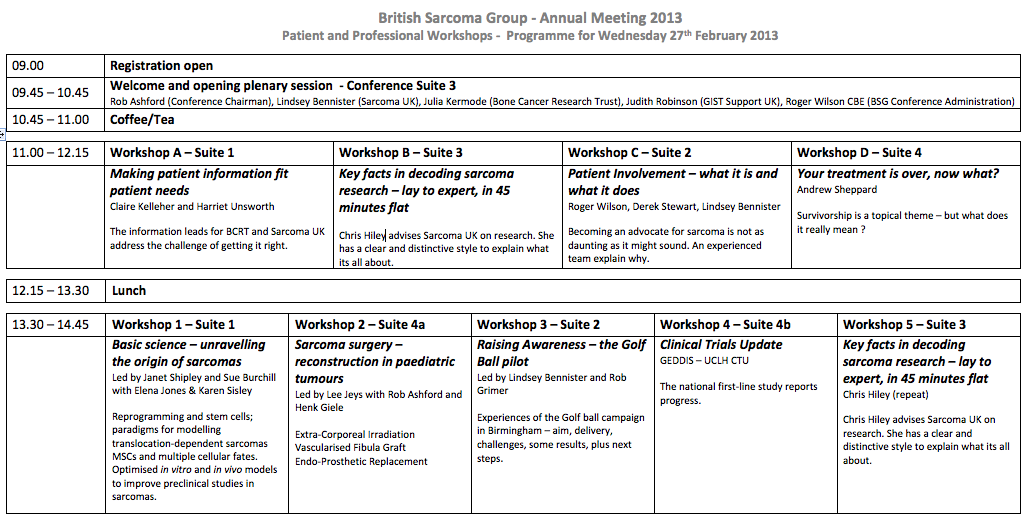
British Sarcoma Group conference

I was invited to attend this year’s British Sarcoma Conference in Nottingham.  The British Sarcoma Group is the professional association of the specialist clinicians, nurses and supporting professionals who treat patients with sarcoma in Great Britain.

On arrival it is evident that there are a great many professionals attending the conference.  It’s wonderful to be invited as a patient advocate with personal experience and to be amongst professionals that want to understand ‘the journey’.

Given that the conference is one day only, I’m pleased about the opportunities to speak with the professionals ‘offline’ ie outside of the workshops.   Often shorter conferences don’t allow time to speak delegate to delegate as the agenda is often squeezed up.

However equally there are a number of workshops that I’d like to attend and have to make a difficult decision between them to fit the agenda!

Screen Shot 2014-08-20 at 12.39.25Screen Shot 2014-08-20 at 12.39.36The first workshop I attend is ‘Your treatment is over, now what?’.  Andrew Shepperd first explains in brief his journey with Ewings Sarcoma and also about his time ‘after treatment’.  He is a Trustee of the Bone Cancer Research Trust and is able to liven the workshop with discussion from his experience of other sarcoma patients and carers.  As you know with an organisation like ‘Living Beyond Diagnosis’ this is a passion of mine and I know from my experience and that of speaking with others that the ‘now what’ is a huge aspect of a cancer diagnosis that isn’t tackled or spoken about.

A few of the points raised were:

  • A sense of isolation when treatment finishes;
  • Friends and family (all good intentioned) tend to stop asking how you are.
  • Reframing the illness by looking at ‘problems’ in a different way.  One person spoke of their recurring dream where they had been ‘watching’ their child’s wedding day but they weren’t present ie implied they were dead.  However had learnt to ‘reframe’ it by putting themselves on the front pew in the dream and then learning to redream it regularly as if they were there.
  • A need to notch down new events and future dates ie ‘investing’ in a new car; child’s first day at school; planning and booking a future holiday.
  • Ask for help earlier about anxiety and worry.  If you ask early it won’t be a surprise if you ask again when and if you need it.
  • Guilt of being a ‘survivor’.  This was a lengthy discussion and would need pages to discuss here.  Suffice it to say that a great many people in the room felt ‘guilty’ about surviving when others they met during treatment/surgery didn’t.  Dealing with the ‘why me’ can be extremely difficult.
  • Counselling.  It was interesting how many hadn’t thought of counselling.  How many had asked for counselling but had had it declined.  How many had received counselling also.  It was felt that this should be more obviously on offer to all diagnosed patients in the UK and not restricted to just when in treatment but an ‘open door’ policy be activated.
  • We also discussed ‘incurable -v- untreatable’.  A big difference in the two and little understanding the general public as to what either really means.

My second workshop was ‘Key facts in decoding sarcoma research – lay to expert, in 45 minutes flat‘ by Chris Hiley.

No mean feat to explain any research project from bench to bedside in 45 minutes but Chris was able to do so.  Also in a very humorous fashion!  Chris spoke about policy and funding applications.  About how decisions were made as to what would be funded and the difficulties sarcoma had in funding from main sources due to the rarity of the cancer type.

My final workshop was the ‘Patient closing plenary – Summarising and action points – patient delegates‘.

This session was led by representatives from Sarcoma UK, Bone Cancer Research Trust and GIST Support UK.

An incredible amount was discussed, ideas banded about with reference to spreading awareness of sarcoma with GPs, primary and secondary healthcare but also within the general population.  We discussed at length the new initiative by Sarcoma UK of the ‘golf ball pilot project‘.

There was also discussion regarding the many types of sarcoma and how it was imperative that we work together rather than pit against eachother.  However priorities should be directed not necessarily to the loudest voice or largest number of sarcoma.


Overall I was pleased with the content and action of the conference however felt that the sessions were slightly more rushed than I would have liked.  They were all large topics and it was obvious from the lively discussions that there was a great deal to talk about and perhaps dig deeper in depth of many of the points raised.  It was great however to have many sarcoma specialists in each of the workshops, taking notes and seeing how something that they may think quite small in a person’s journey can actually be the opposite and be challenging to moving forward.

Launch of Penny Brohn’s National ‘Living Well’ courses

A few months ago I was invited to write a small piece to appear in the Sunday Telegraph. The focus was to be nutritional information following a cancer diagnosis.  A hot topic and one that can be confusing.

Specific nutritional advice should, of course, be sought from your medical teams and indeed is tailored to each person and their specific cancer diagnosis.  For example advice given to a bowel cancer survivor would be different to that given to a lymphoma survivor, at least in part.  In addition, some treatments and particularly some chemotherapy drugs are extremely sensitive to some foods and incorrect advice could be very damaging.

My piece therefore was written on the basis of an overview and enabled me to signpost to some smaller specialist charities and also to organisations that offer nutritional workshops for cancer survivors.  Often these smaller organisations don’t have large media or marketing budgets and rely on word of mouth referrals or editorial similar to that which I was asked to write.  The submitted piece with links is below:

————————————————————

Submitted to the Telegraph:

As a cancer patient diagnosed with a rare soft tissue sarcoma, Phyllodes, in 2009, I am always seeking information and guidance with regard to lifestyle, health and wellbeing. There is often information that appears to contradictory or conflicting in the media and also an overwhelming amount of ‘advice’ from well meaning friends, colleagues and acquaintances. What I have learnt with regard to balancing and increasing my intake of fruit and vegetables is actually quite simple.

· The well known guidance of ‘5 a day’ is a good place to start.
· Divide your plate into imaginary slices so that 50% of the meal is fruit and vegetables.
· Balance the colour of fruit and vegetables you eat. If, for nothing else, it looks more attractive to eat and means you get less ‘bored’ with the healthier choice.
· Experiment and try new fruits and vegetables. Even the ‘oddest’ looking vegetable can taste scrummy and be good for you!
· Snack on fruit (strategically placed fruit bowls help with this).
· When chopping up vegetables for dinner, julienne an extra carrot, celery, pepper or similar. Pop them into a small foodbag. You can then take this out with you or have in the fridge ready for those ‘picking’ moments.

In my role as moderator for a Phyllodes Support Group and also my work with Living Beyond Diagnosis, I am often asked for advice regarding healthy eating or lifestyle choices. I know from conversation with others diagnosed with different cancers and at different stages of treatment or wellness, that some fruits and vegetables can have different effects on the person and therefore professional advice should be sought together with a sensible approach. I am cautious about giving any specific nutrition advice as I’m not qualified to do so but I signpost them to specific charities and organizations specializing in their cancer type and urge them to speak with their oncology consultant and/or cancer care specialist.

There are some fantastic charities and organisations offering dietary information online, nutrition workshops and even cookery classes. Why not make the discovery and incorporation of new fruits and vegetables fun and easy?

NHS Choices has a number of links to healthier eating. They also have a link to 5 a day on a budget.

The Teenage Cancer Trust  make the point ‘Young people with cancer often face rare and difficult to treat disease that requires aggressive chemotherapy and radiotherapy. Being as fit as they can and eating well is critical to helping them fight both the disease and the debilitating treatment. This can be particularly challenging with side effects like severe mouth ulcers, nausea and changes to taste and appetite. It is vital that health services focus on nutrition during treatment and research foods that can add value in a young persons fight against cancer’.  Simon Davies, CEO, Teenage Cancer Trust

The Haven, a national breast cancer charity, provides centres which offer free emotional support and healthy lifestyle advice to anyone before, during or after, breast cancer treatment. Their professional team include experts in nutrition, counselling, exercise and mindfulness to help anyone with and beyond breast cancer. Their research has proven the benefits of its in-depth programme.

The charity provides a healthy eating guide as well as DVDs and CDs to help people who can’t get to one of their centres.

Maggie’s Cancer Caring Centres  offer free comprehensive support for anyone affected by cancer. In addition to the many support groups, emotional and psychological support, benefits advice and practical support, they also run Nutrition Workshops.

The sessions are aimed to promote a healthy, balanced and varied diet and comprise in an informal setting:

  • The importance of good nutrition to overall well-being
  • An overview of what is a healthy diet
  • The role of antioxidants, phytochemicals and essential fatty acids in the prevention and protection from cancer
  • Making the most of the diet in simple and easy to achieve ways

Many people who come to the workshops may have read books on nutrition or sourced information from the internet and the sessions can help to clarify what people have discovered, plus they are an opportunity to explore and share.

Beating Bowel Cancer  have produced a booklet entitled Living With Bowel Cancer: Eating Well which can be downloaded. The booklet outlines dietary advice specifically for bowel cancer patients following treatment or surgery.

Advice is also available via their specialist nurse helpline 08450 719301.

Penny Brohn Cancer Centre provides a unique combination of physical, emotional and spiritual support designed to help anyone affected by cancer at any stage of their illness. Information and advice on healthy eating is one of the many services we offer to support people to live well with the impact of cancer.

Our range of services, which are available to cancer patients and their supporters, include one to one sessions with a qualified Nutritional Therapist, residential courses and a choice of one day courses covering; healthy cooking options and demonstrations, menu planning, how to combine and cook foods and the theory and science behind our guidelines.

Penny Brohn have also produced a guide to maintain a healthy, balanced diet whilst living with cancer “The Bristol Approach to Healthy Eating

Further information can be found at www.pennybrohncancercare.org/eating-well

Anna Wallace
http://www.annawallace.co.uk
Founder of Living Beyond Diagnosis

————————————————————

During my research and conversations with Penny Brohn Cancer Care for the Telegraph piece, I was told about a very exciting development in their programmes.  I was aware of the residential courses in Bristol from friends who have benefitted hugely from attending.  The new news is that they were launching their ‘Living Well’ programme nationally later this year.  It’s been hard not to tell you all before now, such wonderful news.

Tonight, I was honoured to have been invited to attend the launch at a reception hosted by The Rt Hon Dr Liam Fox MP at the Houses of Parliament and hear in full about the exciting project.

————————————————————

What does Penny Brohn Cancer Care do?

Penny Brohn Cancer Care supports people living with the impact of cancer through our unique combination of physical, emotional and spiritual support.  This is designed to support the individual and work alongside their medical treatment.

We provide our services free of charge, thanks entirely to the charitable donationsl and voluntary contributions which fund our work.

Our services are open to everybody over the age of 18 with a cancer diagnosis and their supporters.

For information and support contact our Helpline on 0845 1232310 or email helpline@pennybrohn.org or visit http://www.pennybrohncancercare.org.

What is ‘Living Well’?

Led by experienced, trained facilitators, Penny Brohn Cancer Care’s Living Well course provides people with a tool kit of techniques that can help support physical, emotional and spiritual health.

Information is provided on healthy eating, exercise and understanding the impact of cancer on emotions and relationships.  In addition participants experience different methods of stress management.

People are encouraged to share their experiences with others in similar situations, and think about what future steps they could take to “live well”.

The Living Well course is part of a wider pathway of care at Penny Brohn Cancer Care.  This approach includes ongoing support and other courses are available.

How is ‘Living Well’ delivered?

We have a choice of delivery models:

  1. Partnership with NHS cancer services
  2. Partnership with charitable and independent organisations
  3. Delivery as an independent course

Living Well can be delivered in both residential and non-residential formats and can be tailored to the needs of individual client groups.

————————————————————

Over the past years Penny Brohn have been refining the programme to ensure the content is current, required and flexible to the needs of those attending.

Penny Brohn have created the Living Well programme taking a holistic view of treating the whole person.  Supporting people living with the impact of cancer through a combination of physical, emotional and spiritual support.  They have conducted extensive (and continued) research and evaluations of attendees and supporters from attendance to date to see assess the impact and value of each aspect of the course.  This research and evaluations allow them to continue to support the individuals after attending the courses by keeping the dialogue open and a way to come back for further support or attend courses.

I have been truly encouraged by their approach that the impact of cancer can affect people at different times and in different ways.  I’m also encouraged that this is not only on the ‘heresay’ of a cancer patient but on substantiated research.  We hear a great deal about ‘survivorship’ but often this isn’t backed up with real hard evidence and research.  I’m concerned that when more budget cuts are made within NHS healthcare that cuts will be made in areas without substantiated research underpinning it.  Well done Penny Brohn and the University of Westminster for this continued research and evaluation of need.

I was also excited to hear that as a charity they wanted to share their expertise and work collaboratively with other charities to host Living Well courses around the UK.  Instead of setting up new Penny Brohn Cancer Care centres themselves, costing millions and then servicing people local to their new Centres, they acknowledged that by working with other organisations they can not only reach more people but can also educate and inform of the need for survivorship support of this kind.

In attendance tonight were a large number of representatives from other charities who, I’m pleased to say, seemed agreeable to working WITH Penny Brohn in the national launch of Living Well.

Already organised are a number of regional non-residential courses:

26-28 Nov 2012    National Star College     Cheltenham
3-5 Dec 2012        Willow Lodge      Sheffield
21-23 Jan 2013    The Octagon     Hull
21&28 Jan 2013    Norman Power Centre     Birmingham
4 Feb -18 Mar 2013   Cancerwise    Chichester
5-7 Feb 2013        Penny Brohn Cancer Care   Bristol
18-20 Feb 2013    Great Oaks Hospice    Forest of Dean
19-21 Feb 2013    The Octagon     Hull

Perhaps you know someone who might benefit from attending one of these non-residential courses or indeed a course in Bristol at their HQ.

Perhaps you know an organisation/charity that could co-host a course.

Perhaps you could fundraise for them or propose a corporate donation to your employer.  They run these courses free of charge with voluntary donations.

A link to the BBC news about the launch and services – click here
All change

In my posting in July I mentioned that I had asked my wonderful consultant about referring me to The Royal Marsden hospital’s sarcoma team for my follow up surveillance.

At 2pm today I had my first consultation appointment with the sarcoma team at The Royal Marsden. The waiting room was absolutely packed and I waited nervously for my name to be called.

I was concerned that they wouldn’t take my case on but that I had sort of ‘discharged myself’ from my previous consultant’s care. I was worried that they would perhaps think I was over anxious about follow up scans or perhaps that they would recommend I stay with my existing hospital. I was concerned that although they are a centre of excellence for sarcoma in the UK, that the person I was assigned wouldn’t know about Phyllodes – after all there are over 70 different sub-types of sarcoma.

So despite my waiting only a very short time, I was more than a little anxious. Had I made the right decision in asking my lovely consultant to refer me? Would he take me back if I hadn’t? What would I do if they didn’t take me on as a patient? What would I do if they changed my follow up surveillance schedule in a way that worried me more?

Phew, I’ve been called.

I first met with the nurse who explained what would happen and who I would be seeing. She then left me in the little consulting room whilst I waited for the Registrar. Seemed like ages and once again all my anxieties were kicking in. The Registrar then arrived and ran through my medical history and also asked about my siblings, parents and grandparents’ medical history. She also told me that my case had been discussed at today’s MDT (multi-disciplinary team) meeting in detail.

And then, she asked the question that I was most worried about answering… why was I here and what did I want from the Royal Marsden? So I told her why (see previous post) but I also told her about our Facebook “Phyllodes Support Group” and what I’ve been doing with Living Beyond Diagnosis. She asked a few more questions and then said she’d return with the consultant.

I was then left in the little consulting room on my own… and yes the little voice in my head was once again telling me that they wouldn’t have me as a patient etc etc.

I was terrifically grateful when the door opened once more and the Registrar came back into the room accompanied by a consultant. He introduced himself and we spoke briefly about me, my medical history, why I requested the referral and my previous care.

He then asked more about the Phyllodes Support Group and was terrifically impressed with the number of members, the information and experience sharing, the documents and reference papers that have been collated and also the polls and data that we were collecting and sharing within the group. He also said that he felt that should we, as a group, wish for some assistance or input for the group, then I should just ask and he would try to facilitate this for us.

I was also able to tell him about the report that is currently being finalised containing a section about Phyllodes from the contact I have met at two Cancer data conferences in the UK. He would love to see a copy of this when published.

It goes without saying that I will be looking at what input will be useful from RMH and also what we can provide to RMH from the group… certainly it would be fabulous to have a medical facility, who specialises in sarcoma, to take an active interest in the group members and their health. Watch this space!

We then returned to my health and monitoring for recurrence or metastases from the excised malignant phyllodes tumours. We agreed that my previous consultant had done an excellent surgical job in removing both of the tumours and then ensuring that sufficient clear margins were obtained. He agreed with the advice that I should not have any adjuvant radiotherapy at this time. He also agreed that the screening regimen implemented in my previous hospital was the best to quickly identify any local recurrence (together with my own personal checks). We then spoke about any requirements for any additional screening/surveillance for possible metastases, particularly with regard to the malignancy and mitoses of the excised tumours. He suggested and has requested that I have a 6-monthly chest x-ray at the same time as my existing scans ie annual mammogram with intervening 6 monthly ultrasound of both breasts.  This chest x-ray will be looking for any traces of naughty cells in my lungs.

I left RMH this afternoon feeling that I had made the right decision to ask to be referred. Perhaps I should have made the request at an earlier stage and saved myself some levels of anxiety along the way.  But I also know that I couldn’t have managed to do that before now.

I am, of course, sorry that I won’t be hearing my, now previous, lovely consultant refer to me as ‘Miss Lumpy Bumpy’ again but I’m so very grateful for his care up until now and can only say that whoever the patient is who gets my slot on his busy schedule is a very very lucky lady.  Perhaps I shall pop in with a box of biscuits for him and the team when I’m next passing my old hospital.

So that’s it. Next scans/checks are in January. Between now and then I’ve got a number of cancer conferences to attend, not least the annual Sarcoma conference which this year is in Italy. They were asking for patient advocate attendees to speak at the conference and I’ve put my name forward.  I would love the opportunity to tell them all about our Phyllodes Support Group and also about Phyllodes itself, in the hope that perhaps more medics and researchers will be more aware and knowledgeable.

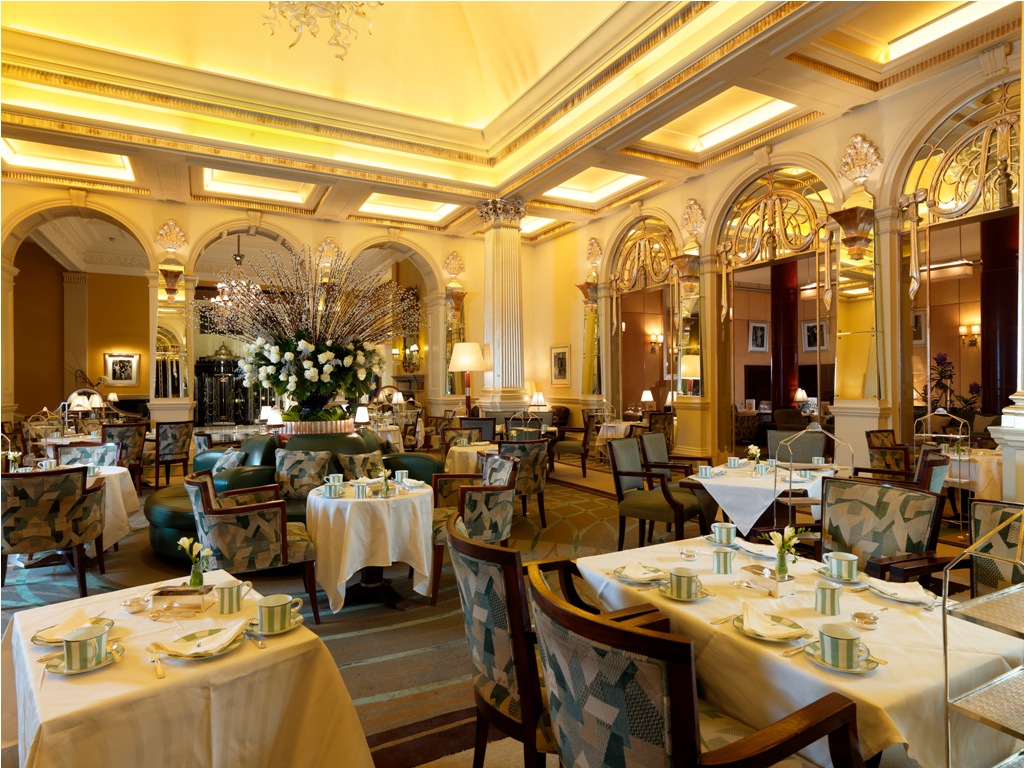
Afternoon tea at Claridges

Don’t you just love little surprises? Particularly when they’re something lovely and it’s a thank you to you for something that you’d have done no matter what.

You’ve probably already worked out that if I believe in someone or something, I’ll tell you about it. I’ll certainly recommend them/it if asked. I am however a bit picky too and my standards are (mostly) pretty high.

So it’ll come as no surprise that when I met Fiona Macrae during my search for services and people to participate in the first Living Beyond Diagnosis event, I had found a something/someone worth recommending. Fiona was diagnosed with breast cancer and despite working in insurance in London, was unable to find travel insurance for a well needed short break between treatment and surgery.

Because of her own experiences and following her own treatment and surgery, she created the business InsuranceWith, providing travel insurance for people with pre-existing medical conditions.

If you’ve been diagnosed with a long term condition or know someone who has, you will understand the importance of holidays, visiting friends and family and time away from the inevitable medical appointments, surgery and treatment. Something that you take for granted is to be able to travel somewhere and relax… so imagine what it feels like when your insurance is revoked, new insurers tell you that your premiums are now in the thousands of pounds or that you simply are uninsurable. Companies like InsuranceWith review each case on it’s own merits. They have medical underwriters who understand risk.

And for the most part, they have been able to offer travel insurance at reasonable rates to friends and acquaintances I’ve referred who have been able to enjoy their holidays, trips of a lifetime or family visits without worry.

Today, Fiona very sweetly took myself and another lady, Kelly, to Claridges to say thank you for supporting her.  Really an unnecessary thank you and in fact it should be in reverse but… I do love afternoon tea… I do love bubbles (just in case you hadn’t noticed)… and I do love the grandeur of deliciously fabulous places such as Claridges.

What a treat…. Thank you Fiona.


Mum’s birthday

Today would have been Mum’s 73rd birthday.  She died in 2009 from a long battle with Multiple Sclerosis.  She was ready to die but I don’t think I was ready to let her go.  Can’t tell you how incredibly selfish that sounds, even to me.

In the past few years there have been so many times when I’ve wanted to or needed to know something about her, our family or an event that happened… she would be the only one who’d know the answer and she’s not here to help.  When I get into my car I often think about dialling her number on my hands free for a long chat whilst sat in traffic or on a motorway journey.  They were the easiest chats, Mum always wanted to talk and I always seemed to have lots to do or be getting on with, so car chats were longer, more amiable wittering affairs.  They were the times when we would talk, really talk, about everything and anything.  Other calls seemed to be short snatched calls, and mostly were about her care, carers, finance, arrangements or such.  So perhaps you understand why I wish I could call Mum from the car for a chat…

Mum didn’t ever knew I was diagnosed with cancer.  My having found the lump the morning of her funeral.  I wonder what she would have said and done to support me?  It’s funny that something that has had such a huge impact in my life is something she hasn’t been able to know or help with.

I do know however that she would have been so extremely proud of what I have done and achieved since my diagnosis.  Both in my personal life and with Living Beyond Diagnosis.  I also know she would have been encouraging me along and probably calling everyone she knew to get involved with it too.

What now Mum?  I need to go back into paid employment and I’m not sure where I want to go?  I’ve gained huge amounts of skills and experiences in the past couple of years and I would like to channel my new found skills into my new career.  I also know that I’d like to do something that matters, something that really matters.

Any ideas, Mum?

Pan London Event: Survivorship and Cancer

Hosted by the Kings Fund in their wonderful building in Cavendish Square the Pan London Event was well attended.  Currently the approach to follow-up for cancer survivors is centred around routine outpatient appointments.  The purpose of this event is to look at developing and testing new approaches to follow up care for those living with and beyond cancer.

The agenda for the day looked to tackle many of the areas and the speakers are experienced and experts in their fields.  However I was a little scared (and rightly as it turned out) about the amount of content for the day. Most of the speakers had between 15 and 30 minutes for their presentations!  I wonder if it would have been better to tackle half the amount of subjects and to have a further event or perhaps make it a two day event.  Sadly, in my opinion, I do feel that for many of the speakers they barely had time to scratch the surface and therefore negated the power of the event.

A link to the full agenda is Pan-London-Survivorship-conference-25th-November-2011.

I won’t go into great detail as a great many of the points made I have previously discussed in this blog.  However bullet points for thought, discussion and response:

  • Cancer incidence is rising.
  • Cancer mortality is falling.
  • We NEED to action a survivorship programme (with funding and holistically) for the increased quantity of people requiring it.
  • We need to put these plans into action NOW as the increase will be unmanageable before we know it.  (Although personally I feel it is already here!)
  • Within the Cancer Reform Strategy there are 4 new partnership initiatives:
    • NAEDI – Awareness and early diagnosis
    • NCSI – Survivorship
    • NCEI – Inequalities
    • NCIN – Intelligence
  • We need to ensure that each of these 4 partnerships work collaboratively but not in competition with eachother.
  • Cancer practice needs to be reviewed to be personalised for each person affected.  We can no longer treat a 17 year old with breast cancer in the same way as a 70 year old!  One size does not fit all and considerations need to be made with changes to the pathways and personalisation at the fore.
  • When we refer to ‘Living with and Beyond Cancer’, there are many considerations and organisations that should be involved – COLLABORATIVELY:
    • Information and communication
    • Psychological support
    • Supportive and palliative care
    • Clinical Nurse Specialists (we need more of these not less!)
    • Cancer Patient Experience Survey Programme.  Many areas need improvement and this survey is a great way of measuring these.  Should be run regularly and measurable penalties be applied.
    • National Cancer Survivorship Initiative.  Working with all third sector organisations to ensure that this initiative is actionable.
  • In 2010 the NCSI-Vision-Document document was published.  This document details the five shifts required in the vision, the priority areas and a general iterative process to achieve this vision.
  • We have a long way to go but at least survivorship is now firmly on the agenda and there’s barely a meeting when it’s not discussed… we just need to make sure that firm plans are in place for anyone living with and beyond a cancer diagnosis.
  • A presentation from Macmillan Cancer Care identifying the cancer care pathway and also crunching numbers of people and stages – this focused on London and despite having heard these numbers plenty of times, it still comes as a shock that they’re so high and rising!
  • Natalie Doyle of The Royal Marsden presented about why Holistic Needs Assessment is so vital in patient care.  A holistic health and social care assessment is undertaken in order to identify supportive and palliative care needs of an individual and to trigger any specialist assessment that may be required.  For instance, home help, nursing staff visiting at home, transport to and from hospital, psychological support, social and occupational needs and spiritual needs.
  • Holistic Needs Assessments should be carried out at a number of points and revised accordingly:
    • Around the time of diagnosis
    • Commencement of treatment
    • Completion of the primary treatment plan
    • The point of recognition of incurability
    • The beginning of end of life
    • The point at which dying is diagnosed
    • At any other time that the patient may request
    • At any other time that a professional carer may judge necessary
    • Each new episode of disease recurrence.
  • We know that often nurses are under a great deal of time pressure and there are cutbacks affecting the number of CNS available.  However this should not affect whether an assessment is carried out.  It should take no more than 30 minutes.
  • The holistic needs assessment and/or treatment summary should be sent from the hospital team to the GP surgery.  The GP should then assist in ensuring that any additional care is implemented and managed locally.
  • We had three presentations fro Cancer Networks showing the sort of projects that had been undertaken within London with reference to breast follow ups, supporting people with brain cancer at work and a cancer transition programme.
  • A presentation regarding the Late Effects work being undertaken at the Royal Marsden.  A critical piece of work that is looking at the long term effects on surviving cancer patients.  In the past life expectancy has meant that many of these effects of treatment (chemotherapy, surgery or radiotherapy) haven’t come to light  However more particularly for people being treated at a younger age, this research is imperative to allow them to survive WELL as well as survive.
  • Pawan Randev spoke about the impact of survivorship on GPs and primary care.  He referred us to the November 2011 edition of the British Journal of General Practice – Cancer Survivorship.

A few other reference points would be to the HSJ Supplement from April 2011 –  HSJ_survivorship_supplement

A further tool book – The Cancer Survivor’s Companion.


Information Prescriptions Learn & Share Event

I’m very nervous about this.  I’ve had sleepless nights of late thinking about this.  I need to do it though.  I’m perfectly placed as I’ve been a Patient Reviewer on the Information Prescription (AKA Information Pathways) and also as a patient who sought information.

I’ve been asked to speak at a training event for nurses and staff that will be using the system first hand.  It’s part of a phased rollout project and there’s been lots of negative comment about the system from users that feel it’s yet another thing that they’re being asked to do when they’re already short of time.  Sadly one aspect of the rollout that I believe was missing was to supply IT equipment and printers to users – a small cost in the big scheme of things and one that is so essential!  In many locations the nurses are writing down the names of forms and papers and then asking patients to print them in the Cancer Information Centres or at home.  I can’t imagine, as a patient, doing this or feeling looked after doing it myself!

I joined the delegates at lunchtime and heard the presentation from David Manning of NCAT talk about the content and where it’s at.  (Sadly as a patient reviewer, I know that we’ve not reviewed any documents for quite some time!).

Then there was a short presentation from nurses using the system.  Telling us some of the quick wins they’d discovered whilst using the system, feedback from patients about the information and also highlighting a few of the hurdles they have had to overcome.

My turn next.  I was so terribly nervous.  I firstly introduced myself as a patient, user, survivor, patient advocate and many other titles!  An introduction to a brief summary of my cancer journey.  Finding the lump, Mum’s funeral, the interaction with primary care, introduction and immersion into cancerland and.. well you know the rest of the story from here.  I ended with a short piece about the Information Prescription system.  Why I thought it was invaluable.  Although it is something else that the nurses have to do (and I appreciate how much they already have do) it is about patient care.

In my view it is important to look after a patient holistically.  If a patient’s needs are met and reviewed regularly, have a system that they can refer to and find reliable information, then wouldn’t their lives actually be made easier as the patient would become more self-managing!

At the end of the day I was so pleased that so many people came up to me to thank me for telling my story.  They told me of parts that they’d not really thought about before.  I hope it’s made a difference.

(***UPDATE*** at the following Cancer Network meeting the Nurse Director pulled me to one side and told me that my talk had been the most influential.  She said since that date, she’d heard nurses discussing it and discussing how they can improve things.  WOW – the impact of a patient story.)

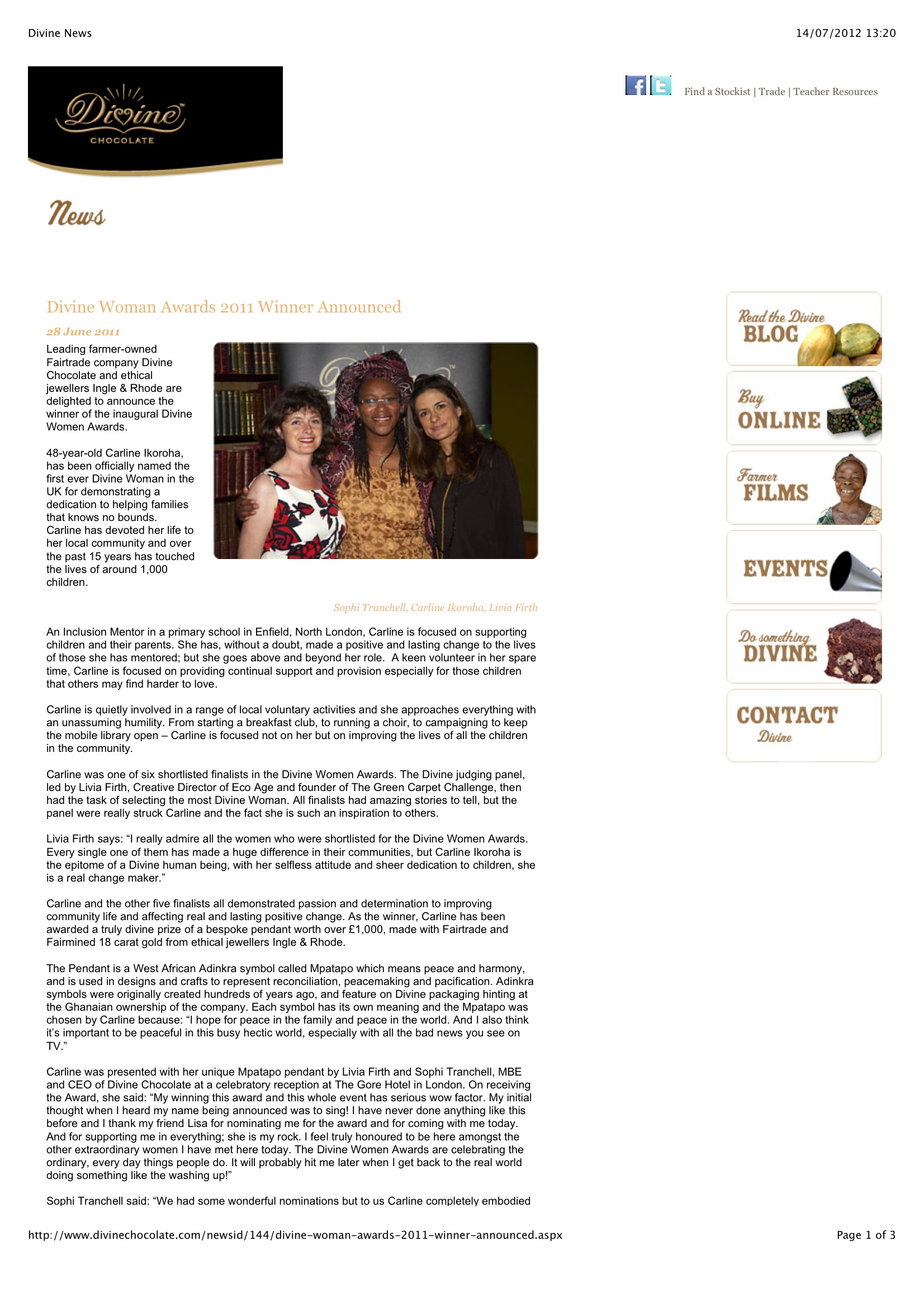
Divine Woman Awards 2011

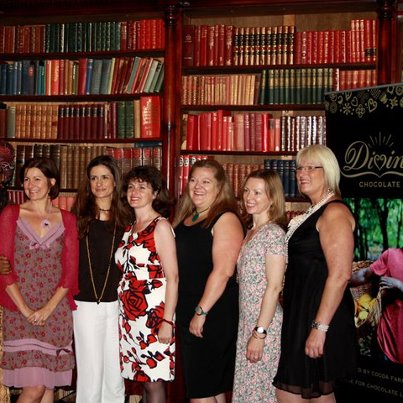
I was recently nominated by two separate people for the Divine Woman Award 2011.  The two people who nominated me don’t even know each other but know me – one from the US and one from the UK.  Astonishingly they also nominated me for slightly different reasons… one for my work within the cancer arena focusing on survivorship, patient involvement and support.  The other for my work within the cancer arena but more particularly for my phyllodes work – finding out more, probing and asking questions, sourcing new information and more importantly my helping others newly diagnosed and through our Facebook group ‘Phyllodes Support Group’.  Divine Chocolate realised that I had been nominated twice and I was shortlisted and  invited, with a plus1, to the Finalists Reception with 5 other entrants.

I didn’t win, but the lady, Carline Ikoroha, who did was very deserving and amazing… as were the other finalists.   Here’s the press release that Divine Chocolate.


(http://www.divinechocolate.com/uk/press/press-releases/2011/6/divine-woman-awards-2011-winner-announced)

Here are the other fabulous finalists together with Livia Firth and Sophi Tranchell…


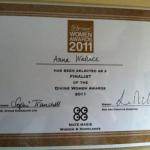
and of course my finalist certificate.


I guess the oddest thing about the award though is that I don’t feel deserving of it nor do I feel that I’ve done anything extraordinary or outstanding.

The one element of all that I’m doing and have done is that I really don’t want to be ‘centre-stage’ – it’s really not about me!

Other press:
http://www.retail-jeweller.com/winner-of-ingle-and-rhode-founded-award-announced/5027045.articlehttp://www.ingleandrhode.co.uk/blog/winner-of-the-divine-women-awards-announced/

About the Girl

There’s always a lot of discussion about looking and feeling good after breast surgery. It’s hard enough to find a decent bra or swimwear to fit when you’ve not had surgery but afterward can be a minefield. I remember my foray into finding anything on the high street to wear straight after surgery. Heartbreaking and difficult.

Through Kelly, I’ve discovered About the Girl. Last night was their launch party at their new showroom in West Sussex. I attended about the girl . If you’ve not found them yet, they’re also online and stock some gorgeous lingerie and swimwear for mastectomy ladies… they will also adjust/customise just for you too.

Oooh they also stock a range of stunning swimwear for people without having had surgery!