Unknown's avatar

About AnnaGoAnna

Aunt~BubblesLover~Volunteer~Sarcoma~Phyllodes~Friend~BerkeleySqBenchOwner~Foodie~Glassmaker~Crafter

My Day 2 at Wimbledon Tennis

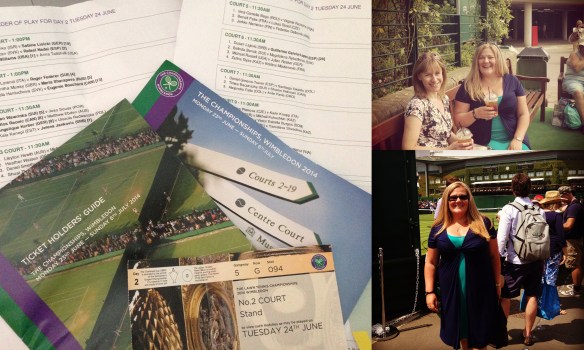
Before I start this post I’m going to acknowledge how fortunate I am to have applied in three different ballots for Wimbledon tickets and to have been allocated tickets to purchase in all three!  The first of which was for two tickets to Court 2 today.

I had an ulterior motive to my rather aggressive approach to getting to Wimbledon tickets.  Many months ago I took a call from my friend Millie asking for advice.  Her daughter, Abi, had a chance, through her school, to be a ball girl but a) wasn’t sure about it; b) didn’t know much about tennis (nobody in the family plays); and c) it would be almost impossible to do the pick up and drop offs for the months of training required after school.  So I offered my ‘Auntie Anna’ services.  My job was to be at Wimbledon each week after training and to drive Abi to Clapham Junction where she would join her Dad on his commuter train home.  I have absolutely loved my weekly 15 minutes or so with Abi between Wimbledon and Clapham.

The training started in January and was intense from week 1.  My first question each week as Abi climbed in my car was ‘are you still in?’ – they whittled the numbers of ball girls/boys down each week as the competition got closer.

I may have also told pretty much anyone who’d listen that Abi was doing the training and hopefully would make it through to Wimbledon tournament.  I just may have mentioned it once or twice.

My darling Abi is a ball girl.   Hmm I’m allowed Auntie Anna bragging rights!

Our day today started early as Millie came up to Wimbledon with Abi.  The early start meant that there was time for us to stop off in the sunshine and have a Pimms and a good catch up!

Wimbledon 2014

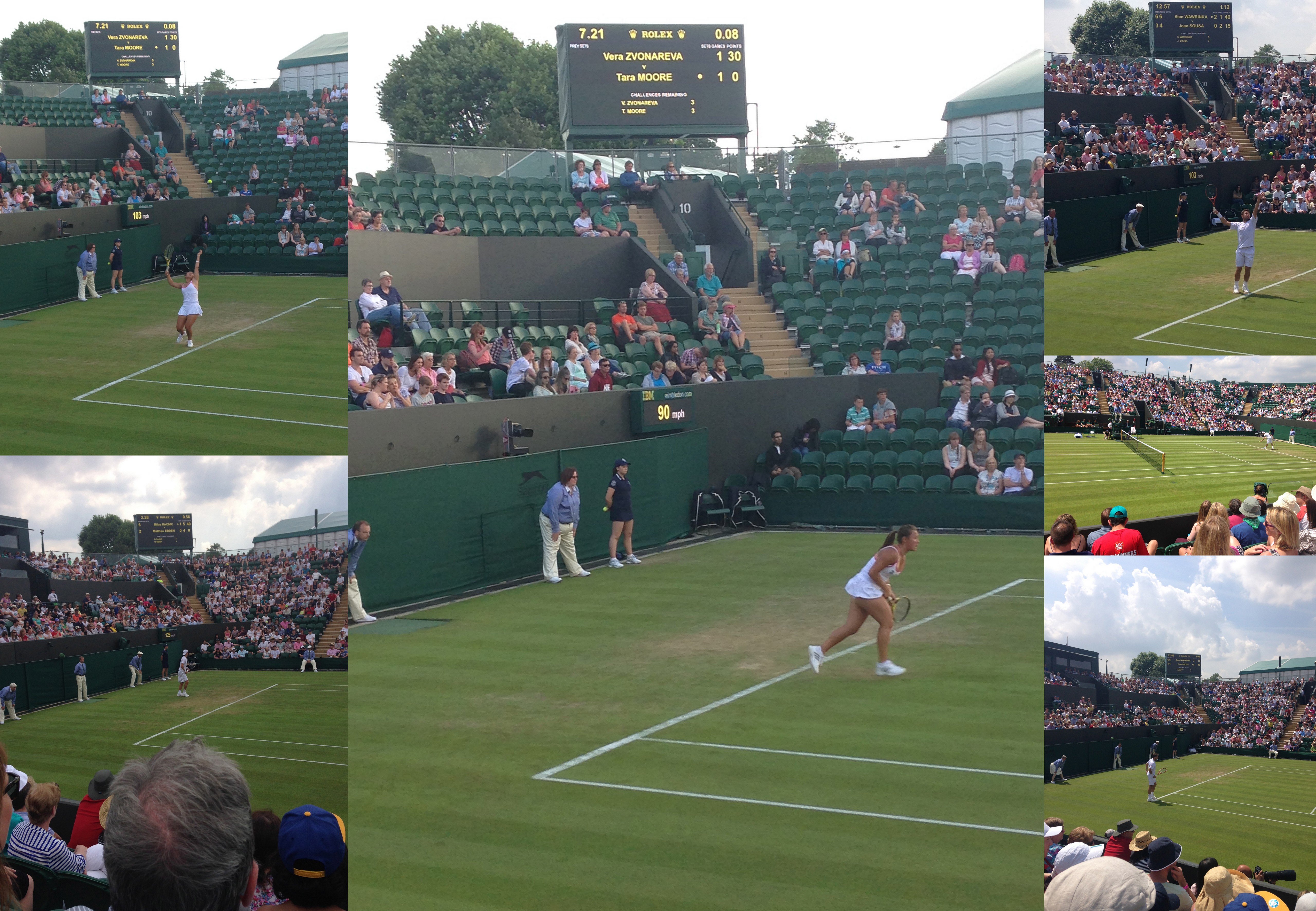
On Court 2 we saw the following matches:

Stan Wawrinka -v- Joao Sousa; Milos Raonic -v- Matthew Ebden; Angelique Kerber -v- Urszula Radwanska; Kaia Kanepi -v- Jelena Jankovic; and Vera Zvonareva -v- Tara Moore.

As you can see from my pictures we were also very fortunate with some perfectly positioned seats.  A wonderful day’s play on Court 2.

Wimbledon 20141

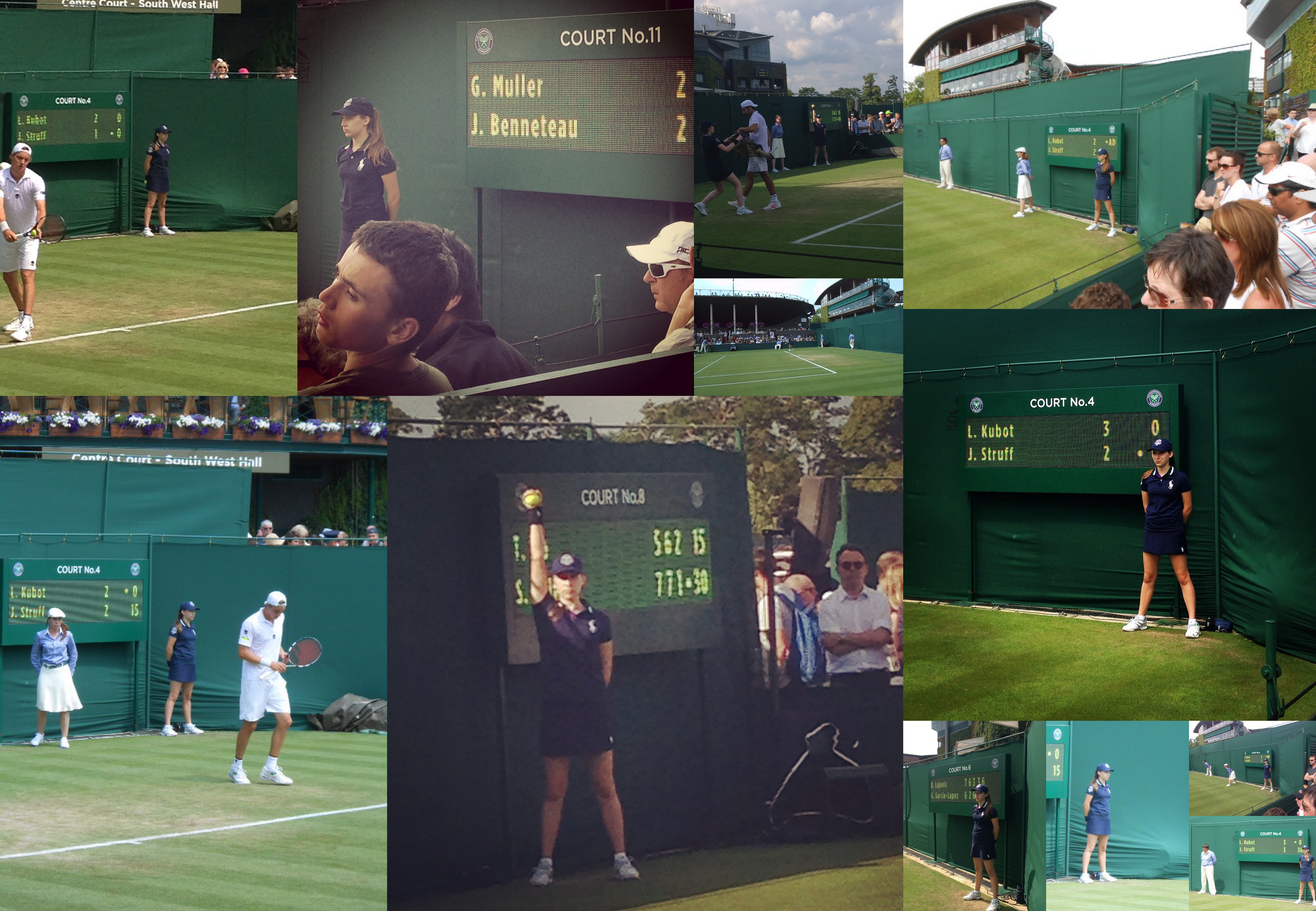
Every couple of hours we would sneak out to the Ball girl/boy office and check which court Abi was on.  They work one hour on court and one hour off but aren’t allowed to talk/walk or acknowledge us until their day’s work has truly finished.   Despite not being able to say hello, I think we managed to ‘stalk’ Abi on all courts with the exception of her last assignment.

I think you’ll agree from the montage of pictures below that she sure looks professional.  I’m so very proud.

Wimbledon 20142

I also knew I’d done a good ‘Auntie Anna job’ when just as she headed off for home with her Mum on the train, she shook her head, laughed and told us that all she’d heard all day was Millie and I proudly ‘whispering’ about Abi or us taking pictures or videos!

She then said ‘Oooh you’re soo embarrassing’… with a big grin on her face!

Bellevue Rendezvous

I am so very very sorry… that I’ve been past this restaurant many many times and not actually eaten here…  until tonight.  I’m sorry because quite frankly I’ve missed out on some extraordinarily fabulous French cuisine.

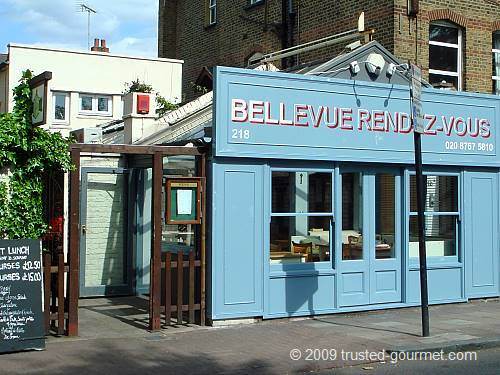
This unassuming French restaurant is situated on the Trinity Road, a busy road which goes from Wandsworth to Tooting.  Not a great place of note for fine food and not, perhaps the most enticing exterior.

bellevueday1

However one peek inside and you’ll see the typically French decor.  The simplistic layout of the interior.  You’ll probably notice that there’s always someone dining.  If you’re within earshot you’ll no doubt hear French being spoken by the staff AND the diners.  It’s always a great sign to hear native speakers in any restaurant.

Tonight I met with some girlfriends here for dinner.  They do a Prix Fixe menu of two courses for £20 and three courses for £24.  Each of the courses has a choice of three well balanced and chosen options.

We chose the 2 course menu and between us had the delicious prawn and beetroot salad starter; charcuterie; and fish soup. All well balanced, perfectly sized and so very delicious. The choices of main course was a roast chicken with smooth mash and peppers; mushroom risotto; or sea bass on a bed of asparagus. Great choice and all perfectly cooked.

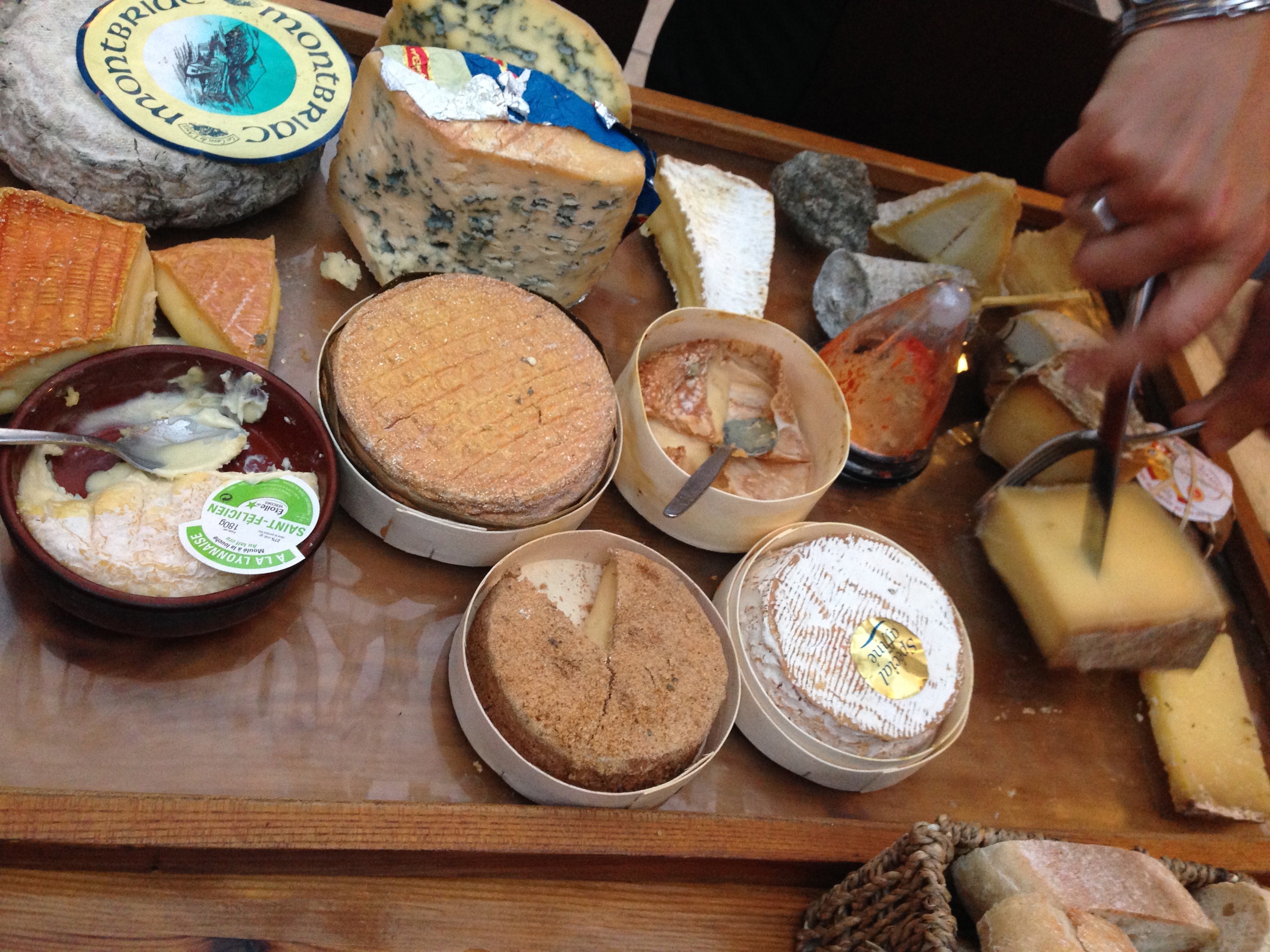
BUT…. then…. the cheeseboard…. Oooh how happy would any cheeseoholic be with this vast selection of goodness?

IMG_5699

The wine list is great with a good variety of reds, whites, fizz, rose in a variety of sizes, glass, carafe or bottle.

The staff were friendly and knowledgeable. The interior was comfortable, clean and French chic. Reasonable prices for great ingredients and well prepared food. Excellent all round.

We will be back so very soon, perhaps for a long leisurely French brunch or lunch.  I am however kicking myself and am truly sorry it took us so long to discover it!

The Great Debate: Should we use social media to recruit patients in clinical research?

Eeek the Agenda has been published for the annual Clinfield Conference for Clinical Research Staff.

Guess who’s speaking and part of the panel debate? Meeee….

“11:45-13:00 The Great Debate: Should we use social media to recruit patients in clinical research?
Chair: Gordon Hill Debaters: Teresa Chinn- We Nurses, Anna Wallace- patient representative, Les Gelling- Ethics Chair”

As always it will give me the ability to mention ‘Phyllodes’ and this occasion to a room full of people at the coalface of clinical research.

As you will all know from this website social media has played a huge part in my finding other people diagnosed with Phyllodes; sharing experiences and supporting one another; researching medical/scientific papers and sharing them with the group; discovering clinical trials around the world and again sharing them with the group; and so much more.

I know that when we’ve discussed clinical trials and research within social media, the thirst for knowledge, how to sign up and get involved and interest in any results and findings from group members is enormous.

Using social media as a way to recruit patients into clinical research is a no-brainer.  It should also be used to educate and inform patients on what research is; what and how you could be involved; why it’s important for medical advancement for you and others; etc.

My ‘journey’ would have been a very different one had social media not played a part.

I’d love to hear your comments.

Ascot

AscotWhat a totally fabulous day at Ascot with the girls.  I think the montage of photos above tell you all that you should know about our day but just in case…

  • A few (ahem) glasses of bubbles.
  • A few pitchers of Pimms.
  • Very patriotic flag waving.
  • A lot of people watching.
  • Men in suits!
  • Watching horses run by and cheering on (in my case) the colourful jockeys and the horses with ‘entertaining’ names… that are nearer the back of the field than the front.
  • A touch of gambling (Debs clearly won in notes form when I just accrued a pocket full of change – see bottom left of montage!).

Mostly though we had a blast.  We laughed a LOT.  Great company.

We looked, as described on Verity’s Diet Coke bottle, Gorgeous…. it just needs an ‘Utterly’ prefixed!


Strengthening public and patient engagement in biobanking – developing plan of action – Cancer Biobank Conference in Cardiff

Strengthening public and patient engagement in biobanking – developing plan of action
Masonic Hall, Cardiff – Wednesday 18th June 2014

~~~~~~~~~~

Sadly due to problems on the M4 I missed the introduction to the day and part of the first speaker’s presentation.

~~~~~~~~~~

Dr Kirstin Goldring
UCL Biobank and NIHR BioResource Coordinator
Public perception of research – where are we starting from?

Kirstin presented some of the findings from recent research as below:

Findings:

  • Majority of respondents want to take part as long as the research has been approved by the research committee.
  • Involving patients in the group helps with research and information written in a way that can be understood by the non-medics. However our research showed that patient involvement in the research project didn’t make any difference to their involvement.

Findings: Eurobarometer

  • The term “Patient involvement” was not clearly understood either by patients or practitioners.
  • But once understood what it means both practitioners and patients appreciate the involvement of patients.
  • Communication was central to the better outcomes however practitioners are aware that they perhaps don’t have the time to do this well.
  • Patients need to feel empowered to ask questions and get more involved if they need to do so.
  • Practitioners worried about giving alternatives as it may dilute the patient’s focus.
  • Chronically ill patients tend to have more awareness of treatments and self-monitoring their wellness.
    Younger patients had higher expectation of their own involvement but were more reluctant to ask questions.

Findings: The Wellcome Study

  • Participants in research showed overwhelming support for the return of health related findings particularly when a condition is treatable and serious. Feedback throughout the process.
  • Respondents valued the role of a health professional or those they already had an existing relationship with during the process.

Findings: STRATUM

  • There is a high level of public support for biomedical research and willingness to donate NHS for this purpose.
  • More information and interaction they have with the process the more people are willing to be involved.
  • There was concern about where samples may be used. It was essential to provide good consent information.

Public Perception of Research

  • Public are interested but need more information, understanding and communication… Begin the conversation.
  • PPI needs to be considered before you start the process of putting a study together. Involve patients before the study is even designed.
  • Heading in the right direct but need to keep involving, developing and evolving.

~~~~~~~~~~
Amir Gander
Lead, Tissue Access for Patient Benefit

  • Falling between the cracks
  • Power of patient involvement
  • Linking across many hospitals over the north and east of London together with NHSBT transplant pathway.
  • Started out setting up and putting in questions about research and consent to all patient questionnaires. This evidenced that most people would give consent but those that didn’t had a doubt as to how their tissue was being used. Simply speaking they weren’t aware of the ethics and rules.

Amir was part of the team who set up a Big Bang Fair which is the largest celebration of science, technology, engineering and maths for young people aged 7-19 in the UK.

During the Fair they were able to speak with the young people about organ transplantation and donating tissue for research.  They also set up questionnaires before and after the process to gauge option on organ transplantation and tissue.  The kids were dressed up in lab coats and participated in many ways including an interactive iPad game and an anatomical model.

What’s next:

  • Going into schools
  • Organising events in neutral locations ie football, community centres etc
  • More Big Bang Festivals
  • Take this format around the country.

~~~~~~~~~~

Alison Parry-Jones
Manager of Wales Cancer Bank

Introduced the next section of the conference with a slide from NCRI.

How others raise awareness and increase understanding – case studies

  • Cancer Research Wales
  • Organ Donation Wales
  • Clinical Trials in Wales
  • GE Healthcare
  • How Tenovus use social media
  • Lay / Volunteer consenting for biobanking

~~~~~~~~~~

Liz Andrews
Director for Cancer Research Wales
Proud to support the Wales Cancer Bank

Totally dependent on the donations that are given by the public to Cancer Research Wales.

How do they generate and raise awareness that leads to donations:

  • press releases
  • radio adverts
  • social media
  • annual open day
  • newsletter monthly
  • website blogs
  • shops
  • community events

They’re also keen to say that all money raised will be used within Wales for research.

Every January they open the doors to our research labs so that the supporters can come in and meet the researchers and have a tour of the facilities.

Cancer Research Wales have a dedicated library for cancer. It is staffed by an excellent team who are able to research and provide specific information to medical professionals, charities and organisations thereby aiding the process.

Using the monthly newsletter to include a story about the research projects. A story on the researchers which includes details on the projects but also some detail about the researcher themselves. In addition to fundraising projects and fundraisers. The emails these generate from the public is very positive.
They track all the links on the newsletter so we can see how many people read which links. This helps them to know what is important to the public.

~~~~~~~~~~

Pat Vernon
Welsh Assembly Government
Organ Donation Wales

There is to be an Opt-Out system for organ donation in Wales.
How do we communicate the change to the public? It’s to be implemented in 01/12/2015.

Organ Donation – why we need to think about it?
The problems – societies’ view, myths and reality

Organ donation:
… is a final act of generosity
One person can save or transform up to 9 other lives by organ donation.
The most successful and cost effective treatment for many.

We have a chronic shortage of organs across the whole of the UK

People who could donate are not becoming actual donors

High rate of family refusal to consent to donation often because we do not know what our relative wants.

People are dying waiting for a transplant – 36 died in Wales in 2012/2013 waiting for organ donations.

What’s stopping us?

  • 9 out of 10 people support organ donation in principle
  • Around 60% never discuss it or get around to doing anything about it.
  • 1m on the Organ Donor Register in Wales but what about the other 2/3rds of the population
  • Reluctant to think about death
  • Faith and culture?

Get informed about organ donation:

  • Age is no barrier
  • Health conditions may NOT preclude organ donation
  • All the major faiths support organ donation
  • Organ donation is a very rare event, 30,000 people die each year in Wales but only around 250 in the way in which donation is possible.
  • Organ donation does not affect the quality of care you are given at the end of your life.

What’s being done in Wales:

  • Changing the law to a soft opt out version. This will happen until 1 December 2015.
  • Means you’ve consented to organ donation unless they’ve said otherwise.
  • Families will still be involved and be able to say if they know their relative didn’t want to donate.
  • Expected to deliver a 25-30 increase in the number of donations or 15 additional donors… which each one could save 9 people!

Awareness raising:

  • All the things above
  • But also the two year period until it is to become fully effective. They need to understand the choices and decisions. If you want to be a donor you can make an express decision to be a donor. Or do nothing and it will be deemed to having no objection to organ donation.
  • If you DON’T want to be donor you can register as that.

Encourage people to talk about organ donation. We know that most people don’t talk to their families about these things and it’s imperative that these conversations take place

The awareness and campaigning will need to continue so that new people to Wales understand their consenting and also so that people are reminded of how they can update their wishes.

~~~~~~~~~~

Barbara Moore
Communications and Engagement Manager
National Institute for Social Care and Health Research Clinical Research Centre

Clincial Trials in Wales

  • Cancer Research UK funded nurses and the research body at first. It’s now funded by the Welsh Govt.
  • NISCHR CRC have research nurses embedded within the NHS staff
  • Involving people through training and also payment.

Cancer Research UK do still fund some clinical research nurses at public promotional events in Wales.

Patient understanding of clinical trials is low. A campaign that was carried out is ‘It’s OK to ASK‘.

~~~~~~~~~~

Alyson Ayland
PR & Organisational Communications Specialist
GE Healthcare

GE provides tools and machinery to pharma but isn’t a pharmaceutical company.

5 step approach to engagement strategy:

Vision:

  • Be clear about your strategy. What outcome are you looking for? A little like a business strategy.
  • It takes time to build relationships and they develop over time with interaction.

Mapping:

  • Prioritise stakeholders
  • Focus internally and externally so that people understand what your strategy is.
  • Partner with other organisations
  • Programme of public speaking events. Prepare a speakers toolkit and ask your supporters to advocate/speak for you.

Media

  • Your people are your best advocates. Make sure they are all informed enough to talk about it.

Tactics:

  • Launch campaigns
  • Showcases
  • Strategic partnerships
  • Site visits from MEPs and people of influence
  • Guest speakers events
  • Photo opportunities and cross pollinating events
  • Newsletters (hard copy as it stays on desks longer)
  • Personal emails and letters
  • Networking events
  • Awards

Keep looking for conversations about what you can do

Milestones:

  • Keep projects energised.
  • Have events and remind people what you’re doing and why. Space them out so that they keep momentum but not too many.
  • Visit from health minister to show and tell about products and aspirations.
  • Signing of Memorandum of understanding with the local universities. Looking for synergies and collaborations.

~~~~~~~~~~

Will Barker
PR & Digital Officer
How Tenovus use social media

There’s a huge amount of people using social media however there’s also a lot of noise. We need to be heard above it.

Tenovus use Facebook, Twitter, Instagram, Youtube, Vine and LinkedIN

  • Want to tell stories of people we support. This increases awareness and also share the work that we do, research , support fundraising and awareness.
  • We want to be heard. A voice of professional opinion and comment.
  • We want to be the voice of cancer patients in Wales.
  • Talk to people that matter to Tenovus in the place that they’ve chosen. i.e. those who are on FB anyway will interact without having to change location
  • Not just broadcasting it’s about having a conversation.

Social media allows your organisation to get what it wants out of it. You can choose how to use it and how to interact.

Social media is a great way to drive people to our website where we can put much more information than we can on a post or tweet.

Must represent all people. Not just pink and female!

We use videos in blogs from researchers to show the ‘face of research’ to the public. A brief introduction but then if someone is interested, they can link through to more information available to them.

~~~~~~~~~~

Dr Balwir Matharoo-Ball
Operations Manager, Translational Research and Biobanking, Nottingham University Hospital
Lay volunteer consenting for biobanking

New biobank in Nottingham. Set up 3 years ago.

Patient Public Involvement in Consenting for Biobanking.  The use of language should also determine the level of the patient public part:

  • Participation – You take part
  • Engagement – You’re on the periphery
  • Involvement – From start to finish involvement

The public voice is really important to learn from and why all should listen.

Process of taking consent for inclusion in biobanking should be sensitive and involve the person and family

Asking for PPI involvement, NHSB produced a job application, training by the hospital trust, give them an honorary contract from the trust and also sign a confidentiality agreement.

As they are also facing the public they need to go through the necessary checks.
The PPI advocates are also taken through the whole process full life cycle of biobanking touring the histology labs and receiving an overview of the NHSB clinical/sample storage.
Annual appraisals for the PPI advocates.
Recognise and acknowledge the number of years given to the Nottingham Uni Hospitals by the PPI advocates.

~~~~~~~~~~

We broke for lunch during which time we were entertained by a wonderful group of singers from the Tenovus Choir.

~~~~~~~~~~

AFTERNOON SESSION

~~~~~~~~~~

Dr Bridget Wilkins
Experimental Cancer Medicine Centre Network / NCRI Pathology Networking and Biobank Lead
Swipe here to donate

Would a ‘swipe to donate’ card work for signing up for giving consent to use your tissue for research?

  • Same as a loyalty card, it might be presented to the person with instructions about how to active online. Once online the person is able to personalise the card, say what they would and would not consent to. Additional information about patient groups in the area, current research studies that are local.
  • Your consent would then be added to a database and the card would be the key. Information is updated if you had a hospital episode of someone has done.
  • You could incentivise someone by doing online research or updating it regularly.

Would need to be prompted to check in and update.. perhaps by email, text or on a letter.

You could also say how you wanted to be contacted i.e. by text/email/post. This communication could be used to send additional information or new trial information.

You could also keep it updated with other information such as recent blood tests.

Record mood, wellbeing, lifestyle information, weight/height etc. Enriches the dataset of your tissue which makes it of more use to the researchers.

A simple interactive tool to volunteer our use for leftover tissue samples.

Counter-argument against swipe cards

What happens if I lose the card? Can’t remember the pin number? Website.
I’m happy you can use my tissue, don’t bother me again.
Personal information about me, how will I know it’s secure? Where is it held?

~~~~~~~~~~

To close the day there was a round table breakout session to come up with action points and an implementation plan to raise understanding and awareness of research.

  • How do you get more public awareness into biobanking?
  • What is biobanking?
  • Would you attend an open day at a biobank?
  • How can biobanks or the CCB address challenges of public engagement in biobanking?

Discussing a number of challenges:
Appropriate communications, avoiding jargon, plain language.
Unfamiliarity about biobanking.

ST – Posters in waiting rooms in GP surgeries, A&E clinics etc
Start conversations about medical research and biobanking at different levels:
School, W1, community groups, Unis, Rotary, soap opera, magazines.
Divorcing fro own personal health but being part of everyday conversation.

ST – develop toolkits to give to resources so that these conversations can be had at appropriate level, professionals, patients, general public.

Trust – make this type of complex and emotionally laden topic accessible to all, accessibility = transparency = trust. Seeing is believing – tours of biobanks.

Looking at what we can do internally within biobanks.
Getting Biobanks managers and boards to understand the difference between involvement/engagement/consultation. Involving actively or engaging passively.
Sharing best practice with case studies from biobanks.
Research studies to demonstrate the impact that public and patient involvement can have on biobanking.
CCB could set up and provide a professional program to train biobanking managers on how to to do it, engage, involve. As part of CCB membership additional ‘kite mark’. Which will also build trust and transparency.

How can the CCB most effectively translate the findings of biobank into health development.
How do you engage Govt to develop a policy? Incentive?

~~~~~~~~~~

An incredible thought provoking day discussing biobanking, tissue and organ donation and also looking at the small amount of people who actually participate and discussing why.

I hope the notes from the above may get you asking questions, perhaps signing up but more than anything having a conversation about it all and letting your friends and family know your wishes.

Cerviche

images-16I’d never tried Peruvian food but am now a convert!  Ceviche was buzzing on a Tuesday night in London’s Soho – we were pleased we had booked a table!

The food is all excellent. Between the four of us we chose a lot of different small plates to share and think we did a pretty good job of trying most dishes. All great but my particular favourites were Don Ceviche (sea bass) – so fabulously fresh. Choclo Corn Cake with Avocado. Sakura Maru (salmon sushi-esque style). Pollo en Panca (chicken in chilli, orange and pepper jam).

The staff were friendly and the tables relatively well spaced. There appeared to be some high long tables where you could join up and eat with others as a two or solo diner.

Definitely returning here.

Regular scans

You listen to me every 6 months talk about the follow up scans, the scanxiety and the results.

Well it’s that time again.  It explains why I’m more than a little antsy too.  No matter whether I’m thinking about it or not, somewhere in the depths of my brain is a little voice saying ‘maybe this time’.  With every twinge or pain that I get in my boobs (and believe me I get a lot) or my back, I wonder if it’s related.  I still get shooting pains which apparently is from the surgery and when I’ve previously discussed the pain with the consultants, I’m told that perhaps this is ‘normal’ for me.  But what IS normal?  How can I differentiate what would have been there anyway and what is because of the surgeries or phyllodes?

I digress but perhaps you might understand why I get anxious.  So last Friday I trotted along to the Royal Marsden.  Appointment card, request for a chest x-ray and letters making and changing my ultrasound appointment firmly in my hand.  I hadn’t received a mammogram appointment letter but presumed that this would be booked in when I got there and that the letter hadn’t yet arrived – previous experience of my receiving the appointment letter after the appointment had taken place fresh in mind!

The waiting room for ultrasound is full but we’re seen quickly.  I’m greeted by my usual lovely sonographer and introduced to a trainee sonographer who is due to qualify into the Marsden in a few months.  I mention that I’ve not received a mammogram appointment.  The trainee does the first exam.  It’s painful as she goes over lumps and bumps (I presume scar tissue) and on occasion stops to have a closer examination of areas.  It’s a little off-putting watching her face as she thinks she see something and hasn’t quite mastered the poker face yet – I guess that’s part of her training.  Then my usual sonographer takes over and they discuss their findings – “usual ‘oddness’, scar tissue and lobular neoplasia” but nothing unusual for me and apparently nothing to worry about.  I’m reminded that I should follow up for a mammogram appointment today.

Next stop chest x-ray.  This is such a quick procedure.  Stand in front of a black panel and breathe.  All done.  I was keen to get this x-ray today.  I’ve had a weird ‘catch’ in my breath and occasional wheezing of late… I’m hoping it relates to the virus I had a few months ago and nothing more sinister.

Now to head to the Outpatients Reception to see if I can find out about the missing mammogram.  I’m given a telephone number for a sarcoma CNS.  I call internally to discover the team are all in an MDT meeting.  Disappointed I head off and leave the Marsden.

I’ll get my results from my consultant at the next appointment which is in 5 weeks time.  It’s ridiculous that the results appointment is so long after the scans – more scanxiety!

Yesterday however I managed to speak to the sarcoma CNS.  She wasn’t sure why I hadn’t had a mammogram appointment and went away to check.  My consultant has now left the Marsden and apparently I’m now under a different consultant but my mammograms are under the breast cancer team.  WHY???

According to whomever she spoke with, I don’t need mammograms in my followup and that an ultrasound and chest x-ray is enough.  Aggggggh the agreed followup was for annual mammogram and six monthly ultrasounds and chest x-rays because Phyllodes doesn’t always show up on ultrasound until it’s grown bigger.  I explained this as calmly as I could… and then promptly burst into tears when I hung up the phone.

The Marsden are great.  They’re a centre for excellence for sarcoma.  BUT I’m waiting for an appointment that actually goes according to plan.  A time when I don’t have to run around the hospital chasing up something or booking in to a different location or calling up to find out what’s going on.  Truly I’m not sure but assume that within the hospital they have a multitude of non-communicating IT systems.  If only the realised the anxiety that these inefficiencies caused to their patients and carers.  I know I’m not the only this happens to as am often having my ear bashed in the waiting room listening to someone else’s anxiety.

So I guess I’ll have to wait for the sarcoma CNS to call me back.  And then wait for the mammogram appointment.  Or perhaps wait until my consultant appointment in July for the results of the ultrasound and chest x-ray.  Discuss with the consultant in July about my having a mammogram, get that booked in, turn up for another appointment and then have to have a further consultant appointment for the result.  Just as well I’m not in full-time employment with all these days off.

I wonder who my new consultant is?

NCIN Conference 2014 (Day 2)

The second day of the conference began with me being fairly grumpy!  The queue to get into the dining room for breakfast was stretching out to reception!  After 20 minutes of waiting, I gave up.  I only wanted a croissant and some fruit but it wasn’t to be as I was keen not to miss any of the conference… but no breakfast = grumpy Anna!  Hilton Hotels get your act together!

~~~~~~~~~~~~~~~~~~

Plenary 3 – Global cancer surveillance: opportunities and challenges

Professor Julia Verne
Director of Knowledge and Intelligence Team SW, Public Health England

Plenary session in the memory of Brian Cottier (1951-2009)

1 in 3 will get cancer
1 in 4 will die from cancer

~~~~~~~~~~~~~~~~~~

Freddie Bray
IARC – International Agency for Research on Cancer
“World wide cancer burden”

Global cancer surveillance opportunities and challenges

Socioeconomic changes and how that impacts cancer incidence and survival.

14.1 new cases in 2012
8.2m deaths
32.5m living with a cancer diagnosis

9 cancers for majority of cancers 2/3rds of burden.

Globocan 2012 provides many graphs and examples.

The changing world – transitions
Major increases in the population coupled with increasing longevity has linked to epidemologic translations Including cancer, moving from infection related cancers toward a western lifestyle.

1 in 3 NCDs are cancers.

A great deal of information and graphs showing changes in some countries for increases in cancer and also decreases eg Japan have an increase in young people with cervical cancer. India have a reduction as marriage age is getting higher. Russia and Belarus have no screening and it has rapidly increased for cervical cancers.

Why registries are so important so we can track what is happening and measure it accordingly.

NCD agenda, of surveillance activities
Training and collaboration with cancer registries around the world. Try to ensure registries are in place to help with cancer control and also for reporting worldwide.

3 way split between high quality data, national and regional data and frequency data but 62 countries with NO data at all.

Current situation
Recognition of increasing global cancer burden.
Despite a long history of cancer registration LMIC have not developed PBCR
Link in with political agenda and tackling of NCDs

UN high level summit talks about cancer registries.
Global monitoring framework

IARC Technical Publication No 42 “Planning and developing population based cancer registration…”

Global Initiative for Cancer Registry objectives

IARC Regional Hubs for Cancer Registration in LMIC

Good data collection and methods of using and sharing data effectively.

~~~~~~~~~~~~~~~~~~
Dr Milena Sant
Instituto Tumori, Italy
EUROCARE 5 – survival of cancer patients in Europe

21 countries with a national registry inc 7 countries from eastern Europe.

50% of European populations including over 10m cancer cases.

Next steps for Eurocare

Reduce inequalities,
Treatment is not only solution for control
primary prevention, early diagnosis, accurate diagnosis – are all factors

~~~~~~~~~~~~~~~~~~
Sara Hiom
Cancer Research UK
The International Cancer Benchmarking Partnership’s Impact on Policy and Practice

What is the ICBP? – unique collaboration in terms of countries, international collaboration involving policy, research, cancer registry and clinical professionals at a global view.

13 jurisdictions in 6 countries
including Scotland for module 5

What are they looking at?

  • breast, lung, colorectal and ovarian

5 modules

  • Epidemiological benchmarking study
  • Public awareness, attitudes and beliefs
  • The role of primary care and healthcare systems
  • Variation in patient,diagnostic and treatment time intervals and routes to diagnosis
  • Data comparability and early deaths

Focus increasingly on the first year post diagnosis. Why are we not getting more patients beyond the first year survival which we can also see affects the 5 year survival statistics.

Module 1 – survival and stage table.

It’s not only early diagnosis that came out from this module and data comparison. It was also access to services and quality of treatment.

Module 2 – awareness and beliefs
Looked at differences in population. In the UK were our people less aware of the signs and symptoms?
Findings: ABC measure was born and has been used for surveying populations.
Generally speaking similar levels of awareness across all ICBP countries.
Generally low awareness across all countries of the increase factor of age.
UK – stood out the reluctance to visit a GP and wasting the Dr’s time. Elements of embarrassment i coming forward in the UK.

Be Clear on Cancer campaign to try to change the belief of wasting GP’s time or embarrassment.

Module 3 – role of primary care
Were there fundamental differences in systems?

  • Progress 2895 GPs responses to online survey and analysis complete in 11 jurisdictions.

Papers are about to be published.

Latest (unpublished) international data suggests that GPs in England:

  • Are less likely to send a patient for tests
  • Report having among the lowest access to specialist advice
  • Tend to feel more strongly about protecting their patients from over investigation and preventing a secondary care overload.

We need to look at the cost structure to overcome this aspect.

Module 4 – patient, GP and specialist intervals
Still underway…

  • Looking at via surveys patients, GP and specialist.
  • Looking at length of time between first noticing symptoms and time to GP and referral.
  • Collecting this information across the cancer pathway in 10 jurisdictions and comparing each of them.
  • Anticipated impact is focus in on areas with longest interval.

Module 5 – data quality simulation
Variations in cancer registry practices affect the comparability of key data used in cancer survival analyses

Look in much more depth of the differences in registries.

Should have a key impact on the best practices and developing tools that look at different factors.

Module 5.2 – short term mortality and co-morbidity
Not started yet…

Building on the legacy of ICBP.  Lots of questions have left unanswered but needs to continue and keep it up on the agenda. Perhaps political policy will assist keeping it on the agenda particularly as comparing with other countries.

~~~~~~~~~~~~~~~~~~

Reducing Health Inequalities
Chair: Dr Tony Moran
Director of Research and Intelligence (North West) at Public Health England

~~~~~~~~~~~~~~~~~~

Therese Lloyd
Prostate Cancer UK
Lifetime risk of diagnosed with and dying from prostate cancer in different ethnic groups

Process of finalising a publication but as yet unpublished.

What do we know?

  • 1 in 8 men in the UK will be diagnosed with prostate cancer at some stage in their life.

We know there are ethnic differences but don’t know how they translate into incidence and mortality.

Data and analysis
Few date issues that meant we weren’t always able to tell the ethnicity for over 1/4 of the data fields.
Total numbers of deaths in the data did not match up the total number of deaths in the office of statistics.

Several analyses in each ethnic group were done.
Best estimate but also larger groups to get a true value.

Used DevCan – system US.

Major ethnic groups analysed – white, black and asian.

Mixed – were difficult to obtain clear results.

Lifetime risk is calculated as percentage and odds.

Although there is a bit of variability based on the methodology used. Consistent message that Asian men (1 in 13) are at a lower risk of being diagnosed of prostate cancer than white men (1 in 8).

Black men are at a much higher risk, although much more variability the research evidences that approximately 1 in 4.

Best estimate – White 1 in 24, Asian 1 in 44 and black 1 in 12 – dying from prostate cancer.

Looked at data from 2008-2010.

When you compare the diagnose number and deaths all groups indicate that 1/3 (across board) will die once diagnosed. Perhaps there is no difference between the aggressiveness of the disease no matter what colour skin.

Need to reach out to BME communities to be aware of symptoms.

More research is needed and collection of perfect ethnicity data is needed.

~~~~~~~~~~~~~~~~~~

Chin Kuo Chang
King’s College London
A cohort study of mental disorders, stage of cancer at diagnosis and subsequent survival

Presentation

2011 cancers has seen the largest percentage of death in the UK accounting for 30% cause of death.
For serious mental illness it’s the 2nd or 3rd cause of death.

Big gap between the general population and people with serious mental illness (‘SMI’).

Only 1 team in WAustralia investigating this.

2 research questions (looking at data 2010-2013) CRIS
early symptoms ignored or not understood. Is the stage also affected when diagnosed.

Cancer linkage

  • Cancer register to include incidence of mental disorders
  • Trajectories of cancer treatments for ppl with SMI
  • Prognosis of cancer patients with psychiatric comorbiditiy.

Extending CRIS system to Cambriddge, Imperial – UCL, Oxford and Camden & Islington.

~~~~~~~~~~~~~~~~~~

Mark Rutherford
Research Associate, University of Leicester
Understanding deprivation and inequalities using loss in execution of life use to a cancer diagnosis (using only UK data)

Please refer to presentation

~~~~~~~~~~~~~~~~~~

Preventing Emergency Presentations – the need for research
Chair: Stephen Duffy
Wolfson Institute

We know that emergency presentation is particularly common in some cancers such as lung and bowel. Associated with a poorer outcome and may be associated with initial treatment from wrong specialist.

Emergency Presentation is more common in older people.

We need better understanding who’s at risk and what can we do about it?

Targets for today from the interactive workshop:

What are the major knowledge gaps?
What cancer sites are most promising for intervention?
What interventions are ready for evaluation?
Not simply to replace Emergency presenting with routine presentation. We want to replace with someone presenting 6-12 months before with stage 1 or 2 cancer.
Who should take this forward?
Very much in our hands as to which teams should take these interventions forward? Research fellows? Charities?

~~~~~~~~~~~~~~~~~~

Less Common Cancers
Chair: Jane Lyons
Cancer52

Cancer52-NCIN-Report-10-June-2014-FINAL

~~~~~~~~~~~~~~~~~~

Lucy Elllis-Brookes
NCIN & PHE
Setting the scene for rare and less common cancers

Presentation

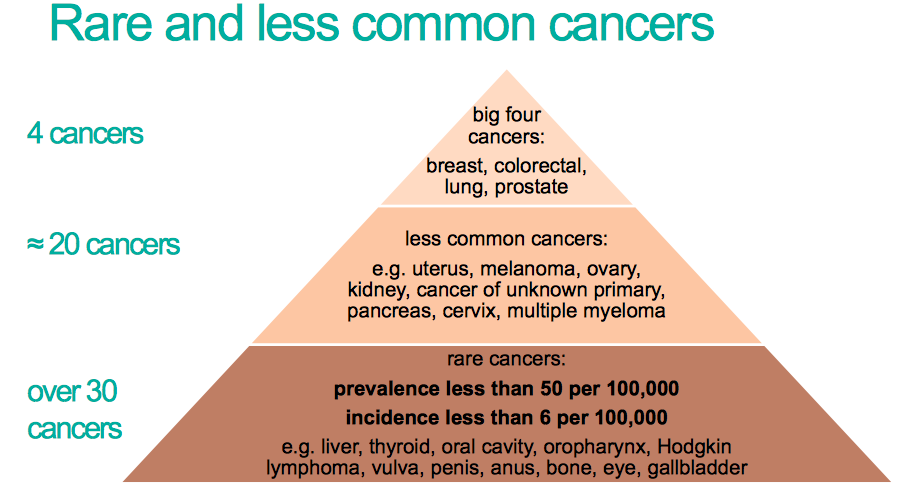
Big 4 – breast colorectal lung and prostate
Less common cancers e.g. uterous, melanoma, ovary, kidney, CUP, pancreas, cervix, multiple myeloma
Rare cancers…. even more !

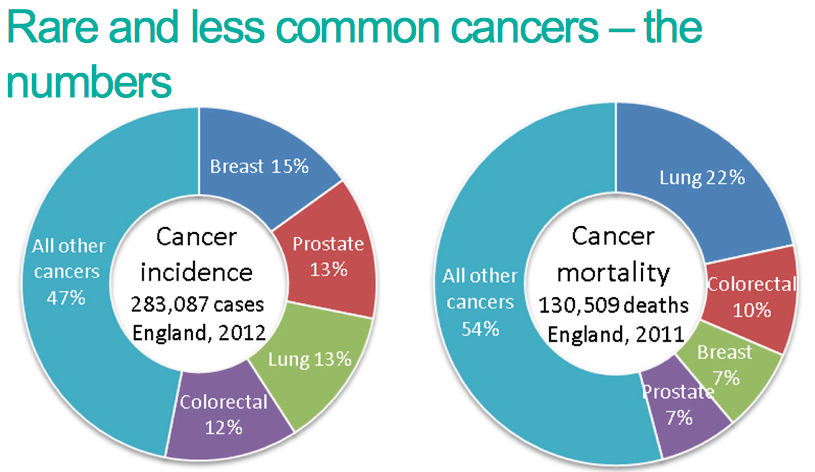
Screen Shot 2014-08-18 at 15.33.40Rare and less common cancers:

Screen Shot 2014-08-18 at 15.34.58

What is NCIN doing?
Routes to diagnosis – increased look at cancer types and producing data from them 22 in 2010 and 57 in 2014.

Deprivation reports – 23 in 2008 and 37 in 2014

Site specific Clinical reference group work (recent examples)

  • vulval cancer – trends and variations by age
  • kidney cancer survival report
  • penile cancer incidence by age

What do rare and less common cancers have in common?

  • Each cancer site shows different results.
  • Different analyses will be required
  • Specialist advice (clinical and analytical) is crucial.

~~~~~~~~~~~~~~~~~~
Oksana Kirichek
University of Oxford
Menopausal hormone therapy and risk of central nervous system tumours: a nested case – control study

Aim of study:

  • Is Hormone therapy (HT) associated with risk of brain and other CNS tumours
  • To test whether the effect of HT varies type, duration or recency of HT preparation used.
  • To assess the effect of HT exposure on the risks for all CNS tumours

GPRD General Practice Research Database

  • Holds primary and secondary data. cross linked with other databases and person specific.

Definition of cases

Results
No significant difference in risk by tumour subtype

Conclusions

  • UK GPRD cohort women who had been prescribed HT
  • HT associated risks did not vary significantly cross the four main tumour subtypes examined
  • Findings from the GPRD agree with those reported previously from other studies with prospectively collected information on HT use.

~~~~~~~~~~~~~~~~~~
Nicola Dennis
Knowledge and Intelligence Team (W Midlands)
Incidence, survival and treatment patterns for patients with head and neck sarcoma

Presentation

1% of all malignancies in England are Soft tissue sarcoma
Narrowed down to head and neck the numbers are even smaller

With the very small numbers of incidence there are limited studies looking at incidence and survival rates.

Both Improving Outcome Guidance in 2004 and 2006 specifically had improvements for head and neck.
Because of the small numbers its hard to see if anything has changed.

4796 head and neck sarcomas in 1990-2010

MDT specialty – positive outcomes since the guidance was set out where we can see that there has been a significant increase in referral to the right MDT specialty.

Patient spread for surgical treatment. Data shows that there are number of trusts that might only have treated 1 patient in the entire 10 years of the study!

~~~~~~~~~~~~~~~~~~
Kwok Wong
University of Birmingham
Risk of Adverse Health and Social Outcomes up to 50 Years After Wilms’ Tumour: The British Childhood Cancer Survivor Study

I will post a link to the presentation once available.

~~~~~~~~~~~~~~~~~~

Plenary 4 – Delivering outcomes that matter – Panel debate with Q&A to the panel
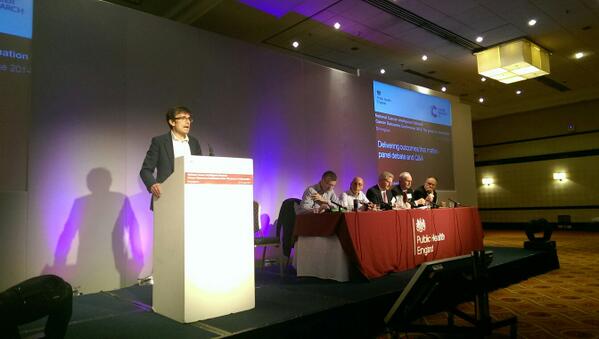
Chair: Robert Peston, BBC’s Economics Editor

• Mr Sean Duffy, National Clinical Director for Cancer Services, NHS England
• Mr Ciaran Devane, Chief Executive, Macmillan Cancer Support
• Professor Peter Johnson, Chief Clinician, Cancer Research UK
• Dr Jem Rashbass, Director for Disease Registration, Public Health England
• Mr Andrew Wilson, Chief Executive, Rarer Cancer Forum
BpxgJTfIcAA0rMM

Ciaran Devane – Chief Exec – Macmillan
We need to move to a strategy when we think in a different way rather than the economics.

We are talking a great deal about the value of services and NHS etc rather than the value of and to the individual.

Changes in the NHS – are we spreading our resources too thinly?

Sean Duffy – National Clinical Director for Cancer NHS England
No doubt the point of contact for you within the health service should be the most important thing. We’ve not yet got it right. If we’re going to visit better outcomes then we need to tackle the first point of contact too.

We don’t wrap the system around the patients enough.

In terms of the data itself – it’s easy to look at national data and say were good at this or that. We can look at a local level. We need to create ownership of the data around the geographies to be sure their own data is better and is owned. Working collectively to gather for the greater good.

Rich national dataset that we can and must use but we haven’t yet made great inroads in it. Need to make more out of the data.

Finally, with such a rich set of data and the ability to intelligently obtain information from it. We need to get cleverer at using the data in order to year on year look at the services to ensure we can achieve the best.

Prof Peter Johnson, Chief Clinician, Cancer Research UK
Echo the good things said about NCIN and the work they do. No doubt research using the data has been saving lives for many years. We know more about how to reduce the risk of cancer and determine the best treatment and long term outcomes.
How are we going to improve further and get up and beyond the levels of other countries?

We know there are at least 10 different types of breast cancer. We know asbestos causes mesothelioma.

Key obstacles we need to address: Regulation – looking at EU regulations and ability to track patients through system and outcomes will be compromised if EU data systems come in.  We must at all costs make sure work is not held down by regulations.
Changes in the health systems recently has given us problems. Relationship with the information centre CPRD and difficulties of joining different data has given us delays and loss of capabilities in the Registry. This has stopped us doing as much as we would have liked and can achieve.

Public perception of data and it’s management has been undoubtedly damaged by care.data. This was a fundamental problem and unsettling. We have to overcome this. There have been ZERO breaches in any confidentiality of the Cancer Registry.

25% to 50% alive 10 years from diagnosis of cancer. CRUK want to bring this to 75% in the next 10 years. We need data to understand this and move forward. Stratified medicine has to understand at a detailed molecular level. We will only be able to capitalise on that if we can get the data systems right and keep them functioning.

Data is a precious life saving resource. Do not take it for granted. Fight to maintain the system that we have.

Dr Jem Rashbass, Director for Disease Regulation PHE
Worth reflecting on how we got here and what this is about  We have had earthquakes of public trust. This is YOUR clinical information that we collect and we are duty bound to look after it and my responsibility to make sure that I protect patient confidentiality.
As Peter has said the support we’ve had over the years to look after your data and you can request it’s removal from the Cancer Registry.

This is about delivering care to individuals. You’ll treat them on the basis of the stats but as we move to personal care it’ll be the molecular abnormalities that determine your outcome.

We need to maintain the public support for data collection and NCIN database that puts the potential for cancer care in this country further forward than anywhere else in the world. In the next 5 years we will have extraordinary ability to provide the most personalised cancer treatment.

Andrew Wilson, CE Rarer Cancer Forum
Current state of play for data. Clear that public feeling has been shaken. Rarer cancers are rare. Data on rarer cancers will be much more identifiable. Huge amount of exciting work going on using data for rarer cancer.

Use of data in rare cancers. Hidden cancers and less visible to the public.
Huge demand for this sort of data. Need to meet this and produce reports that are useful.

NCIN route for diagnosis project showed ongoing problems for cancer patients go far beyond those related to cancer.

We need to be much more open with the data that we hold. Ensure patient identifiable information is removed from data sets. Once this has been done the data that we have is published. Closed shop needs to go. Automate data flow around the system to ensure sticking to rules and make better use of data that we do at present.
We need to work collaboratively to come up with solutions where problems exist.

Q&A
Q – How can we ensure the diagnostic experience for young people is improved?
SD – we have a first point of contact system designed 60 years ago. We need to tackle it externally and internally. Simple things needed – proactive approach to primary care. Safety netting – young person with a set of symptoms its probably the last place they want to be… be proactive and should raise a flag for tests. We have created a mechanism whereby the referral is the only route – needs to be challenged. GP should be able to make a clinical decision on the basis of facts not ask the patient to wait!
JR – We need to recognise that a missed diagnosis is one that everyone inc GP regrets. However some cancers in a young person are difficult to detect. They are rare. Symptoms and signs of a brain tumour are subtle. No of patients that a GP sees with those every week, it’s difficult to identify. Where the value of the dataset comes not from surveillance but that we should learn from every case. How do we raise our game?
SD – there are risk assessment tools that allow patients to flag up symptoms.
You can start to identify in an active way any of the GP patients that maybe at higher risk using some of these tools and data set.

RP – GPs feel they don’t have the level of control and responsibility due to other constraints about referring and cost.
CD – The guidance at the moment is written to say send us these patients but often the ones that don’t fit that mould are overlooked because they don’t fit that picture.
Be Clear on Cancer – enables the patient population community to know what to ask for and what symptoms.
PJ – I think there is a massive amount of data that tells us a lot about patterns of referral. And the outcomes from this. Feeding the information back into the system is incredible important.

Q – As a researcher the amount of time it takes to get access to data approved throughout he current regulatory approval system. Is there a strategy to help researchers get access to the data and make use of them in a more timely way.
JR – Richard’s experience shared by others. We’ve tied ourselves in knots frightened about releasing data and protecting the confidentiality. We need to recognise what you want us to do. Inside PHE we are trying to deal with it and create the structures to manage the data release. The demand for the data is large. We have disadvantaged ourselves by separating the people who pull the data and those who analyse it.
I think we do need a clear process of maintaining that public confidence.
Complex area but we need to be better at giving data confidentially.

RP – What is your attitude to selling data?
JR – Govt data is not available. Not a resource from which to make money. The data that we collect on you is for the social good BUT need to protect patient identifiable.
Financial constraints on delivering personalised health care will not be cheap. We need to enter into the discussion with industry to pay a fair price and benefit.

Q – How big a threat to our ability to gather and use data would changes be that require consent to use the data each time? This would negate the value of a Cancer Registry.
A – It’s a risk and will undermine everything that we’re trying to do. We need our MPs to change this view and to ensure that this change does not take place.

Q – One of the ways that we can prove that consenting to use of data is to show the public how the data can be used for good and can be done.
CD – Hugely disappointed when cancer networks became unpopular. People didn’t believe in coordination. We need to make use of the strategic clinical networks. Make sure the patient voice is embedded in the senates, and clinical settings. We need to be more assertive and move together.
JR – Some basic processes. Transparency and openness. Audit – any patient can approach and ask who looked at my data. Every patient who wishes can have access via a patient portal like the brain hub. An absolute right of opt-out. No process that makes it difficult to do that. I think that is what is needed to protect the data set that we’ve got and we need the community to act and educate the wider audience.

Q – Despite significant Govt rhetoric influencing the NHS work we need to collect ht patient voice at and put it back into the system. How can we go about changing this?
SD – I believe in the patient voice entirely. Within NHS England the patient survey is the most successful at influencing. We need to make more use of it.

Q – NCIN was founded in 2008 with mission to provide the UK with the best intelligence in the world. What does the panel think the new mission for the NCIN should be to take us forward in th next 5 years.
JR – We need to move somewhere else. I want a low level objective to make the patient and the clinician at the centre of the data store. So you can ask where am I in the system? You can check you’re getting the best and ensure that no cancer is left out. Patients and the public at the centre for cancer.

RP – When you collect data that is at a granular level are you recording it?
JR – Yes we are. We need to know what receptor it has. If it responded to medication. etc etc. Absolutely linking it into all sorts of datasets to look at a much bigger picture and make it more personalised.
PJ – 4 years of outstanding progress and 1 year of challenge. I think it’s time to reaffirm the quality of the data and now we need to see it and put it in front of the people who generated it, people, public, patients, clinicians etc. Want to see equally superb access to it.
CD – based on outcomes not last year’s data.

Q. – When a patient comes into hospital with advanced cancer, the patient has rarely been recording if they’ve been attending primary care prior to emergency presentation?
Should we incentivise GPs by giving them QoFs? Perhaps to embed good practice for a period of time.
PD – Both London integrated cancer centres have been involved in looking at attendance of A&E and that will give us some answers about the gaps. I do think there is something about incentivising a better pathway of care. We need to use everything in our power to make the system work.

NCIN Conference 2014 (Day 1)

The NCIN (National Cancer Intelligence Network) is a UK-wide initiative, working to drive improvements in standards of cancer care and clinical outcomes by improving and using the information collected about cancer patients for analysis, publication and research.

When I was first aware of the NCIN, their goal was “To develop the best cancer information service of any large country in the world – by 2012”.

Because of the work they continue to do, UK clinicians, medics, researchers, NHS purse holders, pharma, charities and, of course, patients are now able to draw on an incredible amount of useful data-sets.  This data enables measures to improve outcomes, drug development, research projects, awareness and own patient care.

This year I was honoured to be invited again to attend the NCIN Conference with a bursary place and below is a summary from my notes at the Conference.  Wherever available I have added links to presentations.

Cancer Outcomes Conference 2014 – the power of information
Sponsored by Cancer Research UK and Macmillan

Chris Carrigan
Director of NCIN Public Health England (PHE) 

Chris opened the conference and welcomed those attending.  This year’s conference attendance is larger than ever before with over 570 people attending.  With national and international spread from primary to end of life, charities and patients.

Chris (@C_Carrigan) wrote a blog at the start of the conference on twitter on how bringing people together can improve cancer outcomes – read here


Harnessing the power of information to deliver quality and innovation in cancer surveillance, services and outcomes

Chair: Prof Brian Ferguson
Knowledge Transfer and Innovation Director at PHE
“Innovation at the heart of Public Health England.

Kris Hallenga
Coppafeel! @krispop @coppafeelpeople
Ensuring everyone stands the best chance of surviving breast cancer
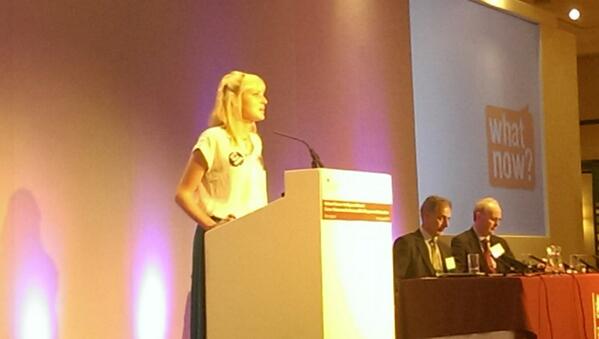
Kris#NCIN2014, Let’s talk boobs

Kris ‘story’ is well documented not least on an incredible documentary that has just been shown on TV “Dying to Live“.

Kris was 22 when she noticed lump.  She ignored for a long time. Eventually went to GP and told more likely to be hormonal.  Went travelling and noticed the lump was getting bigger. Returned to GP. Told nothing. Mum got involved. Returned to GP. 8 months after first going to GP was referred and told breast cancer and spread to spine.

1 in 15,000 chance of getting breast cancer under 25.

“You beat the odds in getting the disease and can beat the odds to get rid of cancer.”

2 months into treatment Kris researched why she didn’t know more about cancer at a younger age and what to expect.

She knew she couldn’t change her diagnosis but she could make it better.  Or as Kris said “You can’t polish a turd… but you can roll it in glitter…”

She kept hearing “Early detection is the best form of defence.”  Why wasn’t there breast cancer awareness in schools, universities, 6th form colleges?  Surely that’d lead to earlier detection.

So Kris thought about where she could reach these young people.   Armed with CoppaFeel! stickers set off to a festival.  Whilst facepainting with her twin sister people started approaching and talking about boobs.  Talking about breast cancer.  Talking about checking yourself.

CoppaFeel! are now a regular set up at music festivals, university campus and many other locations filled with younger people.

As well as Kris and her sister talking about boobs, there are now the Boobettes – young women who’ve been diagnosed with Breast Cancer.  They go into and talk at schools and events about their experiences and awareness and early diagnosis.

Kris has asked “What does BC mean to young people?” and got these answers (amongst others) – life-stopping, turmoil, depressing, threatening, damaging… not good and words that put you off from checking your boobs.
It is a very treatable disease if diagnosed early.

1 in 3 are diagnosed with cancer.  Early diagnosis is key.  #rethinkcancer is a campaign to bring cancer education into schools, colleges and universities.  “I know it will help and I know they want to know it… I’ve spent the last 5 years speaking with them.”

Put an end to late diagnosis of cancer.
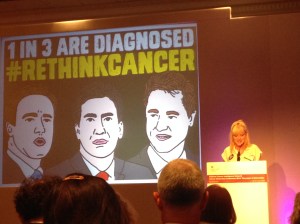
Kris Rethink Cancer

The stats of tomorrow are the young people of today… it can happen to young people. It should go through the mind or every GP and medical professional out there.

“If you have influence please use it. If you have colleagues please pass the message on. If you have boobs, please check them.

Think boobs.”

~~~~~~~~~~~~~~~~~~

Prof John Newton
Chief Knowledge Officer, PHE
Cancer – A public health perspective

Presentation

So many things to learn from what Kris was saying. Behind every statistic and data is a real person like Kris. This should be a reminder.

4 things we need to do:

  • Prevention
  • Diagnosing cancer early
  • Make sure very patient gets the best treatment
  • Care of people who are living with cancer, whatever the outcome

Struck by Cancer Research UK stats that 40% of cancers are preventable. There is a huge challenge but we as a population need to address it.

Good news is that we have the best treatment services and charities in the UK. We have some of the best intelligence systems in the world. The best Cancer Registry.

No doubt that cancer intelligence NCIN has played it’s part in improvements. More that we could do with the data to improve outcomes and prevent cancers.

How do we build NCIN in Public Health England to get even better outcomes?

Mission – “To protect and improve the nations health and to address inequalities working with national and local government, the NHS, industry, academia, the public and the voluntary and community sector”

Broken down into manageable chunks – outcome focused.

  • Helping people to live longer and more healthy lives by reducing preventable deaths and the burden of ill health associated with smoking, obesity etc
  • Reducing the burden of disease and disability in life by focusing on preventing and recovery.
  • Protecting the country from infectious diseases and environmental hazards
  • Supporting families
  • Health in the workplace
  • Promoting development of place based public health systems
  • Developing our own capacity and capability to provide professional scientific and delivery expertise

PHE’s jewels in the crown:

  • National Screening Programme
  • National Cancer Registration Service
  • National Cancer Intelligence Network.

PHE inherited some strong partnerships with many including:
National Cancer Peer Review and National Cancer Research Institute.

PHE have a significant local presence:

  • 4 regions, 15 centres
  • 8 cancer registration teams
  • Central coordination and analytical team
  • 8 knowledge and intelligence teams around the country

Track record of delivery is increasing….

  • National Cancer Registration Service
  • Completed the national migration
  • Data going out trusts
  • Published staging data
  • Cancer analysis system implemented
  • Prostate cancer data network

Our public health perspective:
NCIN

  • Be clear on cancer campaign evaluations have been carried out for lung, blood in pee, breast cancer in over 70s, ovarian, oesophago-gastric, lung reminder and local skin cancer pilot.
  • Analytical work by the central and knowledge and intelligence teams
    • 16 data briefings, 23 in depth reports, 9 press releases
      17 journal articles, profiles, toolkits, routes to diagnosis, workshops for clinicans…
  • New office for data release is established and now operational
  • Reports analytics from the page impressions on our websites show an increase both nationally and internationally.

Collaborative work:

  • Deprivation report with CRUK
  • Routes from Diagnosis with Macmillan
  • Less common cancers – Cancer 52

The patient portal:

  • NCRS and NCIN
  • Brians Trust
  • Cancer Research UK

Summary/Future Look

  • Cancer remains as a significant public health issue
  • Many national cancer bodies inside PHE brings definite synergies, some of which we are now seeing, but there is much more to do… we want your help with it.
  • Growing demands for our intelligence capacity
  • NCIN will grow and flourish as a partnership and as part of PHE’s integrated cancer programme.

Increasing value to assets whilst data, partnerships and resources continue to flourish and grow.  We need to work together to ensure that this data and these collaborations continue to demonstrate improvement for cancer outcomes.

~~~~~~~~~~~~~~~~~~

Sean Duffy
National Clinical Director for Cancer – NHS England
Progress on the delivery of optimal care for cancer patients in the new NHS

Presentation

Optimal cancer care in the new NHS – an absolute commitment to deliver services for better outcomes.

The survival challenge

  • Mortality improvements v survival gap
    • Although we’ve made gains in the survival in the UK. Other countries have also had improvements.  We need not to equal the other countries improvements but to ensure our improvements are greater.
    • Eurocare 5 (2013 analysis of 2007 data)
  • Stage at presentation and earlier diagnosis.
    • We need a cultural and system shift to lead a stage shift.
    • Primary care interface – % flows
      • GP direct access to tests. Does it make a difference. On average access to test should make a difference for 6% cases. BUT hides 15-20% for cases such as stomach, ovarian, pancreas, renal, brain.
    • Route to diagnoss, England 2006-2008
      • All cancers emergency presentations 24%

Ownership of treatment decision
We should ask every MDT in every hospital to look at least once a year at the decisions it has made (treatments) and what it has meant for its patients (outcomes).  By revisiting these decisions they may be able to see improvements or identify changes that need to be made.

National datasets for cancer should enable the work – chemo, radiotherapy and outcomes data
National audits need to be used more.
Transparency is essential

12 senate geographies for the cancer map. If they took a grip of their own survival curves then we could be in a better position.
Plea – Own your 1 year survival and work collaboratively together.

Selection bias

  • Age and outcomes
    • 34% of 80-84 and 43% of 85+ are diagnosed via emergency route compared to 25% of 70-79 year olds.
  • Age and treatment
    • Access to treatment of the older population is variable. There is an age bias that exists and the data sets demonstrate this. Not just for surgery but also chemo, radio and access to a cancer nurse specialist.
    • Perhaps there could be a co-morbitity and late stage diagnosis but not completely responsible for decline in survival in older patients.
    • Older patients get less chemotherapy delivery for colorectal patients.

Structure

  • Key factors that influence greatest impact is access
  • The question of volume and outcomes
  • Community of care, not individual or isolated providers
  • Redefine the model – ideal structure within given senate geographers based on IOG principles and evidence.

What is best and where?

Summary

  • Gap in survival to tackle together.
  • Effective plan for early diagnosis to ensure the front end of our health care system delivers what you need it to.
  • Local MDT and senate geography focus on outcomes as a result of treatment decisions is vital to improve survival.
  • There is an inherent age bias that if tackled could yield significant survival benefits.
  • The evidence for volume linked to survival outcome cannot be ignored.

Q&A

Q (Kathy – London Cancer Alliance) – What has happened with the key recommendation in 1995 re early diagnosis?  Ambition was to go much further than they did at the time. The data at that time wasn’t as robust as at the moment. We have to be driven by the evidence. Any change moving forward has to be with improvements.
A (Michael CR_UK) – Are you talking to your colleagues in Scotland Wales and N Ireland about how to tackle the problems as a UK wide problem?
We are an English organisation but we are doing as much as we can with the UK. Spoke last week with the Welsh Health Minister (who are producing a white paper which is very interesting). Certainly on research we are very keen to work across the UK. Every reason and possibility of working across the UK not just England.
Julia Vern NCIN public health lead – UK and Ireland Association of Cancer Registries – absolutely a priority for all of us.

Q (Bob – Former NHS professional and lay rep) – Where is recent data?
A – Pointing you to the right person for the data question.

Q (Ian – Patient) – Emphasis is always on the clinicians rather than the patients. If there was more of a focus on the patient not the clinicians then I think you would see more survival times. Supporting stop smoking, diet etc particularly those of the poorer socioeconomic groups.
A – I think you’re right. Workstreams should be looking at exercise and other actions as a joint initiative between NHS England and Public Health England.
Approach moves away from a health service that provides testament for someone who is ill, rather than helping patients help themselves before they become a patient… it needs collaboration with charities, education and health care systems.

Q (Ms Clifton – Clic Sergeant) – Early/late diagnosis. GP dismissal of patients. Is any research done on looking at the reasons for late diagnosis or sending for tests in primary care?
A – How long have we got? There is a lot of research and simple things that primary care have developed to be more proactive. Got plenty to base a plan and are working on it. Key for me is that this is about public and primary care behaviour. The new changes should enable us to have more conversations and changes in this area.
Kris – We ran a focus group with some GPs. Reduction of the younger patients and also looked at the flip side of empowering patients about what you expect from a GP visit. Makes a huge difference.

Q – (Sara Hyams CR_UK) – Pick up on the age issue. How do we get more on the agenda for early diagnosis of the younger patients? i.e. under 30. How can we also improve things at the other end of the scale too?

Q – CCG – when would staging data be available to CCG levels?
A – Staging data has already been published. By CCG I understand it’s going to be June. NCIN is publishing it later this month.

Q – Health intelligence officer – I’ve got a 23 year old daughter. All this activity around data and intelligence isn’t worth anything unless it is used for the benefit of the patients.

~~~~~~~~~~~~~~~~~~

Plenary 1 – Outcomes for young people with cancer: matching commissioning guidance with the evidence

Martin McCabe
Chair of NCIN Young Patient Oncologist

NICE guidance on improving outcomes for young people and children with cancer.  (“CYP” children & young people)

  • Care co-ordinated as close to home as possible
  • Networks should meet the needs of CYP with cancer
  • MDT should provide cancer acre
  • Each CYP with cancer should have a key worker
  • Care appropriate to CYPs age and type of cancer
  • CYP with cancer should be offered the chance to take part in research trials
  • Treatment should be based on agreed protocols
  • Sufficient specialist staff
  • A register of all cancers in people aged 15-24

National Registry of Childhood Tumours
Established in England, Soctland and Wales in 1962

Childhood cancer isn’t well fit with ICCD coding so they have their own code. Birch coding.

TYA cancer
Teenage and Adult with Cancer TYAC founded in 2004.

In children cancer is always rare. Rare because it’s found in a child or because it is rare anyway.

Looking at survival AND important is quality of survival for children and young people.

Treated at a Principle Treatment Centre… but what happens when they’re referred out of the PTC?

One of the main advancements in childhood cancers is the enrollment of children into clinical trials. New paper from NCRI to be published very shortly which demonstrates this.

~~~~~~~~~~~~~~~~~~

Kathy Pritchard-Jones
UCL London Cancer
Paediatric clinical outcomes research – UK policy and the role of the European Network of Cancer Research in Children and Adolescents – early diagnosis

Talking about the European agenda for paediatric cancer clinical outcomes research.
ENCCA European network for cancer research in children and adolescents 2011-15
SIOP European standard of care for children with cancer
ExPO-r-NET European Expert Paed Oncology Research Network for Diagnostics and Treatment

Outcomes research

  • Outcomes seeks to provide evidence bout which intervention work best
  • Study of the end results of health services to take account opatients experience and costs to society
  • Provide scientific evidence

NHS Outcomes of framework

  • What can we really measure that is important to patients?

ENCCA – in 4th year of operation

  • Building a strategy to enable biology driven clinical and pre-clinical research. Tissue sampling, biobanking and sharing tissue across boundaries, training for clinicians, researchers and scientist. Long term sustainability of encca is bringing together national paed and cross cutting research groups to take it forward.

Why has overall mortality for children with neuroblastoma in the UK worsened?  Is it because there’s no trial currently open?

Infants with cancer have the highest rate of early mortality. Can we improve their model of care?

Equal access across Europe. Appointed by DG-SANCO to pilot how cross-border research can be done correctly?

Collaboration, defining entities, regulatory, embedding teaching and research.

~~~~~~~~~~~~~~~~~~
Tony Moran
Public Health England
Survival trends for young patients in the UK – the good and the bad diagnosis

Background
Lower survival in UK than several other countries
Rate of improvement slower in TYA than other age groups?

[Once the presentation is available, I’ll upload it here]

~~~~~~~~~~~~~~~~~~
Kathryn O’Hara
The Christie NHS Foundation Trust
Referral to and from specialist Centres- how widespread is the practice?

Presentation

Normal for 0-14 year olds to be under the principle treatment centres classified by extent of shared care. It’s not consistent in all areas.

~~~~~~~~~~~~~~~~~~

Plenary 2 – Living with and beyond cancer
Heather Monteverde
GM of Northern Ireland with Macmillan Cancer

Presentation

Considering living with and beyond cancer is a newly adopted consideration… relatively. So many changes within cancer with chemo, radiotherapy, surgery etc.

Consequences of treatment or late affects have a huge impact on the quality of life of people living with and beyond a cancer diagnosis. This also needs to be addressed. The physical as well as the emotional and psychosocial issues.

~~~~~~~~~~~~~~~~~~
Raoul Reulen
Uni of Birmingham
Teenage and Young Adult Cancer Survival study

Approx 225,000 5-yr survivors
Population based cohort
Diagnosed 1971-2006
Age 15-39
Covers England and Wales

Study link

~~~~~~~~~~~~~~~~~~

Matthew Francis
Public Health England, Knowledge and Intelligence Team, West Midlands
Method of identifying stage IV cancer

Presentation – please refer for charts and graphs.

Matthew spoke about the differences in staging sarcoma compared to other cancers.  The usual methods of staging include tumour size, nodal involvement and if there are any distant metastases identified.

With reference to sarcoma patients only 2% of those diagnosed with stage IV actually comply with these staging rules.  This makes it increasingly difficult to make comparisons and potentially contribute to a less favourable outcome.

In addition the rarity of sarcoma:
450 bone sarcomas new diagnosis
2,800 soft tissue sarcoma new diagnosis
less than 1% of malignancy
occur in different anatomical locations.

Detailed staging data is not available for patients with sarcoma.

Metastases site recording in HES can be the only identifier but this information isn’t always recorded.

4,602 new cases of bone sarcoma
20% of had metastases at diagnosis
27,913 soft tissue sarcoma between 2000-2010
3,602 13% had metastases

Soft tissue sarcoma – some sites have space for growth i.e. abdominal or breast where the tumours have space to grow and therefore not diagnosed as quickly i.e. may be identified at diagnosis with metastases.

Conclusions
Staging data for sarcoma is incomplete.
Those with metastases have significantly poorer outcomes.
The methodology used to identify stage IV sarcoma patients could be applied to other cancer data sites and assist the National Cancer Registration Service.

~~~~~~~~~~~~~~~~~~
Chris Brown
National Cancer Registry Ireland
Using routine prescribing data to identify comorbidities in ovarian cancer patients

Presentation

Please refer to the slides and data of the presentation.

~~~~~~~~~~~~~~~~~~

Plenary 2 – “Show me the data!” – information and intelligence for your ovarian cancer service

Chair: Annwen Jones
Target Ovarian Cancer

Presentation

Ovarian cancer outcomes could be improved. NCIN has provided hard evidence that outcomes can improve and also provided data and insights to shape policy and practice.
7,000 cases diagnosed each year
3/4 of cases aged 55 years and over
4th most common cause of death from cancer in women
4,300 women die each year
Late diagnosis is a major issue

Before 2007 (i.e. before NCIN) we had very little and incomplete data that was also unreliable.

32% of women diagnosed with ovarian cancer via admission to A&E v 24% of all cancers
15% of women die within two months of diagnosis.

Pathfinder Study – Target Ovarian Cancer – 2009, 2012, 2015… ongoing study.
Looks at patient delay, GP delay and system delay.

[Key findings published to date click here]

International benchmarking partnership (ICBP):
1 yr survival for ovarian cancer in England lags behind comparable countries
5 year survival difference results from 1 year difference. In England we do quite well at this point.

Data shows that there are wide regional differences in survival.

What is the underlying cause of variation and what more can we do to improve survival for all women with ovarian cancer? What does the data intelligence that we currently have tell us? What further data do we need?

Put patients at the heart… policymakers, patient organisations, commissioners and clinicians around patients.  The patient must be central.
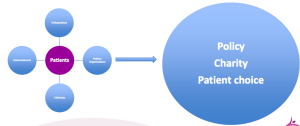
Screen Shot 2014-08-18 at 13.14.34

The value of data to patient organisations:
Policy – impossible to influence policy without robust data.
Charity – we have to make sure that we’re spending the donations wisely. Data helps make decisions and priorities as a charity.
Patient choice – patients with a voice.  Personal note – it was wonderful to see the faces of patients on Annwen’s slide particularly that of my gorgeous smiling friend, Tish, who I miss so very much.  Tish was such a wonderful patient advocate for Target and others diagnosed with ovarian cancer.

~~~~~~~~~~~~~~~~~~
Dr Andy Nordin
Chair NCIN Gynaecological Cancer site specific clinical reference group
Ovarian caner in the UK: the emerging picture

ICBP – opportunity to compare outcomes with other high quality data countries such as Australia, Cancer, Denmark, Norway, Sweden 1996-2007

Gynae cancer hub with NCIN run through of projects carried out.

Results are improving in younger women but data identified that it hasn’t improved in the older patients. NCIN were then able to look at this area too.

Routes to Diagnosis in November 2010 we all know was that a great many people present as emergency presentation… ovarian is one that indicates this highly.

Short term ovarian case mortality:

  • why the elderly
  • late presentation
  • reluctance for referral
  • performance status
  • patient preference
  • access to specialist surgery
  • access to chemo
  • national variation

There needs to be more specialisation at a surgical level.  To look at the number of consultants by caseload and acknowledge that they should be doing more than 15 cases per year.  This surgery should NOT be undertaken by general surgeons but by specialist surgeons in specialist centres.

More use should be made of the cancer e-atlas

~~~~~~~~~~~~~~~~~~
Jason Poole
Associate Director, Public Health England
Short term ovarian cancer mortality in and across England

ICBP
Early results 2006-2009:
5288 women 31% died in the first year
2,592 died in first 2 months

3 contributory factors:
emergency presentation
advanced age
non-specific tumour morphology

case-mix analyses

  • women 2008-2010 resident in England, ages 15-99
  • data from national cancer data repository
  • HES inpatent and outpaitient
  • Ovarian cancer including fallopian tube and primary peritoneal cancers
  • Excl borderline tumours, sarcoma, germ cell tumours
  • 15,000 women in analysis

Patient outcome – excess mortality ie over and above ‘normal’ population mortality
3 periods of analysis – diagnosis to 1m, 1mto 6m; 6-12m

case mix factors

  • age groups
  • deprivation quintile
  • comorbidity
  • route to diagnosis
  • stage
  • morphology
  • treatment
  • basis of diagnosis

~~~~~~~~~~~~~~~~~~
Dr Rob Gornall
Clinical Director Cancer Services
The challenge of improving cancer services by commissioning pathways – the increasing value of data

Presentation

Rob’s presentation reiterated a great many of the points earlier regarding early diagnosis, variation in primary and secondary care services, complex commissioning pathways, patient behaviour and perception of risk.

Please refer to the presentation for more data on the above but please note there are graphic photographs.

~~~~~~~~~~~~~~~~~~
Louise Bayne
CEO Ovacome
Robust data – the value to patients and patient organisations of the NCIN

Why is the NCIN data required and quality of it so important?:

  • demographically representative
  • statistically significant sample size
  • non biased enquiry motive
  • highly skilled practitioners
  • published in full

Without NCIN data, charities need to look inwards for data sources and information. That has intrinsic problems about it.  Attract a sub-set of the cancer community who are not representative. Might be questionable motives as to why a charity has come up with a news story or report.

Why does this matter?

Data is used for:

  • NICE decisions on access of treatments.
  • shaping research proposals
  • commissioning
  • advocacy programs
  • patient information
  • individual treatment choice

Without excellent data patient organisation activities risk being characterised as:

  • opinion drive
  • biased
  • questionable motives

Leading to:

  • wasted resources
  • lobby fatigue
  • harm to misrepresented clinical sectors
  • poorer outcomes for community

Making the data count

  • Quality profiles – annual report using NCIN/DH data to provide a local picture of service/standards
  • Available on the Ovacome website
  • Parliamentary outreach day with Ovacome members lobbying their MPs
  • Circumvents clinical gagging clauses
  • Puts clinicians in the driving seat – we don’t say what’s to happen – clinical empowered to suggest improvements
  • Last year resulted in Secretary of State intervention, improvements to the data collection, the recruitment of clinical staff and improvements in clinical service (in one centre the development of a GP helpline)

The drive to improve diagnosis:

  • the majority of women have advanced stage disease at diagnosis
  • received wisdom – ovarian cancer is a silent killler – only symptomatic at advanced stage

But the studies said differently….

Using data for improving diagnosis:
BEAT campaign Bloating Eating Abdominal Talking.

Survivors teaching students

Commissioning – why NCIN is now essential
Commissioning challenges us to consider business as usual or optimal practice
To drive improvement trustworthy data is essential
However gaps in data remain a challenge

 

Polo in the Park

Family day at the Polo in the Park, Hurlingham Park, London started at 11.30 this morning when I was first in line to get into the Park with some rugs and suntan lotion.  I found a spot right by the pitch sideline and spread the rugs out.  We were near the children’s area, a short walk from the toilet block and in the other direction the food and drink outlets.  Perfect spot for a day at the polo.

Via an offer of substantially discounted tickets on LivingSocial we managed to round up a few friends with and without families for a day at the polo.  There was plenty of activity on the pitch for the children whilst everyone arrived – huge great big bouncy castles, children entertainers, games and sports competitions.  This was followed by a jousting display (gosh they must have been hot in their outfits!) and then the first polo match between Beijing and Sydney.  The polo play had been slightly simplified for Hurlingham and because of a smaller pitch they also only had 3 players on each team.  This didn’t however stop the fast and furious play on the pitch.  Throughout the day there were three different matches with little breaks for us and, of course for the polo ponies and teams.

So lovely to spend the day with some very special people drinking Pimms, enjoying lots of chats and conversations and, of course, watching some great polo.  A little hot at times for us all and I, for one, have an ‘interesting’ red-tinged tan!

I think this collage of pictures sums up our day beautifully.

Hurlingham Polo

An amazing day with amazingly wonderful friends.