Phyllodes Support Group

One of the things I don’t often blog about in great detail is our patient-led Facebook group, “Phyllodes Support Group“.  You will recall from the beginning of my journey (still don’t like that word but haven’t come up with a better one yet!) that I found myself feeling alone and isolated with a diagnosis of Phyllodes.

I remember the fear when I was told that there is no/little information available for patients; no completed clinical trials or reliable data; no ‘specialists’ in the World and a varying degree of myth and misunderstanding on the Internet.

Our Facebook group has now been ‘found’ by over 500 members and grows almost every day.  We’re from around the World and have differing ‘success’ with medical teams knowing about Phyllodes, the treatment and outcomes.  So our group, I believe, has been critical to each and every member.  We share experiences, information and resources.  We ‘hold each others hands’ at times of anxiety and worry.  We have created a database of all the journals and papers ever written about Phyllodes.  We run polls of our members to find out the age of diagnosis, the prevalence of benign, borderline or malignant and much more.

We also have a poll that asks members where in the World they are from.  This poll has allowed us to be more specific with some information and support by sharing local ‘sarcoma protocols’ or similar.

There are 4 administrators/moderators of the group.  We live in different parts of the US, Italy and me in the United Kingdom.  For my part I try to befriend the members from the UK and share with them more local information that may be useful.

Today was no different.  I’ve been speaking with a new member of the group who was dissatisfied with her local hospital.  They had said they knew it was Phyllodes and how they were going to treat it – ‘watch and wait’ – despite it growing rapidly.  It was suggested that she get a referral to the Royal Marsden for a second opinion.

This morning I met up with her and her husband at the RMH before their appointment.  Inevitably there were a heap of questions they both had before their appointment (and ones they’d not wanted to ask in the group).  I hope my company was of value and comfort to them both.

I know I would have loved to have found just one other person with Phyllodes in the UK that I could speak to when I was diagnosed.

Neurology Appointment

Finally, after several visits to the GP I have now received an appointment with a Neurologist.  I have been extremely concerned as I’ve had a headache for many months that barely seems to dissipate.  Not always delibitating but sometimes it’s accompanied by a visual disturbance so that I can’t read, see a computer, watch anything and feel nauseous.

Recently, my GP ran a number of blood tests to see if they could find anything awry that may be causing the headaches.  My GP tells me that two of the tests have come back with extremely high results but on their own don’t tell us enough but could be an indication of a number of different ailments. Oh joy but hence my referral to the experts!

The consultant I saw today was extremely thorough.  A long questioning followed by some visual and physical tests.  He then asked that I follow this appointment with ‘a few’ blood tests and also referred me for an MRI of my brain.

I don’t mind saying that some of my concern relates to my phyllodes – could it have spread to my brain?  I also know that might make me sound paranoid but it’s a concern that keeps popping up.  However I’m also aware that I’m getting to that age when my body is changing and these changes have different impacts on my health!

The nurse nearly passed out when I handed him my blood test forms… after a short while he counted them up and suggested I make myself comfortable whilst he takes 17 vials of blood!  Wowza, we needed to find a second vein to complete the drain!

Now to wait on the blood test results and the MRI appointment.

Why Walkactive?

It’s been quite a while since I did my first introductory course at Champneys and I was asked to write a piece about my Joanna Hall Walkactive experience.  I thought you might like to know what I think and why I’ve carried on with it.

The period following my diagnosis with a rare cancer, Phyllodes, I was consumed with appointments, scans, surgeries and just plain coping. Exercise and fitness had taken 2nd or perhaps 7th place and the further down the list it slipped, the harder it felt to regain it or any control over it.


We read and hear daily from the media about the benefits of healthy eating and exercise. We also hear a great deal about it being critical in recovery from illness. However translating the knowledge into action, particularly when you’re feeling unwell, fatigued or in pain is another thing entirely.


I had needed the impetus and encouragement to regain my fitness. I found this with Joanna Hall. It made ‘exercise’ less of a chore and more of an enjoyment. I’ve discovered new parks, new parts of parks, different routes to the shops and even when it’s windy and rainy, a wonderful sense of being alive.


My first foray was at a spa break where I learnt the technique and was introduced to Joanna Hall. I then refined it by sporadically taking other courses as I feel it helps motivate me, kick starts a new phase, eliminate any bad habits and also brush up on my technique.

Walking is a fabulous free accessible activity that can be done at any time of day or night! Add the Joanna Hall technique and scientific methodology and you can increase your well-being and fitness whilst also reshaping your waistline, tums, bums and thighs.


I have found that instead of jumping in my car to visit friends, post a letter or buy a pint of milk, I now put on my trainers and “Joanna Hall” it out of the front door.

Over the past 18 months I’ve completed most of the courses and trips too! They’ve all been fun and beneficial but perhaps in different ways and meeting different needs at different times.


WOW – Being measured at the start and end of the 4 week course motivated me to stick to the nutritional aspects of the course as well as the walks. There’s no better motivation than ‘literally’ seeing the inches disappear and be replaced by a waist!
WOWI – A 2week version of the WOW. Intensive, needs commitment to dedicate the time but a great way to kickstart.
WalkFit – 4 week course concentrating on technique and increasing pace.
WalkFirm – 4 week course which incorporates not only the Joanna Hall technique but also utilising park equipment for additional exercises such as benches, stairways and fences.
Spa breaks – A gentle(r) introduction to the Joanna Hall technique with workshops on nutrition and fitness balanced with walks and spa treatments.
La Manga Training Camp – A comprehensive timetable of techniques, improvement time trials, mountain challenge, yoga, stretches, nutrition workshop and sunshine.


Sometimes ‘life’ gets in the way of being good and doing exercise. I’m pleased to say that it’s mostly ‘life’ rather than ‘cancer’ these days. But despite not currently doing any courses (life is a bit busy), I hope you can still see the ‘open ankles’, longer strides and incorporated ‘J’s as I dash for the bus!

All change

In my posting in July I mentioned that I had asked my wonderful consultant about referring me to The Royal Marsden hospital’s sarcoma team for my follow up surveillance.

At 2pm today I had my first consultation appointment with the sarcoma team at The Royal Marsden. The waiting room was absolutely packed and I waited nervously for my name to be called.

I was concerned that they wouldn’t take my case on but that I had sort of ‘discharged myself’ from my previous consultant’s care. I was worried that they would perhaps think I was over anxious about follow up scans or perhaps that they would recommend I stay with my existing hospital. I was concerned that although they are a centre of excellence for sarcoma in the UK, that the person I was assigned wouldn’t know about Phyllodes – after all there are over 70 different sub-types of sarcoma.

So despite my waiting only a very short time, I was more than a little anxious. Had I made the right decision in asking my lovely consultant to refer me? Would he take me back if I hadn’t? What would I do if they didn’t take me on as a patient? What would I do if they changed my follow up surveillance schedule in a way that worried me more?

Phew, I’ve been called.

I first met with the nurse who explained what would happen and who I would be seeing. She then left me in the little consulting room whilst I waited for the Registrar. Seemed like ages and once again all my anxieties were kicking in. The Registrar then arrived and ran through my medical history and also asked about my siblings, parents and grandparents’ medical history. She also told me that my case had been discussed at today’s MDT (multi-disciplinary team) meeting in detail.

And then, she asked the question that I was most worried about answering… why was I here and what did I want from the Royal Marsden? So I told her why (see previous post) but I also told her about our Facebook “Phyllodes Support Group” and what I’ve been doing with Living Beyond Diagnosis. She asked a few more questions and then said she’d return with the consultant.

I was then left in the little consulting room on my own… and yes the little voice in my head was once again telling me that they wouldn’t have me as a patient etc etc.

I was terrifically grateful when the door opened once more and the Registrar came back into the room accompanied by a consultant. He introduced himself and we spoke briefly about me, my medical history, why I requested the referral and my previous care.

He then asked more about the Phyllodes Support Group and was terrifically impressed with the number of members, the information and experience sharing, the documents and reference papers that have been collated and also the polls and data that we were collecting and sharing within the group. He also said that he felt that should we, as a group, wish for some assistance or input for the group, then I should just ask and he would try to facilitate this for us.

I was also able to tell him about the report that is currently being finalised containing a section about Phyllodes from the contact I have met at two Cancer data conferences in the UK. He would love to see a copy of this when published.

It goes without saying that I will be looking at what input will be useful from RMH and also what we can provide to RMH from the group… certainly it would be fabulous to have a medical facility, who specialises in sarcoma, to take an active interest in the group members and their health. Watch this space!

We then returned to my health and monitoring for recurrence or metastases from the excised malignant phyllodes tumours. We agreed that my previous consultant had done an excellent surgical job in removing both of the tumours and then ensuring that sufficient clear margins were obtained. He agreed with the advice that I should not have any adjuvant radiotherapy at this time. He also agreed that the screening regimen implemented in my previous hospital was the best to quickly identify any local recurrence (together with my own personal checks). We then spoke about any requirements for any additional screening/surveillance for possible metastases, particularly with regard to the malignancy and mitoses of the excised tumours. He suggested and has requested that I have a 6-monthly chest x-ray at the same time as my existing scans ie annual mammogram with intervening 6 monthly ultrasound of both breasts.  This chest x-ray will be looking for any traces of naughty cells in my lungs.

I left RMH this afternoon feeling that I had made the right decision to ask to be referred. Perhaps I should have made the request at an earlier stage and saved myself some levels of anxiety along the way.  But I also know that I couldn’t have managed to do that before now.

I am, of course, sorry that I won’t be hearing my, now previous, lovely consultant refer to me as ‘Miss Lumpy Bumpy’ again but I’m so very grateful for his care up until now and can only say that whoever the patient is who gets my slot on his busy schedule is a very very lucky lady.  Perhaps I shall pop in with a box of biscuits for him and the team when I’m next passing my old hospital.

So that’s it. Next scans/checks are in January. Between now and then I’ve got a number of cancer conferences to attend, not least the annual Sarcoma conference which this year is in Italy. They were asking for patient advocate attendees to speak at the conference and I’ve put my name forward.  I would love the opportunity to tell them all about our Phyllodes Support Group and also about Phyllodes itself, in the hope that perhaps more medics and researchers will be more aware and knowledgeable.

3 years and I’m still having a momentary panic!

Even in a tent with post-festival fever, I still awoke remembering the panic that I felt 3 years ago today.  Genuinely startled once again at remembering that moment when I was getting ready for Mum’s funeral that I felt the first lump… ‘we don’t have cancer in our family’, ‘it can’t be happening to me’ and ‘WTF do I do now?’.  Thank God I’d had a friend who’d lost 3 family members to cancer, awake and able to be the voice of reason at 6am that day.

Anyway, not ready to face the other remaining ‘campers’ I did what I do most mornings before getting out of bed… reach for the phone and check my email, social networks and support groups.  Sort of wish I hadn’t today.  No that’s not true.  Sort of wish I’d read something different.  The lovely Gwen passed away in the small hours of this morning.  Like many in the support groups, we’d not met in person but at different times had been in touch daily and shared parts of a very long road together.  Another fabulous young person with a zest for life cut short by cancer.  I, like so many, will miss the pithy comments and crazy Scottish phrases.

As for me, I know I’ve got to be vigilant about checking for lumps and I’ve just received my referral to The Royal Marsden Sarcoma team.  I’m still hugely nervous about my choice to leave the incredibly wonderful care of my lovely consultant at Kingston but know it’s the right thing to do to be with a specialist sarcoma team rather than the breast cancer unit… however it does feel a little like I’m on the cliff edge and hoping for no gusts of wind!


(PS I will write an entry for the festival shortly… just not truly in the mood to be upbeat!)

Whoohooo, the results are in and it’s good!

I can’t tell you how sick I felt today going to the hospital. Why? I should be used to it by now. … shouldn’t I? The anxiety levels were through the roof as I tried to find a parking space in the car park. As I was cutting it fine, arriving only a minute before my appointment time, I decided to only buy 1 hours car parking (at a mere cost of £2.20/hr). Rushing across the lengthy car park and nearly coming a cropper as I missed a pavement, I rather launched myself into the clinic!

After checking in, I settled down and waited. And waited.

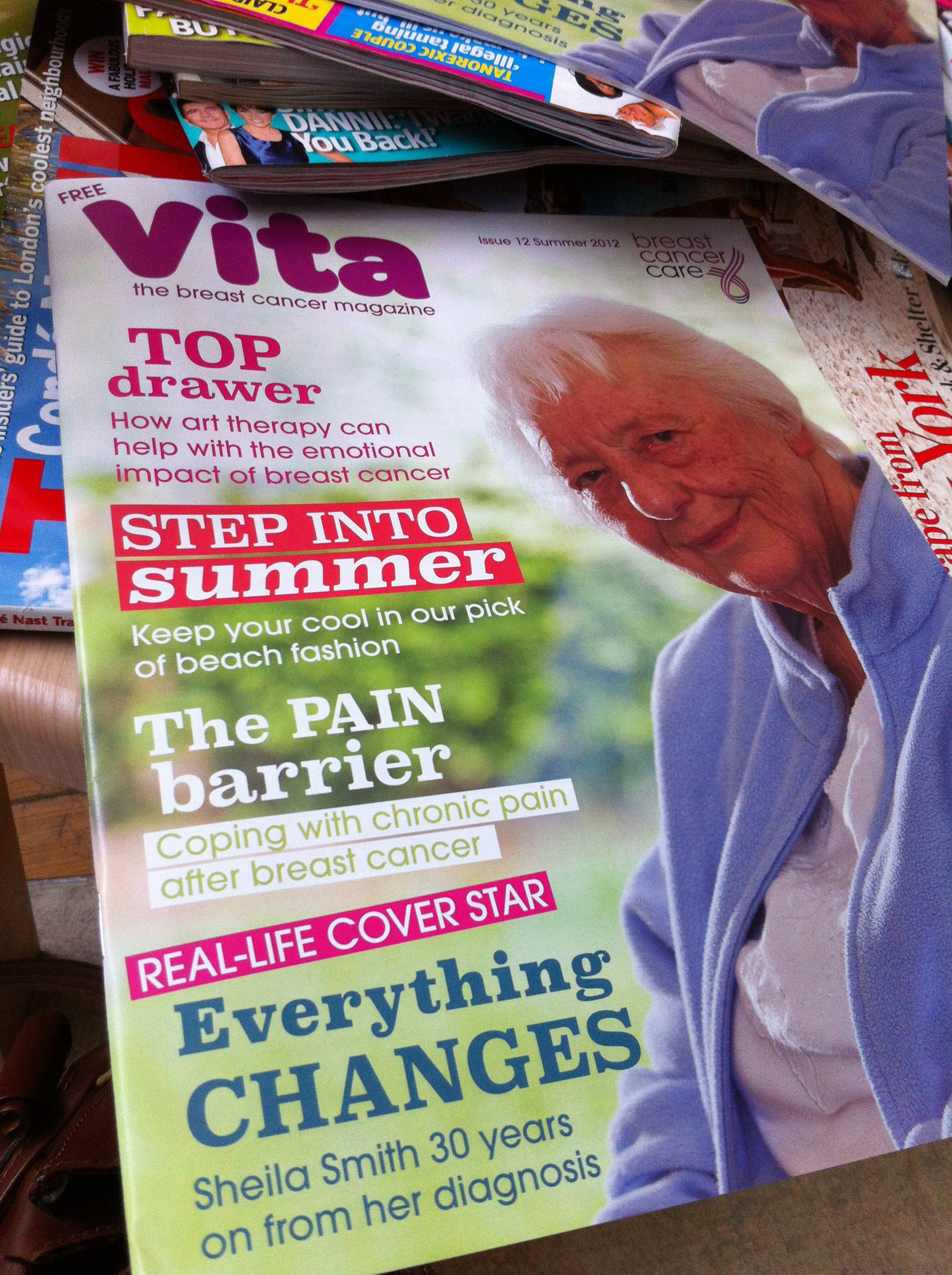
I realised though that actually I’d been spending far less time in this particular clinic of late… well there were magazines I’d not read, so that’s got to be a good sign. Right? They even had the latest Vita, which is a magazine produced by Breast Cancer Care and a wonderful source of information and support for anyone with primary or secondary breast cancer (and their carers).


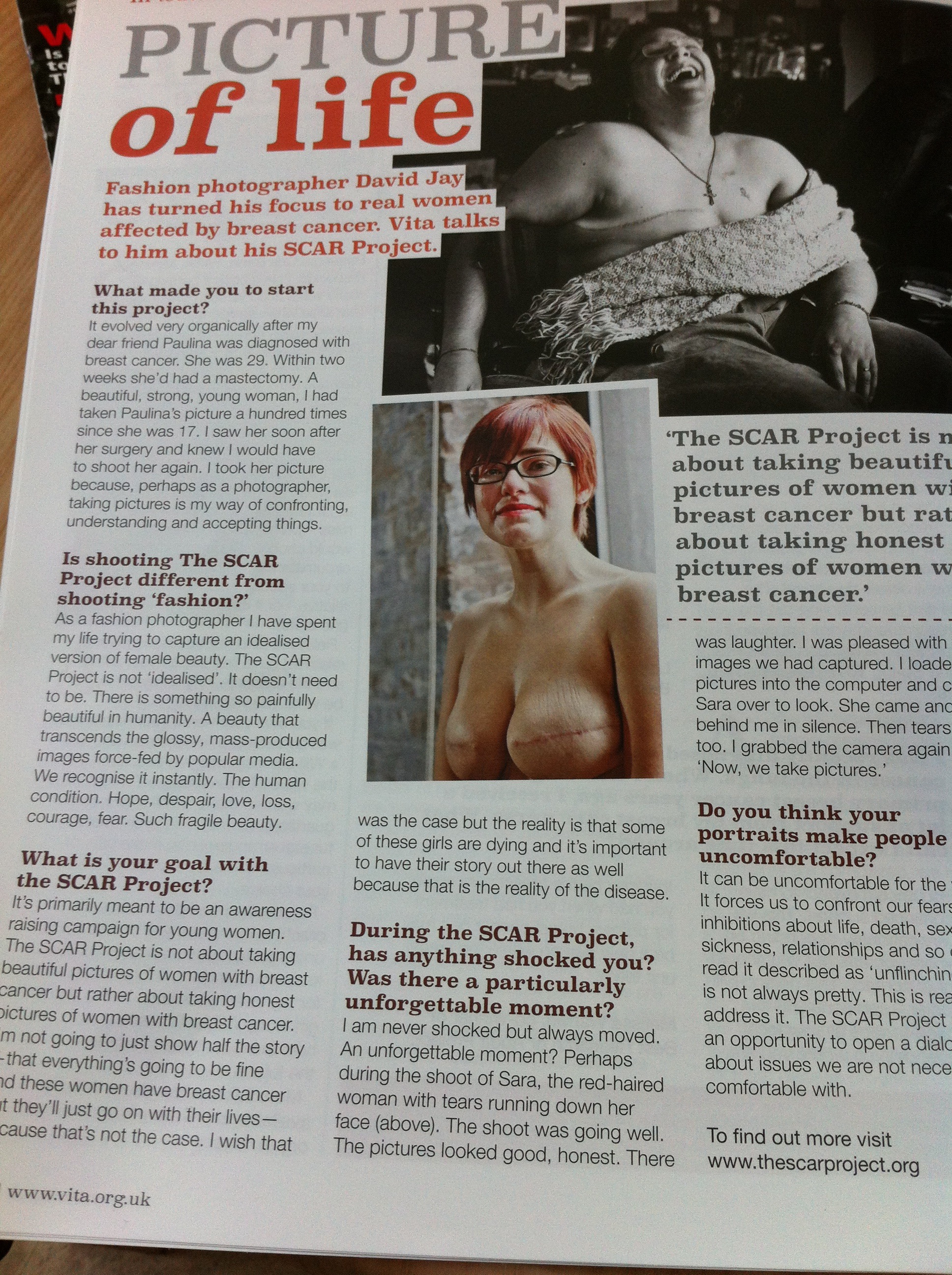
I was also super-chuffed that there was an article about David Jay and The Scar Project. Love that project and am so honoured to have known Jolene and others who have taken part and shared their journey through the images. Incredible.
After an hour, I rushed out to put more money in for another hour parking…. And of course half way across the car park the heavens opened!

Seriously though, the cost of car parking in hospitals is absolutely mental and for those of us who have to visit hospitals regularly, is a real cost burden. As I made my way back to clinic in the rain, I thought I’ve probably had over 50 hospital appointments since 2009 and each of them cost roughly £4, that’s £200 I could have spent on champagne!!! (Oh I mean saved for a rainy day)

Anyway I think the trip to the car and my attempts at mathematics helped me get some perspective about my appointment. It wasn’t long afterward that I was called in to see the consultant and get my results.

I was shown into the ‘good room’ (ie not the room of doom), which helps enormously. A few minutes later, my consultant appeared with a smiley face and welcomed me warmly. Seriously, if there are any medics reading this, you could really learn from this man – how much easier is an appointment and our anxiety levels when someone is genuinely warm and welcoming?

We had our usual little chat, he told me I was looking well (another point for the medics!). Although to be fair, I’ve also learnt that I need to make the effort when I’m anxious.. always matching underwear, shoes, nails, hair done and make up applied.

We then talked some more about Phyllodes, what it is, what I’d learnt, what he’s learnt and what he’s telling his trainees. It’s always so encouraging to think that by my diagnosis and it being weird and rare, he’s taken that (and with my encouragement) and ensuring that there are going to be some medics of the future that know a little bit about it. I always hope that they get eager to learn more.

Next the manual examination. Once again I could commend him on his surgical handywork. The scar tissue is getting less and the excision site becoming more even. We talked about ‘evening up’ by surgery and it’s good to know the offer is there and he’d do a fabulous job… but I’m not ready for surgery again anytime soon.

Then I broached the ‘difficult subject’. As you will all know from reading my blog, I can’t be any happier with the way my consultant has looked after me, managed my case and helped me through this, supporting me every step of the way. However there have been the blips with the radiography department where they don’t necessarily understand about Phyllodes nor feel checks are necessary (or as has been mentioned “it’s not as if you’ve got breast cancer”!).

Anyway, the bottom line is that as someone diagnosed with Phyllodes, a rare soft tissue sarcoma, my case should have been referred to a sarcoma specialist to manage. However I’ve always been more than a little anxious to leave the fabulous care of my consultant. I still am.

But today I asked him if I could be referred to the Royal Marsden in London for my follow up regimen. I explained why I thought it was important to be with a sarcoma team and also a team that I know have other Phyllodes patients and understand them and the best treatment etc. I also told him that I was sorry I couldn’t still be seen by him sometimes! It does seem right though that I move on and my place in the breast cancer unit is indeed filled with a breast cancer patient. He’s a truly wonderful consultant and surgeon and whoever fills my slot in his busy schedule is indeed a very fortunate person.

He agreed that this was probably the best thing. However has said that if ever I’m worried or he can help in anyway, then to give him a call.

As I left, he put his hand out to shake mine and then laughed and said he felt it more appropriate to give me a hug!

On the way home in the car I shed a tear or two. I’m not sure if it’s because I’m scared if I’ve done the right thing. Am I leaving someone who I knows cares about my wellbeing and health and stepping into the unknown or am I leaving him but going to a more specialist unit that will be able to add Phyllodes expertise as well as care?

I hope I’ve done the right thing.
Urology consultant appt

I was determined that today was going to be my last and final visit to “the mortuary”… but not before an open and honest discussion was to take place between myself and the consultants. With all the tests I’ve had over the past 18 months from CT scans, endoscopy, colonoscopy, gastroscopy and more ultrasounds than I could shake a stick at… I’ve had enough.

I’ve had enough of waiting rooms, endless letters, grumpy self-effacing doctors that don’t listen, being prodded and poked, having to find friends available to pick me up following any procedures, hospital car parking charges, and… ooh I could go on!

As someone with an NHS frequent flyer card, I’ve had over 24 hospital and GP appointments since my first ‘obvious’ symptoms ie blood.  My first appointment was with my GP and he referred me to for an urgent gastroscopy – such a shame that this appointment at the hospital didn’t happen for some 7 months!  Instead I was passed through many departments and had many more tests.

I will now write the posts that I should have written during my journey with this little ‘hiccup’. Until now I’ve felt let down, depressed, anxious and worried that the symptoms were in fact all pointing to a metastases of cancer… but without feeling as if any of the tests or people I was seeing were listening or really gave a monkey nut about finding a solution.

I’ve been passed from pillar to post and between three hospital sites that all (allegedly) are the same medical unit but really don’t speak to one another or share notes. I’ve had to remind all but 2 hospital consultants that I am also a cancer survivor ie have a history of cancer (apparently it’s been missing from my notes throughout… although I now know this to be untrue, just simply that they haven’t read my notes!)

All that said, today’s appointment went well. I met with a urology consultant who was kind, listened and ‘consulted’. He welcomed me to the consulting room. Apologised for the delay in being seen (a delay is a given in this hospital but this the first apology I’ve ever received!). He then quickly looked at the test results I had bought in from my last appointment at a different hospital – the nurse had given them to me rather than rely on internal post!

We then discussed my case. How I was feeling currently. Had the latest course of antibiotics worked. He also discussed the ‘theory’ that ALL these problems stemmed from an infection I received in 2009 following my 2nd Phyllodes operation. This infection not being treated and steadily getting worse and spreading to other organs. It makes sense. It also explains the earlier symptoms which were (amongst others) constant nausea, fatigue, sporadic pain and cramps… the worst of which were nausea and fatigue!

As the infection spread the symptoms got worse and led the additional external symptoms in the loss of blood and constant need for the loo.

The latest course of antibiotics were given to me for the infections discovered in my oesophagus and stomach.  These appear to have worked (mostly).  At least the blood has now stopped. The pain is much less frequent and the reflux pain can be managed with a regular swig of Gaviscon or chewing a Rennie or two.

So with consultation, we decided that we know what’s gone on. We know where the issues are. The symptoms appear to have faded or be improving. We also know I don’t want to spend a moment longer in hospitals, more tests or retests or with endless courses of antibiotics.

I chose today to be discharged from the hospital. The lovely consultant said he would be writing to my GP to explain that should I get any of the symptoms back, I am to have an emergency appointment with the GP for urgent antibiotics. And IF the blood returns, I get a ‘go straight to hospital card’.

I truly wish we could have had this conclusion some months ago. Or for the nurse that caused the problems in 2009 to have thought about the consequences and perhaps have given me antibiotics at the time. I’m saddened that I’ve felt so dreadful for so long and spent a great many hours worrying that the cancer had spread and it’s being missed whilst I skip from hospital department to another.

I guess today I should be grateful that it’s not more cancer.

(tomorrow I go to a different hospital for the results of my 6 monthly Phyllodes check – what joy!)

Mammogram

As you know from my previous post, I’ve been a touch anxious about this upcoming check.  What I neglected to tell you is that I’ve been having a lot of pain in my breasts in the past couple of months to the point where the pain has been waking me up at night or I’ve found myself clutching or rubbing my breast in public! They’ve also been quite lumpy bumpy.

You’ll also know from my previous posts that I’ve not a clue what’s ‘normal’.  I wasn’t one of those people who followed the instructions and checked themselves regularly and therefore knew what was my ‘normal’.  The first time I’d really ‘checked myself’ was after I’d found ‘the lump’.

So I think the lumpy bumpiness has really added to my scanxiety this time round.  Last night I eventually fell asleep at about 2.30am and was awake again at 4.30am!  Another thing about me, is that when I’m tired I get tearful but I knew I had to pull myself together and get through today.

My appointment was at 10am and I knew that I was being seen with the ‘special cases’ today (not a normal mammo day at our hospital) and was therefore really hoping that we had the nice mammographer.  There shouldn’t be such a difference between them but there is.  There’s the younger lady who has quite clearly never had a mammogram nor does she think they hurt.  I remember once when I had tears running down my face and wincing with pain when she said “stop making a fuss, it’ll be over in a minute”… if my boob hadn’t been sandwiched tightly, I’d have thumped her!

Luckily today I had the lovely mammographer who took the time to ‘position’ me perfectly and told me when to breathe in and out to relieve the pain too.  Sounds odd, but what I’ve learnt is that even the positioning of your feet and shoulders have a bearing on the pain levels.  Oooh I also cheated a little by taking an ibuprofen and paracetemol beforehand so that they were a little less painful!

I was seen quickly and the mammogram seemed to take only a short while AND without the need to redo any pictures!  I was then asked to wait in the screening waiting area and not to get dressed whilst the radiographer looked over the slides.  I couldn’t help wonder if this was because there was something suspicious.

10 minutes later, I was told to get dressed (as if I’d not want to wear those gorgeous gowns a moment longer??) and was free to leave.

I’m back to the consultant for the results next week but, subject to being ushered into ‘the room of doom’, I think it’s OK.

And if it’s not, this is what I’ve threatened my consultant with…

Right now though, I’m shattered.   Oooh I so can’t wait to go to bed soon…

PS  Could the painful boobs be due to an early menopause?  I wonder when Mum went through menopause?  Wish she was still alive and able to tell me.

Scanxiety

I’m sorry to say it’s whinge time…. we wonder why the NHS has no money when we know there are inefficiencies taking place every day.  It’s just terrifically frustrating when you’re on the receiving end of them!

On Saturday I received two letters from my hospital about my six monthly checkup scans.  Why two?  Hmm that’s a very fine question to ask.  Why two indeed?  And why are they identical?  Both invite me to the same appointment, same date, same time and both with the time and date handwritten in the same writing!  But of course in two different envelopes with two postage marks saying that our beloved NHS has paid double to advise me about my one appointment!

Is that my only whinge?  Errr no!!

The appointment(s) that they’ve given me is a week AFTER my appointment with my consultant where he will give me the results of the scans I’m having a week later… Doh!

So on Monday I called the number advised on the letter(s).  Of course it went through to an answerphone where I left a message asking for my appointment to be bought forward to prior to my consultant appointment.  Late on Monday, I had a call from someone to advise that they’d picked up the message but weren’t in charge of booking, couldn’t change my appointment and really didn’t understand why I wanted it sooner anyway?  After much explaining (gesticulating and pulling faces at my end – thank heavens for non-video calls!) and pointedly repeating the dates and order that scans and results should be in, she advised that she’d have to call me back tomorrow.

Tomorrow is now today… she understands the problem.  They’ve squeezed me in to an appointment slot a week BEFORE my consultant appointment.   Hurrah!  Well done.  2 letters and 3 phone calls later… oh and the new letter(s) that will be on their way to confirm the phone call.

What really frustrates me about all this though is a couple of things.  I was already having scanxiety about the upcoming appointment (which I knew was in July even if they didn’t!).  Do they not think that we have sleepless nights and worry that they might just find a return of the cancer?   Do they know get that the reason these scans are done is to prove that it’s not come back?  Do they not think that actually this is important?  Do they not think that it’s a little bit more stressful than a visit to the hairdressers?  So to have to take time out and to explain why the scan and result should be in that order etc is just adding to the anxiety levels.

And if they F’ing tell me at this appointment that I should be bloody “grateful that it’s not breast cancer” or “well at least it’s not breast cancer” or similar, I promise you I am going to hit them!

No it was a rare cancer, Phyllodes, something that no bugga out there appears to know anything about or able to provide consistent cohesive advice and information about surgery, treatment, prognosis or care!

And breathe…

Right, whinge over.  Thanks for listening.

Soz… am just a little stressed and worried about these scans – no other reason than the “what if…

Sarcoma Awareness Week

This week is Sarcoma Awareness Week.  I wonder if you knew that?  The problem with being a rare cancer type is that even if you have an Awareness Week, you’re only a small voice in the big noise of life.  Even if you are able to get others to share the awareness and retweet or repost about it in their own social networking, how many people actually read it or look at links?  However I, for one, have tried to share the word.  I’ve taken Sarcoma UK leaflets into hospitals and GP surgeries.  I’ve even taken to leaving a few on seats of trains or tubes or buses – and loved it when people pick it up and read it to fill a few minutes of their journey.  You never know but what they read may well help someone else or themselves understand a sarcoma diagnosis.

So, I’m going to give you just a few facts about Sarcoma (extracted from Sarcoma UK’s website www.sarcoma.org.uk) and I’d really really appreciate it if you could tell someone something about Sarcoma.

  • Sarcomas are rare cancers that develop in the supporting or connective tissues of the body such as muscle, bone, nerves, cartilage, blood vessels and fat.
  • There are around 3,200 new cases of sarcoma diagnosed each year in the UK.
  • Sarcomas account for about 11% of childhood cancers.
  • Sarcomas account for about 14% of cancers in teenagers.
  • Most sarcomas (approx 55%) affect the limbs, most frequently the leg.  About 15% affect the head and neck area or are found externally on the trunk, while the remainder will be found internally in the retroperitoneum (abdominal area).
  • There are around 70 different sub-types of sarcoma within these broad categories.  These sub-types are determined by the tissue of origin (the tissue in the body where the tumour originally formed), genetic characteristics or by other molecular analysis undertaken by expert pathologists.

Types of Sarcoma

  • Sarcomas fall into three broad categories:
  • Soft tissue cancers
  • Primary bone cancers
  • Gastro-intestinal stromal tumours (a type of soft tissue found in the stomach and intestines commonly known as GIST)

Causes of Sarcoma

The causes of most sarcomas are unknown.

Treatment

Despite the many different sub-types of sarcoma, the general pattern of treatment is similar.

Surgery is commonly viewed as the best option for a ‘cure’.  Chemotherapy will usually be used with bone sarcomas before and after surgery, although it is less often used with soft tissue sarcoma. The case for chemotherapy following surgery is uncertain with soft tissue sarcoma but may be suggested with sub-types known to respond well to chemotherapy.

There are circumstances when radiotherapy offers benefits, usually after surgery but occasionally at other times too.

The treatment plan developed by your doctors will be specific for you. You may meet other patients with a similar diagnosis but who are having different treatment but this is usual and nothing to be worried about.

Surgery should be undertaken under the supervision of a sarcoma specialist multi-disciplinary team, even when the surgeon is not a regular member of that team.

There’s a really informative video created by Papercut Pictures called “All in it Together – Living with Sarcoma” from which you will a small selection of different ages, diagnoses and stories.  Do take a minute to watch http://vimeo.com/papercutpictures/sarcomauk


Phyllodes is a soft tissue sarcoma…


Tonight found me at our London Sarcoma Support Group’s party to celebrate Sarcoma Awareness Week held at Maggie’s Cancer Caring Centre in Fulham, London.  An amazing vital group of patients, carers and friends.  The volume was high and the laughter loud.  There was also tears and supportive hugs.  It was lovely to meet some of the group members’ husbands, wives, children, partners who were also there supporting them.

Sadly one of the group had lost his wife only a few weeks ago and I hope found comfort in our company.  Another has just found out his cancer has returned and he is to start yet another course of chemotherapy to keep it in check.  BUT whatever was happening with each of us in attendance you knew that there was a strong bond of support there and a lot of giggling and laughter.  Despite my not having been to several of the recent monthly meetings due to a number of reasons, I was touched that so many of the group were pleased to see me and remembered what I had been diagnosed with, what I was off doing shortly after we last met.

You see I’m not a ‘support group’ sort of a person.  For those of you that know me well, you’ll know that despite my putting this blog up in the public domain, I’m actually fairly private about a lot.  For some reason, for me, I find it useful to be able to use this blog to be open!  I also know that my family can read it and know what’s going on but don’t need to speak about it or mention it – we’re not good at talking!

All that said, I enjoy attending the sarcoma support group… but I perhaps sometimes appear to the group as the one ‘who’s sorted’ and is ‘supporting’ rather than ‘needing support’!