NCIN Conference 2014 (Day 2)

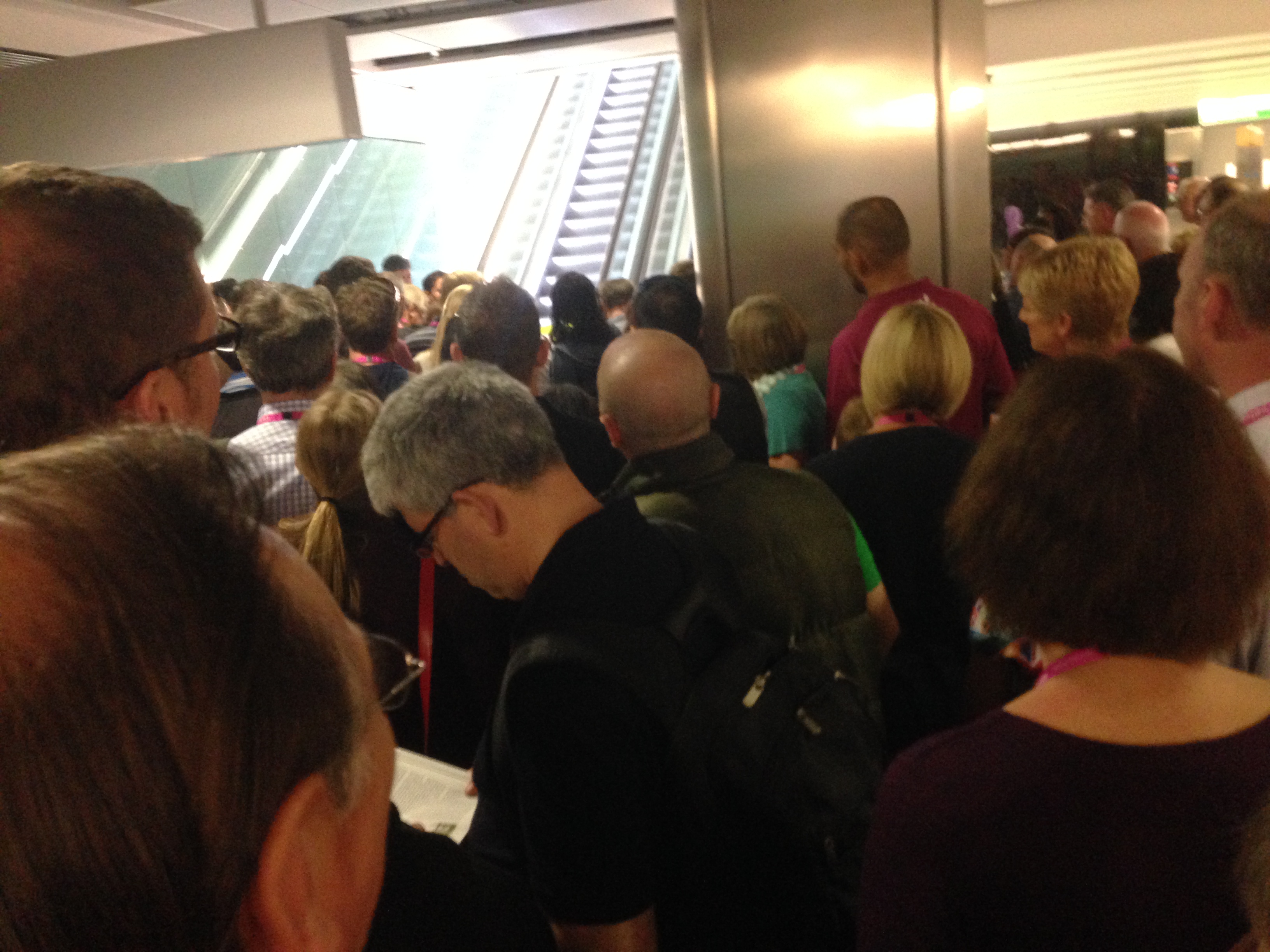
The second day of the conference began with me being fairly grumpy!  The queue to get into the dining room for breakfast was stretching out to reception!  After 20 minutes of waiting, I gave up.  I only wanted a croissant and some fruit but it wasn’t to be as I was keen not to miss any of the conference… but no breakfast = grumpy Anna!  Hilton Hotels get your act together!

~~~~~~~~~~~~~~~~~~

Plenary 3 – Global cancer surveillance: opportunities and challenges

Professor Julia Verne
Director of Knowledge and Intelligence Team SW, Public Health England

Plenary session in the memory of Brian Cottier (1951-2009)

1 in 3 will get cancer
1 in 4 will die from cancer

~~~~~~~~~~~~~~~~~~

Freddie Bray
IARC – International Agency for Research on Cancer
“World wide cancer burden”

Global cancer surveillance opportunities and challenges

Socioeconomic changes and how that impacts cancer incidence and survival.

14.1 new cases in 2012
8.2m deaths
32.5m living with a cancer diagnosis

9 cancers for majority of cancers 2/3rds of burden.

Globocan 2012 provides many graphs and examples.

The changing world – transitions
Major increases in the population coupled with increasing longevity has linked to epidemologic translations Including cancer, moving from infection related cancers toward a western lifestyle.

1 in 3 NCDs are cancers.

A great deal of information and graphs showing changes in some countries for increases in cancer and also decreases eg Japan have an increase in young people with cervical cancer. India have a reduction as marriage age is getting higher. Russia and Belarus have no screening and it has rapidly increased for cervical cancers.

Why registries are so important so we can track what is happening and measure it accordingly.

NCD agenda, of surveillance activities
Training and collaboration with cancer registries around the world. Try to ensure registries are in place to help with cancer control and also for reporting worldwide.

3 way split between high quality data, national and regional data and frequency data but 62 countries with NO data at all.

Current situation
Recognition of increasing global cancer burden.
Despite a long history of cancer registration LMIC have not developed PBCR
Link in with political agenda and tackling of NCDs

UN high level summit talks about cancer registries.
Global monitoring framework

IARC Technical Publication No 42 “Planning and developing population based cancer registration…”

Global Initiative for Cancer Registry objectives

IARC Regional Hubs for Cancer Registration in LMIC

Good data collection and methods of using and sharing data effectively.

~~~~~~~~~~~~~~~~~~
Dr Milena Sant
Instituto Tumori, Italy
EUROCARE 5 – survival of cancer patients in Europe

21 countries with a national registry inc 7 countries from eastern Europe.

50% of European populations including over 10m cancer cases.

Next steps for Eurocare

Reduce inequalities,
Treatment is not only solution for control
primary prevention, early diagnosis, accurate diagnosis – are all factors

~~~~~~~~~~~~~~~~~~
Sara Hiom
Cancer Research UK
The International Cancer Benchmarking Partnership’s Impact on Policy and Practice

What is the ICBP? – unique collaboration in terms of countries, international collaboration involving policy, research, cancer registry and clinical professionals at a global view.

13 jurisdictions in 6 countries
including Scotland for module 5

What are they looking at?

  • breast, lung, colorectal and ovarian

5 modules

  • Epidemiological benchmarking study
  • Public awareness, attitudes and beliefs
  • The role of primary care and healthcare systems
  • Variation in patient,diagnostic and treatment time intervals and routes to diagnosis
  • Data comparability and early deaths

Focus increasingly on the first year post diagnosis. Why are we not getting more patients beyond the first year survival which we can also see affects the 5 year survival statistics.

Module 1 – survival and stage table.

It’s not only early diagnosis that came out from this module and data comparison. It was also access to services and quality of treatment.

Module 2 – awareness and beliefs
Looked at differences in population. In the UK were our people less aware of the signs and symptoms?
Findings: ABC measure was born and has been used for surveying populations.
Generally speaking similar levels of awareness across all ICBP countries.
Generally low awareness across all countries of the increase factor of age.
UK – stood out the reluctance to visit a GP and wasting the Dr’s time. Elements of embarrassment i coming forward in the UK.

Be Clear on Cancer campaign to try to change the belief of wasting GP’s time or embarrassment.

Module 3 – role of primary care
Were there fundamental differences in systems?

  • Progress 2895 GPs responses to online survey and analysis complete in 11 jurisdictions.

Papers are about to be published.

Latest (unpublished) international data suggests that GPs in England:

  • Are less likely to send a patient for tests
  • Report having among the lowest access to specialist advice
  • Tend to feel more strongly about protecting their patients from over investigation and preventing a secondary care overload.

We need to look at the cost structure to overcome this aspect.

Module 4 – patient, GP and specialist intervals
Still underway…

  • Looking at via surveys patients, GP and specialist.
  • Looking at length of time between first noticing symptoms and time to GP and referral.
  • Collecting this information across the cancer pathway in 10 jurisdictions and comparing each of them.
  • Anticipated impact is focus in on areas with longest interval.

Module 5 – data quality simulation
Variations in cancer registry practices affect the comparability of key data used in cancer survival analyses

Look in much more depth of the differences in registries.

Should have a key impact on the best practices and developing tools that look at different factors.

Module 5.2 – short term mortality and co-morbidity
Not started yet…

Building on the legacy of ICBP.  Lots of questions have left unanswered but needs to continue and keep it up on the agenda. Perhaps political policy will assist keeping it on the agenda particularly as comparing with other countries.

~~~~~~~~~~~~~~~~~~

Reducing Health Inequalities
Chair: Dr Tony Moran
Director of Research and Intelligence (North West) at Public Health England

~~~~~~~~~~~~~~~~~~

Therese Lloyd
Prostate Cancer UK
Lifetime risk of diagnosed with and dying from prostate cancer in different ethnic groups

Process of finalising a publication but as yet unpublished.

What do we know?

  • 1 in 8 men in the UK will be diagnosed with prostate cancer at some stage in their life.

We know there are ethnic differences but don’t know how they translate into incidence and mortality.

Data and analysis
Few date issues that meant we weren’t always able to tell the ethnicity for over 1/4 of the data fields.
Total numbers of deaths in the data did not match up the total number of deaths in the office of statistics.

Several analyses in each ethnic group were done.
Best estimate but also larger groups to get a true value.

Used DevCan – system US.

Major ethnic groups analysed – white, black and asian.

Mixed – were difficult to obtain clear results.

Lifetime risk is calculated as percentage and odds.

Although there is a bit of variability based on the methodology used. Consistent message that Asian men (1 in 13) are at a lower risk of being diagnosed of prostate cancer than white men (1 in 8).

Black men are at a much higher risk, although much more variability the research evidences that approximately 1 in 4.

Best estimate – White 1 in 24, Asian 1 in 44 and black 1 in 12 – dying from prostate cancer.

Looked at data from 2008-2010.

When you compare the diagnose number and deaths all groups indicate that 1/3 (across board) will die once diagnosed. Perhaps there is no difference between the aggressiveness of the disease no matter what colour skin.

Need to reach out to BME communities to be aware of symptoms.

More research is needed and collection of perfect ethnicity data is needed.

~~~~~~~~~~~~~~~~~~

Chin Kuo Chang
King’s College London
A cohort study of mental disorders, stage of cancer at diagnosis and subsequent survival

Presentation

2011 cancers has seen the largest percentage of death in the UK accounting for 30% cause of death.
For serious mental illness it’s the 2nd or 3rd cause of death.

Big gap between the general population and people with serious mental illness (‘SMI’).

Only 1 team in WAustralia investigating this.

2 research questions (looking at data 2010-2013) CRIS
early symptoms ignored or not understood. Is the stage also affected when diagnosed.

Cancer linkage

  • Cancer register to include incidence of mental disorders
  • Trajectories of cancer treatments for ppl with SMI
  • Prognosis of cancer patients with psychiatric comorbiditiy.

Extending CRIS system to Cambriddge, Imperial – UCL, Oxford and Camden & Islington.

~~~~~~~~~~~~~~~~~~

Mark Rutherford
Research Associate, University of Leicester
Understanding deprivation and inequalities using loss in execution of life use to a cancer diagnosis (using only UK data)

Please refer to presentation

~~~~~~~~~~~~~~~~~~

Preventing Emergency Presentations – the need for research
Chair: Stephen Duffy
Wolfson Institute

We know that emergency presentation is particularly common in some cancers such as lung and bowel. Associated with a poorer outcome and may be associated with initial treatment from wrong specialist.

Emergency Presentation is more common in older people.

We need better understanding who’s at risk and what can we do about it?

Targets for today from the interactive workshop:

What are the major knowledge gaps?
What cancer sites are most promising for intervention?
What interventions are ready for evaluation?
Not simply to replace Emergency presenting with routine presentation. We want to replace with someone presenting 6-12 months before with stage 1 or 2 cancer.
Who should take this forward?
Very much in our hands as to which teams should take these interventions forward? Research fellows? Charities?

~~~~~~~~~~~~~~~~~~

Less Common Cancers
Chair: Jane Lyons
Cancer52

Cancer52-NCIN-Report-10-June-2014-FINAL

~~~~~~~~~~~~~~~~~~

Lucy Elllis-Brookes
NCIN & PHE
Setting the scene for rare and less common cancers

Presentation

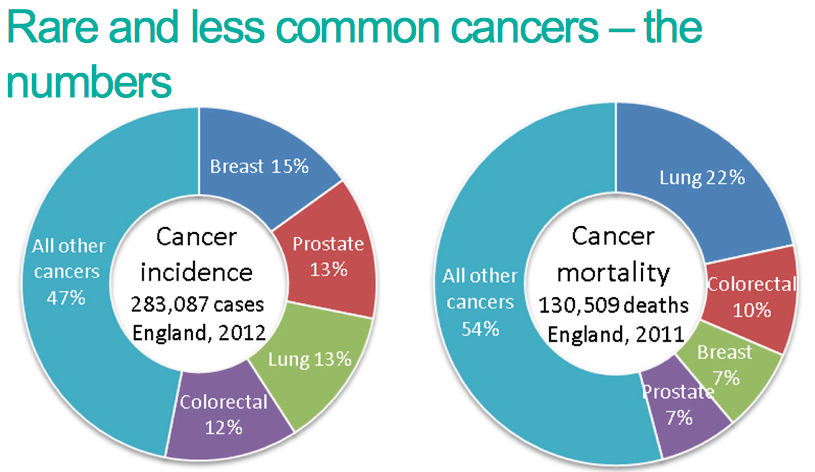
Big 4 – breast colorectal lung and prostate
Less common cancers e.g. uterous, melanoma, ovary, kidney, CUP, pancreas, cervix, multiple myeloma
Rare cancers…. even more !
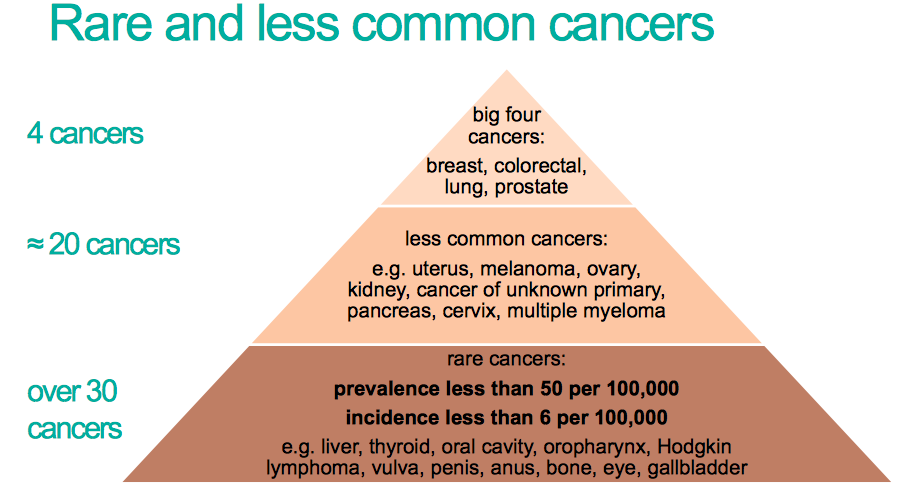
Screen Shot 2014-08-18 at 15.33.40Rare and less common cancers:

Screen Shot 2014-08-18 at 15.34.58

What is NCIN doing?
Routes to diagnosis – increased look at cancer types and producing data from them 22 in 2010 and 57 in 2014.

Deprivation reports – 23 in 2008 and 37 in 2014

Site specific Clinical reference group work (recent examples)

  • vulval cancer – trends and variations by age
  • kidney cancer survival report
  • penile cancer incidence by age

What do rare and less common cancers have in common?

  • Each cancer site shows different results.
  • Different analyses will be required
  • Specialist advice (clinical and analytical) is crucial.

~~~~~~~~~~~~~~~~~~
Oksana Kirichek
University of Oxford
Menopausal hormone therapy and risk of central nervous system tumours: a nested case – control study

Aim of study:

  • Is Hormone therapy (HT) associated with risk of brain and other CNS tumours
  • To test whether the effect of HT varies type, duration or recency of HT preparation used.
  • To assess the effect of HT exposure on the risks for all CNS tumours

GPRD General Practice Research Database

  • Holds primary and secondary data. cross linked with other databases and person specific.

Definition of cases

Results
No significant difference in risk by tumour subtype

Conclusions

  • UK GPRD cohort women who had been prescribed HT
  • HT associated risks did not vary significantly cross the four main tumour subtypes examined
  • Findings from the GPRD agree with those reported previously from other studies with prospectively collected information on HT use.

~~~~~~~~~~~~~~~~~~
Nicola Dennis
Knowledge and Intelligence Team (W Midlands)
Incidence, survival and treatment patterns for patients with head and neck sarcoma

Presentation

1% of all malignancies in England are Soft tissue sarcoma
Narrowed down to head and neck the numbers are even smaller

With the very small numbers of incidence there are limited studies looking at incidence and survival rates.

Both Improving Outcome Guidance in 2004 and 2006 specifically had improvements for head and neck.
Because of the small numbers its hard to see if anything has changed.

4796 head and neck sarcomas in 1990-2010

MDT specialty – positive outcomes since the guidance was set out where we can see that there has been a significant increase in referral to the right MDT specialty.

Patient spread for surgical treatment. Data shows that there are number of trusts that might only have treated 1 patient in the entire 10 years of the study!

~~~~~~~~~~~~~~~~~~
Kwok Wong
University of Birmingham
Risk of Adverse Health and Social Outcomes up to 50 Years After Wilms’ Tumour: The British Childhood Cancer Survivor Study

I will post a link to the presentation once available.

~~~~~~~~~~~~~~~~~~

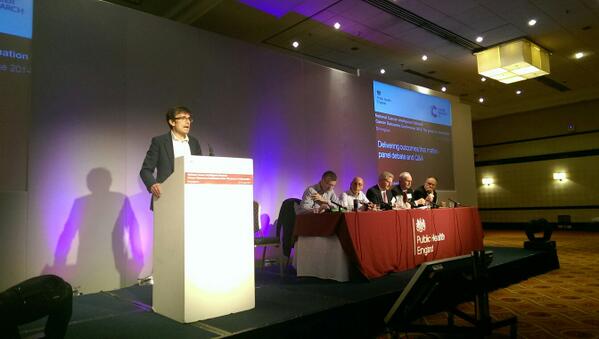
Plenary 4 – Delivering outcomes that matter – Panel debate with Q&A to the panel
Chair: Robert Peston, BBC’s Economics Editor

• Mr Sean Duffy, National Clinical Director for Cancer Services, NHS England
• Mr Ciaran Devane, Chief Executive, Macmillan Cancer Support
• Professor Peter Johnson, Chief Clinician, Cancer Research UK
• Dr Jem Rashbass, Director for Disease Registration, Public Health England
• Mr Andrew Wilson, Chief Executive, Rarer Cancer Forum
BpxgJTfIcAA0rMM

Ciaran Devane – Chief Exec – Macmillan
We need to move to a strategy when we think in a different way rather than the economics.

We are talking a great deal about the value of services and NHS etc rather than the value of and to the individual.

Changes in the NHS – are we spreading our resources too thinly?

Sean Duffy – National Clinical Director for Cancer NHS England
No doubt the point of contact for you within the health service should be the most important thing. We’ve not yet got it right. If we’re going to visit better outcomes then we need to tackle the first point of contact too.

We don’t wrap the system around the patients enough.

In terms of the data itself – it’s easy to look at national data and say were good at this or that. We can look at a local level. We need to create ownership of the data around the geographies to be sure their own data is better and is owned. Working collectively to gather for the greater good.

Rich national dataset that we can and must use but we haven’t yet made great inroads in it. Need to make more out of the data.

Finally, with such a rich set of data and the ability to intelligently obtain information from it. We need to get cleverer at using the data in order to year on year look at the services to ensure we can achieve the best.

Prof Peter Johnson, Chief Clinician, Cancer Research UK
Echo the good things said about NCIN and the work they do. No doubt research using the data has been saving lives for many years. We know more about how to reduce the risk of cancer and determine the best treatment and long term outcomes.
How are we going to improve further and get up and beyond the levels of other countries?

We know there are at least 10 different types of breast cancer. We know asbestos causes mesothelioma.

Key obstacles we need to address: Regulation – looking at EU regulations and ability to track patients through system and outcomes will be compromised if EU data systems come in.  We must at all costs make sure work is not held down by regulations.
Changes in the health systems recently has given us problems. Relationship with the information centre CPRD and difficulties of joining different data has given us delays and loss of capabilities in the Registry. This has stopped us doing as much as we would have liked and can achieve.

Public perception of data and it’s management has been undoubtedly damaged by care.data. This was a fundamental problem and unsettling. We have to overcome this. There have been ZERO breaches in any confidentiality of the Cancer Registry.

25% to 50% alive 10 years from diagnosis of cancer. CRUK want to bring this to 75% in the next 10 years. We need data to understand this and move forward. Stratified medicine has to understand at a detailed molecular level. We will only be able to capitalise on that if we can get the data systems right and keep them functioning.

Data is a precious life saving resource. Do not take it for granted. Fight to maintain the system that we have.

Dr Jem Rashbass, Director for Disease Regulation PHE
Worth reflecting on how we got here and what this is about  We have had earthquakes of public trust. This is YOUR clinical information that we collect and we are duty bound to look after it and my responsibility to make sure that I protect patient confidentiality.
As Peter has said the support we’ve had over the years to look after your data and you can request it’s removal from the Cancer Registry.

This is about delivering care to individuals. You’ll treat them on the basis of the stats but as we move to personal care it’ll be the molecular abnormalities that determine your outcome.

We need to maintain the public support for data collection and NCIN database that puts the potential for cancer care in this country further forward than anywhere else in the world. In the next 5 years we will have extraordinary ability to provide the most personalised cancer treatment.

Andrew Wilson, CE Rarer Cancer Forum
Current state of play for data. Clear that public feeling has been shaken. Rarer cancers are rare. Data on rarer cancers will be much more identifiable. Huge amount of exciting work going on using data for rarer cancer.

Use of data in rare cancers. Hidden cancers and less visible to the public.
Huge demand for this sort of data. Need to meet this and produce reports that are useful.

NCIN route for diagnosis project showed ongoing problems for cancer patients go far beyond those related to cancer.

We need to be much more open with the data that we hold. Ensure patient identifiable information is removed from data sets. Once this has been done the data that we have is published. Closed shop needs to go. Automate data flow around the system to ensure sticking to rules and make better use of data that we do at present.
We need to work collaboratively to come up with solutions where problems exist.

Q&A
Q – How can we ensure the diagnostic experience for young people is improved?
SD – we have a first point of contact system designed 60 years ago. We need to tackle it externally and internally. Simple things needed – proactive approach to primary care. Safety netting – young person with a set of symptoms its probably the last place they want to be… be proactive and should raise a flag for tests. We have created a mechanism whereby the referral is the only route – needs to be challenged. GP should be able to make a clinical decision on the basis of facts not ask the patient to wait!
JR – We need to recognise that a missed diagnosis is one that everyone inc GP regrets. However some cancers in a young person are difficult to detect. They are rare. Symptoms and signs of a brain tumour are subtle. No of patients that a GP sees with those every week, it’s difficult to identify. Where the value of the dataset comes not from surveillance but that we should learn from every case. How do we raise our game?
SD – there are risk assessment tools that allow patients to flag up symptoms.
You can start to identify in an active way any of the GP patients that maybe at higher risk using some of these tools and data set.

RP – GPs feel they don’t have the level of control and responsibility due to other constraints about referring and cost.
CD – The guidance at the moment is written to say send us these patients but often the ones that don’t fit that mould are overlooked because they don’t fit that picture.
Be Clear on Cancer – enables the patient population community to know what to ask for and what symptoms.
PJ – I think there is a massive amount of data that tells us a lot about patterns of referral. And the outcomes from this. Feeding the information back into the system is incredible important.

Q – As a researcher the amount of time it takes to get access to data approved throughout he current regulatory approval system. Is there a strategy to help researchers get access to the data and make use of them in a more timely way.
JR – Richard’s experience shared by others. We’ve tied ourselves in knots frightened about releasing data and protecting the confidentiality. We need to recognise what you want us to do. Inside PHE we are trying to deal with it and create the structures to manage the data release. The demand for the data is large. We have disadvantaged ourselves by separating the people who pull the data and those who analyse it.
I think we do need a clear process of maintaining that public confidence.
Complex area but we need to be better at giving data confidentially.

RP – What is your attitude to selling data?
JR – Govt data is not available. Not a resource from which to make money. The data that we collect on you is for the social good BUT need to protect patient identifiable.
Financial constraints on delivering personalised health care will not be cheap. We need to enter into the discussion with industry to pay a fair price and benefit.

Q – How big a threat to our ability to gather and use data would changes be that require consent to use the data each time? This would negate the value of a Cancer Registry.
A – It’s a risk and will undermine everything that we’re trying to do. We need our MPs to change this view and to ensure that this change does not take place.

Q – One of the ways that we can prove that consenting to use of data is to show the public how the data can be used for good and can be done.
CD – Hugely disappointed when cancer networks became unpopular. People didn’t believe in coordination. We need to make use of the strategic clinical networks. Make sure the patient voice is embedded in the senates, and clinical settings. We need to be more assertive and move together.
JR – Some basic processes. Transparency and openness. Audit – any patient can approach and ask who looked at my data. Every patient who wishes can have access via a patient portal like the brain hub. An absolute right of opt-out. No process that makes it difficult to do that. I think that is what is needed to protect the data set that we’ve got and we need the community to act and educate the wider audience.

Q – Despite significant Govt rhetoric influencing the NHS work we need to collect ht patient voice at and put it back into the system. How can we go about changing this?
SD – I believe in the patient voice entirely. Within NHS England the patient survey is the most successful at influencing. We need to make more use of it.

Q – NCIN was founded in 2008 with mission to provide the UK with the best intelligence in the world. What does the panel think the new mission for the NCIN should be to take us forward in th next 5 years.
JR – We need to move somewhere else. I want a low level objective to make the patient and the clinician at the centre of the data store. So you can ask where am I in the system? You can check you’re getting the best and ensure that no cancer is left out. Patients and the public at the centre for cancer.

RP – When you collect data that is at a granular level are you recording it?
JR – Yes we are. We need to know what receptor it has. If it responded to medication. etc etc. Absolutely linking it into all sorts of datasets to look at a much bigger picture and make it more personalised.
PJ – 4 years of outstanding progress and 1 year of challenge. I think it’s time to reaffirm the quality of the data and now we need to see it and put it in front of the people who generated it, people, public, patients, clinicians etc. Want to see equally superb access to it.
CD – based on outcomes not last year’s data.

Q. – When a patient comes into hospital with advanced cancer, the patient has rarely been recording if they’ve been attending primary care prior to emergency presentation?
Should we incentivise GPs by giving them QoFs? Perhaps to embed good practice for a period of time.
PD – Both London integrated cancer centres have been involved in looking at attendance of A&E and that will give us some answers about the gaps. I do think there is something about incentivising a better pathway of care. We need to use everything in our power to make the system work.
NCIN Conference 2014 (Day 1)

The NCIN (National Cancer Intelligence Network) is a UK-wide initiative, working to drive improvements in standards of cancer care and clinical outcomes by improving and using the information collected about cancer patients for analysis, publication and research.

When I was first aware of the NCIN, their goal was “To develop the best cancer information service of any large country in the world – by 2012”.

Because of the work they continue to do, UK clinicians, medics, researchers, NHS purse holders, pharma, charities and, of course, patients are now able to draw on an incredible amount of useful data-sets.  This data enables measures to improve outcomes, drug development, research projects, awareness and own patient care.

This year I was honoured to be invited again to attend the NCIN Conference with a bursary place and below is a summary from my notes at the Conference.  Wherever available I have added links to presentations.

Cancer Outcomes Conference 2014 – the power of information
Sponsored by Cancer Research UK and Macmillan

Chris Carrigan
Director of NCIN Public Health England (PHE) 

Chris opened the conference and welcomed those attending.  This year’s conference attendance is larger than ever before with over 570 people attending.  With national and international spread from primary to end of life, charities and patients.

Chris (@C_Carrigan) wrote a blog at the start of the conference on twitter on how bringing people together can improve cancer outcomes – read here


Harnessing the power of information to deliver quality and innovation in cancer surveillance, services and outcomes

Chair: Prof Brian Ferguson
Knowledge Transfer and Innovation Director at PHE
“Innovation at the heart of Public Health England.

Kris Hallenga
Coppafeel! @krispop @coppafeelpeople
Ensuring everyone stands the best chance of surviving breast cancer

Kris#NCIN2014, Let’s talk boobs

Kris ‘story’ is well documented not least on an incredible documentary that has just been shown on TV “Dying to Live“.

Kris was 22 when she noticed lump.  She ignored for a long time. Eventually went to GP and told more likely to be hormonal.  Went travelling and noticed the lump was getting bigger. Returned to GP. Told nothing. Mum got involved. Returned to GP. 8 months after first going to GP was referred and told breast cancer and spread to spine.

1 in 15,000 chance of getting breast cancer under 25.

“You beat the odds in getting the disease and can beat the odds to get rid of cancer.”

2 months into treatment Kris researched why she didn’t know more about cancer at a younger age and what to expect.

She knew she couldn’t change her diagnosis but she could make it better.  Or as Kris said “You can’t polish a turd… but you can roll it in glitter…”

She kept hearing “Early detection is the best form of defence.”  Why wasn’t there breast cancer awareness in schools, universities, 6th form colleges?  Surely that’d lead to earlier detection.

So Kris thought about where she could reach these young people.   Armed with CoppaFeel! stickers set off to a festival.  Whilst facepainting with her twin sister people started approaching and talking about boobs.  Talking about breast cancer.  Talking about checking yourself.

CoppaFeel! are now a regular set up at music festivals, university campus and many other locations filled with younger people.

As well as Kris and her sister talking about boobs, there are now the Boobettes – young women who’ve been diagnosed with Breast Cancer.  They go into and talk at schools and events about their experiences and awareness and early diagnosis.

Kris has asked “What does BC mean to young people?” and got these answers (amongst others) – life-stopping, turmoil, depressing, threatening, damaging… not good and words that put you off from checking your boobs.
It is a very treatable disease if diagnosed early.

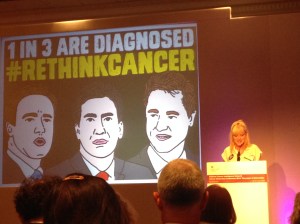
1 in 3 are diagnosed with cancer.  Early diagnosis is key.  #rethinkcancer is a campaign to bring cancer education into schools, colleges and universities.  “I know it will help and I know they want to know it… I’ve spent the last 5 years speaking with them.”

Put an end to late diagnosis of cancer.

Kris Rethink Cancer

The stats of tomorrow are the young people of today… it can happen to young people. It should go through the mind or every GP and medical professional out there.

“If you have influence please use it. If you have colleagues please pass the message on. If you have boobs, please check them.

Think boobs.”

~~~~~~~~~~~~~~~~~~

Prof John Newton
Chief Knowledge Officer, PHE
Cancer – A public health perspective

Presentation

So many things to learn from what Kris was saying. Behind every statistic and data is a real person like Kris. This should be a reminder.

4 things we need to do:

  • Prevention
  • Diagnosing cancer early
  • Make sure very patient gets the best treatment
  • Care of people who are living with cancer, whatever the outcome

Struck by Cancer Research UK stats that 40% of cancers are preventable. There is a huge challenge but we as a population need to address it.

Good news is that we have the best treatment services and charities in the UK. We have some of the best intelligence systems in the world. The best Cancer Registry.

No doubt that cancer intelligence NCIN has played it’s part in improvements. More that we could do with the data to improve outcomes and prevent cancers.

How do we build NCIN in Public Health England to get even better outcomes?

Mission – “To protect and improve the nations health and to address inequalities working with national and local government, the NHS, industry, academia, the public and the voluntary and community sector”

Broken down into manageable chunks – outcome focused.

  • Helping people to live longer and more healthy lives by reducing preventable deaths and the burden of ill health associated with smoking, obesity etc
  • Reducing the burden of disease and disability in life by focusing on preventing and recovery.
  • Protecting the country from infectious diseases and environmental hazards
  • Supporting families
  • Health in the workplace
  • Promoting development of place based public health systems
  • Developing our own capacity and capability to provide professional scientific and delivery expertise

PHE’s jewels in the crown:

  • National Screening Programme
  • National Cancer Registration Service
  • National Cancer Intelligence Network.

PHE inherited some strong partnerships with many including:
National Cancer Peer Review and National Cancer Research Institute.

PHE have a significant local presence:

  • 4 regions, 15 centres
  • 8 cancer registration teams
  • Central coordination and analytical team
  • 8 knowledge and intelligence teams around the country

Track record of delivery is increasing….

  • National Cancer Registration Service
  • Completed the national migration
  • Data going out trusts
  • Published staging data
  • Cancer analysis system implemented
  • Prostate cancer data network

Our public health perspective:
NCIN

  • Be clear on cancer campaign evaluations have been carried out for lung, blood in pee, breast cancer in over 70s, ovarian, oesophago-gastric, lung reminder and local skin cancer pilot.
  • Analytical work by the central and knowledge and intelligence teams
    • 16 data briefings, 23 in depth reports, 9 press releases
      17 journal articles, profiles, toolkits, routes to diagnosis, workshops for clinicans…
  • New office for data release is established and now operational
  • Reports analytics from the page impressions on our websites show an increase both nationally and internationally.

Collaborative work:

  • Deprivation report with CRUK
  • Routes from Diagnosis with Macmillan
  • Less common cancers – Cancer 52

The patient portal:

  • NCRS and NCIN
  • Brians Trust
  • Cancer Research UK

Summary/Future Look

  • Cancer remains as a significant public health issue
  • Many national cancer bodies inside PHE brings definite synergies, some of which we are now seeing, but there is much more to do… we want your help with it.
  • Growing demands for our intelligence capacity
  • NCIN will grow and flourish as a partnership and as part of PHE’s integrated cancer programme.

Increasing value to assets whilst data, partnerships and resources continue to flourish and grow.  We need to work together to ensure that this data and these collaborations continue to demonstrate improvement for cancer outcomes.

~~~~~~~~~~~~~~~~~~

Sean Duffy
National Clinical Director for Cancer – NHS England
Progress on the delivery of optimal care for cancer patients in the new NHS

Presentation

Optimal cancer care in the new NHS – an absolute commitment to deliver services for better outcomes.

The survival challenge

  • Mortality improvements v survival gap
    • Although we’ve made gains in the survival in the UK. Other countries have also had improvements.  We need not to equal the other countries improvements but to ensure our improvements are greater.
    • Eurocare 5 (2013 analysis of 2007 data)
  • Stage at presentation and earlier diagnosis.
    • We need a cultural and system shift to lead a stage shift.
    • Primary care interface – % flows
      • GP direct access to tests. Does it make a difference. On average access to test should make a difference for 6% cases. BUT hides 15-20% for cases such as stomach, ovarian, pancreas, renal, brain.
    • Route to diagnoss, England 2006-2008
      • All cancers emergency presentations 24%

Ownership of treatment decision
We should ask every MDT in every hospital to look at least once a year at the decisions it has made (treatments) and what it has meant for its patients (outcomes).  By revisiting these decisions they may be able to see improvements or identify changes that need to be made.

National datasets for cancer should enable the work – chemo, radiotherapy and outcomes data
National audits need to be used more.
Transparency is essential

12 senate geographies for the cancer map. If they took a grip of their own survival curves then we could be in a better position.
Plea – Own your 1 year survival and work collaboratively together.

Selection bias

  • Age and outcomes
    • 34% of 80-84 and 43% of 85+ are diagnosed via emergency route compared to 25% of 70-79 year olds.
  • Age and treatment
    • Access to treatment of the older population is variable. There is an age bias that exists and the data sets demonstrate this. Not just for surgery but also chemo, radio and access to a cancer nurse specialist.
    • Perhaps there could be a co-morbitity and late stage diagnosis but not completely responsible for decline in survival in older patients.
    • Older patients get less chemotherapy delivery for colorectal patients.

Structure

  • Key factors that influence greatest impact is access
  • The question of volume and outcomes
  • Community of care, not individual or isolated providers
  • Redefine the model – ideal structure within given senate geographers based on IOG principles and evidence.

What is best and where?

Summary

  • Gap in survival to tackle together.
  • Effective plan for early diagnosis to ensure the front end of our health care system delivers what you need it to.
  • Local MDT and senate geography focus on outcomes as a result of treatment decisions is vital to improve survival.
  • There is an inherent age bias that if tackled could yield significant survival benefits.
  • The evidence for volume linked to survival outcome cannot be ignored.

Q&A

Q (Kathy – London Cancer Alliance) – What has happened with the key recommendation in 1995 re early diagnosis?  Ambition was to go much further than they did at the time. The data at that time wasn’t as robust as at the moment. We have to be driven by the evidence. Any change moving forward has to be with improvements.
A (Michael CR_UK) – Are you talking to your colleagues in Scotland Wales and N Ireland about how to tackle the problems as a UK wide problem?
We are an English organisation but we are doing as much as we can with the UK. Spoke last week with the Welsh Health Minister (who are producing a white paper which is very interesting). Certainly on research we are very keen to work across the UK. Every reason and possibility of working across the UK not just England.
Julia Vern NCIN public health lead – UK and Ireland Association of Cancer Registries – absolutely a priority for all of us.

Q (Bob – Former NHS professional and lay rep) – Where is recent data?
A – Pointing you to the right person for the data question.

Q (Ian – Patient) – Emphasis is always on the clinicians rather than the patients. If there was more of a focus on the patient not the clinicians then I think you would see more survival times. Supporting stop smoking, diet etc particularly those of the poorer socioeconomic groups.
A – I think you’re right. Workstreams should be looking at exercise and other actions as a joint initiative between NHS England and Public Health England.
Approach moves away from a health service that provides testament for someone who is ill, rather than helping patients help themselves before they become a patient… it needs collaboration with charities, education and health care systems.

Q (Ms Clifton – Clic Sergeant) – Early/late diagnosis. GP dismissal of patients. Is any research done on looking at the reasons for late diagnosis or sending for tests in primary care?
A – How long have we got? There is a lot of research and simple things that primary care have developed to be more proactive. Got plenty to base a plan and are working on it. Key for me is that this is about public and primary care behaviour. The new changes should enable us to have more conversations and changes in this area.
Kris – We ran a focus group with some GPs. Reduction of the younger patients and also looked at the flip side of empowering patients about what you expect from a GP visit. Makes a huge difference.

Q – (Sara Hyams CR_UK) – Pick up on the age issue. How do we get more on the agenda for early diagnosis of the younger patients? i.e. under 30. How can we also improve things at the other end of the scale too?

Q – CCG – when would staging data be available to CCG levels?
A – Staging data has already been published. By CCG I understand it’s going to be June. NCIN is publishing it later this month.

Q – Health intelligence officer – I’ve got a 23 year old daughter. All this activity around data and intelligence isn’t worth anything unless it is used for the benefit of the patients.

~~~~~~~~~~~~~~~~~~

Plenary 1 – Outcomes for young people with cancer: matching commissioning guidance with the evidence

Martin McCabe
Chair of NCIN Young Patient Oncologist

NICE guidance on improving outcomes for young people and children with cancer.  (“CYP” children & young people)

  • Care co-ordinated as close to home as possible
  • Networks should meet the needs of CYP with cancer
  • MDT should provide cancer acre
  • Each CYP with cancer should have a key worker
  • Care appropriate to CYPs age and type of cancer
  • CYP with cancer should be offered the chance to take part in research trials
  • Treatment should be based on agreed protocols
  • Sufficient specialist staff
  • A register of all cancers in people aged 15-24

National Registry of Childhood Tumours
Established in England, Soctland and Wales in 1962

Childhood cancer isn’t well fit with ICCD coding so they have their own code. Birch coding.

TYA cancer
Teenage and Adult with Cancer TYAC founded in 2004.

In children cancer is always rare. Rare because it’s found in a child or because it is rare anyway.

Looking at survival AND important is quality of survival for children and young people.

Treated at a Principle Treatment Centre… but what happens when they’re referred out of the PTC?

One of the main advancements in childhood cancers is the enrollment of children into clinical trials. New paper from NCRI to be published very shortly which demonstrates this.

~~~~~~~~~~~~~~~~~~

Kathy Pritchard-Jones
UCL London Cancer
Paediatric clinical outcomes research – UK policy and the role of the European Network of Cancer Research in Children and Adolescents – early diagnosis

Talking about the European agenda for paediatric cancer clinical outcomes research.
ENCCA European network for cancer research in children and adolescents 2011-15
SIOP European standard of care for children with cancer
ExPO-r-NET European Expert Paed Oncology Research Network for Diagnostics and Treatment

Outcomes research

  • Outcomes seeks to provide evidence bout which intervention work best
  • Study of the end results of health services to take account opatients experience and costs to society
  • Provide scientific evidence

NHS Outcomes of framework

  • What can we really measure that is important to patients?

ENCCA – in 4th year of operation

  • Building a strategy to enable biology driven clinical and pre-clinical research. Tissue sampling, biobanking and sharing tissue across boundaries, training for clinicians, researchers and scientist. Long term sustainability of encca is bringing together national paed and cross cutting research groups to take it forward.

Why has overall mortality for children with neuroblastoma in the UK worsened?  Is it because there’s no trial currently open?

Infants with cancer have the highest rate of early mortality. Can we improve their model of care?

Equal access across Europe. Appointed by DG-SANCO to pilot how cross-border research can be done correctly?

Collaboration, defining entities, regulatory, embedding teaching and research.

~~~~~~~~~~~~~~~~~~
Tony Moran
Public Health England
Survival trends for young patients in the UK – the good and the bad diagnosis

Background
Lower survival in UK than several other countries
Rate of improvement slower in TYA than other age groups?

[Once the presentation is available, I’ll upload it here]

~~~~~~~~~~~~~~~~~~
Kathryn O’Hara
The Christie NHS Foundation Trust
Referral to and from specialist Centres- how widespread is the practice?

Presentation

Normal for 0-14 year olds to be under the principle treatment centres classified by extent of shared care. It’s not consistent in all areas.

~~~~~~~~~~~~~~~~~~

Plenary 2 – Living with and beyond cancer
Heather Monteverde
GM of Northern Ireland with Macmillan Cancer

Presentation

Considering living with and beyond cancer is a newly adopted consideration… relatively. So many changes within cancer with chemo, radiotherapy, surgery etc.

Consequences of treatment or late affects have a huge impact on the quality of life of people living with and beyond a cancer diagnosis. This also needs to be addressed. The physical as well as the emotional and psychosocial issues.

~~~~~~~~~~~~~~~~~~
Raoul Reulen
Uni of Birmingham
Teenage and Young Adult Cancer Survival study

Approx 225,000 5-yr survivors
Population based cohort
Diagnosed 1971-2006
Age 15-39
Covers England and Wales

Study link

~~~~~~~~~~~~~~~~~~

Matthew Francis
Public Health England, Knowledge and Intelligence Team, West Midlands
Method of identifying stage IV cancer

Presentation – please refer for charts and graphs.

Matthew spoke about the differences in staging sarcoma compared to other cancers.  The usual methods of staging include tumour size, nodal involvement and if there are any distant metastases identified.

With reference to sarcoma patients only 2% of those diagnosed with stage IV actually comply with these staging rules.  This makes it increasingly difficult to make comparisons and potentially contribute to a less favourable outcome.

In addition the rarity of sarcoma:
450 bone sarcomas new diagnosis
2,800 soft tissue sarcoma new diagnosis
less than 1% of malignancy
occur in different anatomical locations.

Detailed staging data is not available for patients with sarcoma.

Metastases site recording in HES can be the only identifier but this information isn’t always recorded.

4,602 new cases of bone sarcoma
20% of had metastases at diagnosis
27,913 soft tissue sarcoma between 2000-2010
3,602 13% had metastases

Soft tissue sarcoma – some sites have space for growth i.e. abdominal or breast where the tumours have space to grow and therefore not diagnosed as quickly i.e. may be identified at diagnosis with metastases.

Conclusions
Staging data for sarcoma is incomplete.
Those with metastases have significantly poorer outcomes.
The methodology used to identify stage IV sarcoma patients could be applied to other cancer data sites and assist the National Cancer Registration Service.

~~~~~~~~~~~~~~~~~~
Chris Brown
National Cancer Registry Ireland
Using routine prescribing data to identify comorbidities in ovarian cancer patients

Presentation

Please refer to the slides and data of the presentation.

~~~~~~~~~~~~~~~~~~

Plenary 2 – “Show me the data!” – information and intelligence for your ovarian cancer service

Chair: Annwen Jones
Target Ovarian Cancer

Presentation

Ovarian cancer outcomes could be improved. NCIN has provided hard evidence that outcomes can improve and also provided data and insights to shape policy and practice.
7,000 cases diagnosed each year
3/4 of cases aged 55 years and over
4th most common cause of death from cancer in women
4,300 women die each year
Late diagnosis is a major issue

Before 2007 (i.e. before NCIN) we had very little and incomplete data that was also unreliable.

32% of women diagnosed with ovarian cancer via admission to A&E v 24% of all cancers
15% of women die within two months of diagnosis.

Pathfinder Study – Target Ovarian Cancer – 2009, 2012, 2015… ongoing study.
Looks at patient delay, GP delay and system delay.

[Key findings published to date click here]

International benchmarking partnership (ICBP):
1 yr survival for ovarian cancer in England lags behind comparable countries
5 year survival difference results from 1 year difference. In England we do quite well at this point.

Data shows that there are wide regional differences in survival.

What is the underlying cause of variation and what more can we do to improve survival for all women with ovarian cancer? What does the data intelligence that we currently have tell us? What further data do we need?

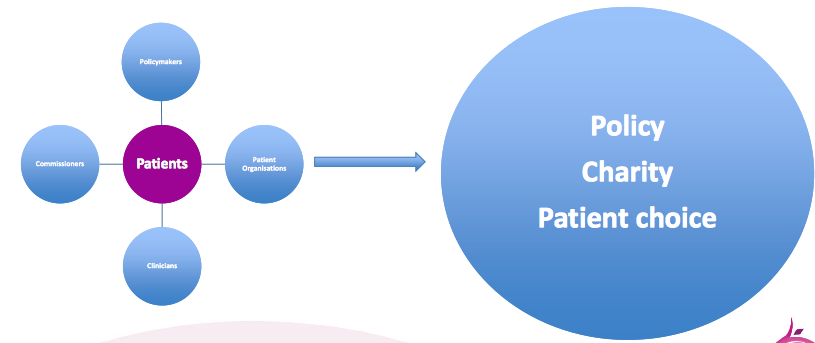
Put patients at the heart… policymakers, patient organisations, commissioners and clinicians around patients.  The patient must be central.

Screen Shot 2014-08-18 at 13.14.34

The value of data to patient organisations:
Policy – impossible to influence policy without robust data.
Charity – we have to make sure that we’re spending the donations wisely. Data helps make decisions and priorities as a charity.
Patient choice – patients with a voice.  Personal note – it was wonderful to see the faces of patients on Annwen’s slide particularly that of my gorgeous smiling friend, Tish, who I miss so very much.  Tish was such a wonderful patient advocate for Target and others diagnosed with ovarian cancer.

~~~~~~~~~~~~~~~~~~
Dr Andy Nordin
Chair NCIN Gynaecological Cancer site specific clinical reference group
Ovarian caner in the UK: the emerging picture

ICBP – opportunity to compare outcomes with other high quality data countries such as Australia, Cancer, Denmark, Norway, Sweden 1996-2007

Gynae cancer hub with NCIN run through of projects carried out.

Results are improving in younger women but data identified that it hasn’t improved in the older patients. NCIN were then able to look at this area too.

Routes to Diagnosis in November 2010 we all know was that a great many people present as emergency presentation… ovarian is one that indicates this highly.

Short term ovarian case mortality:

  • why the elderly
  • late presentation
  • reluctance for referral
  • performance status
  • patient preference
  • access to specialist surgery
  • access to chemo
  • national variation

There needs to be more specialisation at a surgical level.  To look at the number of consultants by caseload and acknowledge that they should be doing more than 15 cases per year.  This surgery should NOT be undertaken by general surgeons but by specialist surgeons in specialist centres.

More use should be made of the cancer e-atlas

~~~~~~~~~~~~~~~~~~
Jason Poole
Associate Director, Public Health England
Short term ovarian cancer mortality in and across England

ICBP
Early results 2006-2009:
5288 women 31% died in the first year
2,592 died in first 2 months

3 contributory factors:
emergency presentation
advanced age
non-specific tumour morphology

case-mix analyses

  • women 2008-2010 resident in England, ages 15-99
  • data from national cancer data repository
  • HES inpatent and outpaitient
  • Ovarian cancer including fallopian tube and primary peritoneal cancers
  • Excl borderline tumours, sarcoma, germ cell tumours
  • 15,000 women in analysis

Patient outcome – excess mortality ie over and above ‘normal’ population mortality
3 periods of analysis – diagnosis to 1m, 1mto 6m; 6-12m

case mix factors

  • age groups
  • deprivation quintile
  • comorbidity
  • route to diagnosis
  • stage
  • morphology
  • treatment
  • basis of diagnosis

~~~~~~~~~~~~~~~~~~
Dr Rob Gornall
Clinical Director Cancer Services
The challenge of improving cancer services by commissioning pathways – the increasing value of data

Presentation

Rob’s presentation reiterated a great many of the points earlier regarding early diagnosis, variation in primary and secondary care services, complex commissioning pathways, patient behaviour and perception of risk.

Please refer to the presentation for more data on the above but please note there are graphic photographs.

~~~~~~~~~~~~~~~~~~
Louise Bayne
CEO Ovacome
Robust data – the value to patients and patient organisations of the NCIN

Why is the NCIN data required and quality of it so important?:

  • demographically representative
  • statistically significant sample size
  • non biased enquiry motive
  • highly skilled practitioners
  • published in full

Without NCIN data, charities need to look inwards for data sources and information. That has intrinsic problems about it.  Attract a sub-set of the cancer community who are not representative. Might be questionable motives as to why a charity has come up with a news story or report.

Why does this matter?

Data is used for:

  • NICE decisions on access of treatments.
  • shaping research proposals
  • commissioning
  • advocacy programs
  • patient information
  • individual treatment choice

Without excellent data patient organisation activities risk being characterised as:

  • opinion drive
  • biased
  • questionable motives

Leading to:

  • wasted resources
  • lobby fatigue
  • harm to misrepresented clinical sectors
  • poorer outcomes for community

Making the data count

  • Quality profiles – annual report using NCIN/DH data to provide a local picture of service/standards
  • Available on the Ovacome website
  • Parliamentary outreach day with Ovacome members lobbying their MPs
  • Circumvents clinical gagging clauses
  • Puts clinicians in the driving seat – we don’t say what’s to happen – clinical empowered to suggest improvements
  • Last year resulted in Secretary of State intervention, improvements to the data collection, the recruitment of clinical staff and improvements in clinical service (in one centre the development of a GP helpline)

The drive to improve diagnosis:

  • the majority of women have advanced stage disease at diagnosis
  • received wisdom – ovarian cancer is a silent killler – only symptomatic at advanced stage

But the studies said differently….

Using data for improving diagnosis:
BEAT campaign Bloating Eating Abdominal Talking.

Survivors teaching students

Commissioning – why NCIN is now essential
Commissioning challenges us to consider business as usual or optimal practice
To drive improvement trustworthy data is essential
However gaps in data remain a challenge


PPI Group – Imperial/Cancer Research – Meeting

A fascinating meeting this evening of the Patient and Public Involvement Group from Imperial College and Cancer Research.

We meet regularly however often we discuss aspects that I’m unable to share with you so I don’t post a blog entry about every meeting.  However some of the tweets/facebook posts about upcoming events or opinion may be posted from Living Beyond Diagnosis accounts.

Tonight’s meeting was slightly different to our usual discussions.  In that many of the agenda items related to artistic and creative projects that it is hoped will support, aid and influence both patients and the public.

I am unable to go into the finer detail but wanted to share a little about the items and ask for your feedback.

Artwork in hospitals and cancer clinics.  An artist has been commissioned to produce some artwork for display in a very busy hospital cancer clinic.  Tonight he was able to share with us a few of his ideas of what he would like to produce and also to hear our feedback and comments on the proposed work.  His medium is ceramics and his aim is for the artwork to be uplifting for patients, intriguing and engaging for those who may visit the clinic often and perhaps to also be further dimensional to include some more medical references and in particular research and cells.

No mean feat ahead of this chap.

What a wonderful project… for him to create and of course for others to enjoy.

The discussions this evening were varied.  Some were very much for it being engaging and uplifting.  Some felt that if it had medical references to research and cells it may be too much in this clinic but others thought it may bring about discussion and hope.  We discussed where it should be placed.. or perhaps could it transcend both the reception desk and surrounding walls?  Perhaps to include some clever lighting?  There are many considerations and much planning to also ensure that no matter where you sit or walk within the clinic you can enjoy the artwork.

What would be your considerations?

Video Project.  We were presented with a video project that has been taking place over the past 6 months.  Video cameras were given to 9 women who had been diagnosed with breast cancer (some with secondary breast cancer).  Each women was asked simply to record whatever they liked.  Some did a ‘talking heads’ approach of short interviews to camera; others were determined to show their families and life living WITH cancer; most of them showed bad times as well as the good; living with side effects; what the treatment and drug regime was like; and so much more.

The videos have been sensitively edited (with each of the women involved) and the task of how best to use the honest and open footage to educate the public and also support and inform others diagnosed.

The aim is that it will become part of an art installation where each video is played continuously on 9 walls of a gallery.  Thereby giving the ‘viewer’ the opportunity to watch all or part of each journey.

It is also hoped to edit the footage (approximately 2hrs for each lady) down to a documentary length and to be able to get it onto the TV.

We also discussed the possibility of some of it being used for the training of people working with cancer patients.  Medical professionals but also HR/employers.  Perhaps in a similar way to the GP Training film that I was involved in that is now part of the London Deanery GP training.

Where else do you think this could be used?

I suggested that in addition to the current footage perhaps another video project might be looking at the 360* surrounding the diagnosed.  For example taking a point in time of the diagnosis (perhaps being told of cancer, the start of treatment, surgery dates etc) and asking the diagnosed to tell what that moment was like as well as their colleague, husband/wife, child, parent, neighbour, friend etc etc.  To demonstrate that cancer affects much more than the individual and allowing others to understand.

Portrait Project.  A fascinating project created and considered by a lady herself diagnosed with secondary breast cancer and recently told that she is now in palliative stages.  Her background is in visual media and she would like to share her journey through photographs.  HOWEVER not of herself but highlighting the wonderful team of medical professionals that have been part of her journey, have been keeping her alive and indeed for whom she is truly grateful.  She would like to say thank you and for others to know that a cancer patient’s journey is filled with teams of professionals who work together for the best outcome.

She has put together a team of photographers, videographers, editors and other talented people who will be responsible for capturing each and everyone who’s been involved in ‘keeping her alive’.  From the nurses, breast consultant, sarcoma consultant, oncologist, heart specialist, plastic surgeon, wig fitter, receptionist, cleaner, anesthetist etc etc.  They are asked (and with her guidance) that each portrait will show the person behind the white coat as well as acknowledge the work they have done.

It is aimed that this portrait project will be finished and on display in SW London in September of this year.

Tissue Collection.  At this point, I can’t tell you everything about this agenda item.  However I would like your opinion please.

A great deal of cancer research is carried out on tissue samples taken from patients via a biopsy or surgical excision.  Sadly not everyone knows how to donate tissue to research projects and, historically, consultants are concerned about having discussions about research with patients so this may be overlooked.

My question to you is at what point and with whom do you think you should have a discussion about tissue collection for research purposes?  Was it discussed with you?  How did you feel about it?

Are you aware that cancer cells change during a cancer ‘journey’ and particularly if it spreads to other parts of the body.  There is therefore huge value in tissue samples being examined from each part of the body affected and indeed researchers feel that this information will help guide to the best outcome for individual treatment.

Another taboo that needs to also be overcome (in my opinion) is that of tissue donation after death.  Researchers again have huge value in looking at the tissue of a deceased patient.  If they are able to compare the tissue with that taken from a primary tumour and again any secondary tumours, they believe this may also aid them in understanding cancer development and further treatments.

Would you give your specific consent to tissue sample being taken after you death?  When and how do you think it should be discussed?

Breast Cancer Lecture Series.  There next in the series – “The Secondary Breast Clinical Nurse Specialist: her role in breast cancer patient care.  6-7pm 15th July at Maggie’s Centre, Charing Cross Hospital.

These lectures are in an informal setting and after the talk you are invited, and encouraged, to ask questions of the speaker.  Please do pass on the invitation to others.  If you’re interested in attending please email Kelly Gleason k.gleason@imperial.ac.uk as places are limited to approximately 20 people.

I’d love to hear from you about any of the points above.

Terminal 2 – Trial End to End Trial

Several months ago I received an email from Heathrow Rewards (I’m on their mailing list as a frequent flyer through Heathrow). This email however wasn’t telling me that I can get cheap perfume or reduced commission currency but more particularly about the newly built Terminal 2 and it’s reopening. The email asked for volunteers to test the new terminal.

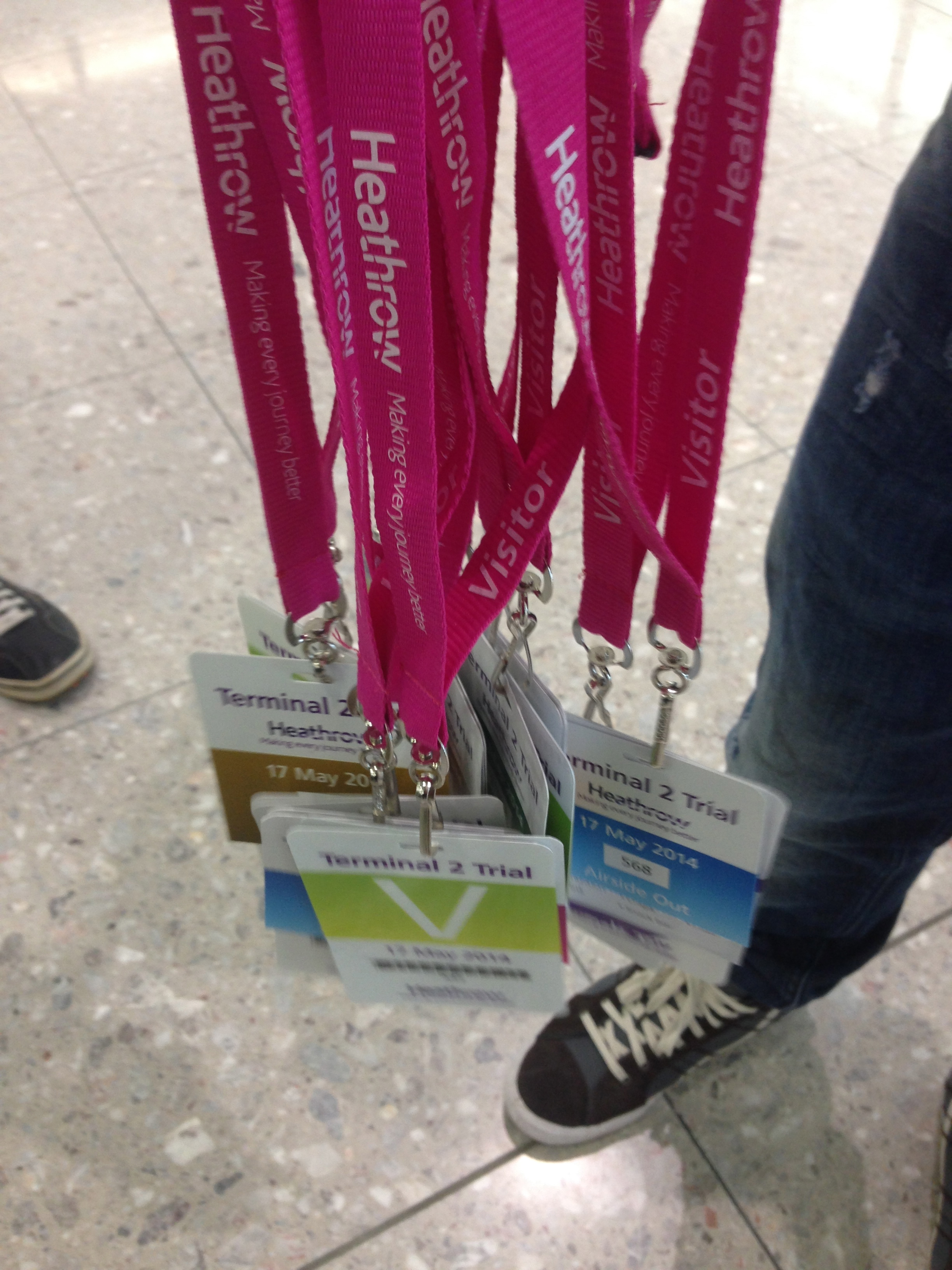
Bn1-D5dIcAAkpLoBn15FraIMAADeSJ

They were looking for four different trial phases to check the parking, signage, flow of passengers, the check-in procedure, security, boarding, passport control, baggage and pretty much everything that you experience at an airport when arriving or departing. The aim of the test phases was to establish that all the routines, training and building works were designed perfectly for the many thousands of people that would be traveling through Terminal 2.

More importantly that any ‘problems’ (teething or otherwise) could be resolved before the terminal is open to the public. Volunteers would be rewarded with a poke around the new Terminal and a promise of a wonderful goody bag after every trial.

I was intrigued as to what was really involved in an airport trial. I already do customer reviews of restaurants, hotels, leisure/sports facilities, physios and bars looking at the customer experience so wondered how this would be different.

Sadly I was only available for one of the trial dates, the final date – today.

For the past few weeks there have been automated emails advising me a little of the procedure for the day. Registering for a car parking pass, instructions for parking and a little more about what to expect. In the last week, I’ve received emails telling me how well the project is going and how the trials have helped iron out teething issues raised. Apparently there have been over 800 issues raised through these trials and 620 of these have already been resolved. Let’s see how they do today!

IMG_5479

The first group of arrivals were called for a briefing where the day was explained to us. During this briefing there was mention many times that we’d have a fabulous day. Pet hate… don’t tell me, let me decide if it’s a fabulous day thanks!

IMG_5473

Then we left the briefing and headed for the next ‘briefing’ stage where we were given our first assignment scripts.

My script indicated I was a gentleman passenger flying alone to Taipei via Bangkok. Flying with Eva Air. I had to collect a trolley and then pick up two pieces of hold luggage. Checkin at a desk and then head through security to the departure lounge and wait my flight to be called. My flight time at 1pm and boarding time approximately midday.

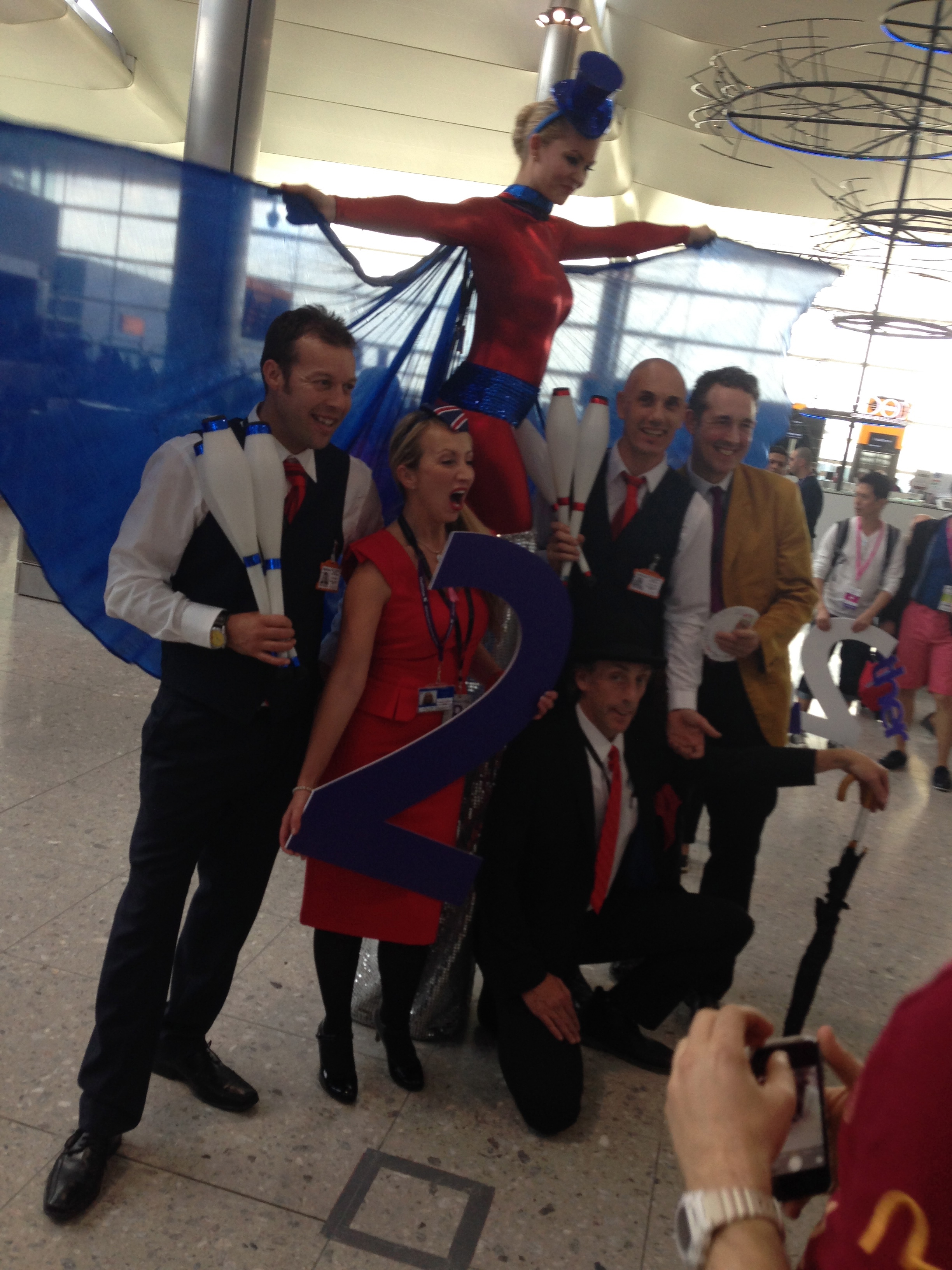
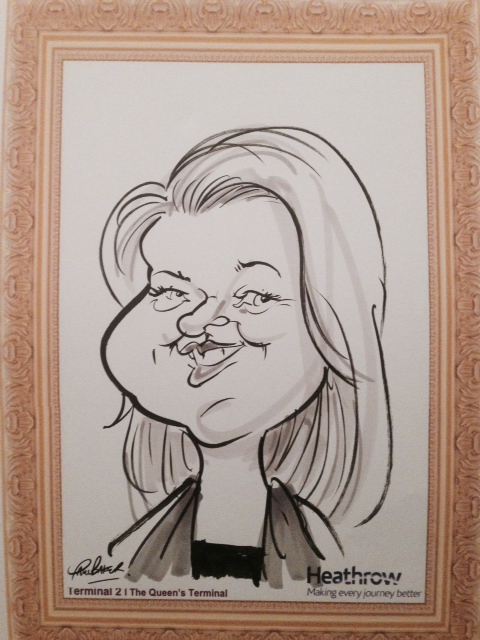
IMG_5470The collection of the trolley, locating my two pieces of luggage, checking in and even security went very smoothly. (I’m a particular fan of the bigger security trays in T2). In fact I’d say I flew through all of this and then had time to kill in the lounge. Heathrow had laid on lots of drinks, snacks, muffins, chocolate bars, yoghurts and magazines to keep us fed, watered and occupied. Also traveling around the terminal were magicians, caricature artists and balloon makers as well as some arts and crafts competitions for the younger trial testers.

IMG_5476photo

I was chatting to a lovely gentleman who’d done two of the previous trials and was happy to do the final one to see the end results. He told me of a few of the things they’d picked up before and also of the contents of the goody bags (alarm clocks, travel plugs etc). Fortunately for me, he was also on the same flight journey and knew the ropes!

At about 11.30 there was a short presentation about the airport, a short speech from Brian Woodhead, Operations Director at BAA. We learnt a little more about Terminal 2. How the original Terminal 2 (AKA Queens Building) was opened by Prince Philip and Queen Elizabeth some 60 years ago and on 23rd June 2014 they will return to open the new Terminal 2.

We were then encouraged to take part in a short film about Terminal 2, dancing, singing and generally smiling that will be cut into a music video as part of the promotional film and also include other clips from the day and previous days.

As soon as this finished, our flight’s boarding gate appeared. Oh but we were also encouraged to pick up our packed lunch and take it with us on the journey. However the queue to pick up lunch was mahoooosive and many of my flight companions decided to grab lunches after this flight and before the next. Oh how we’d regret that decision!

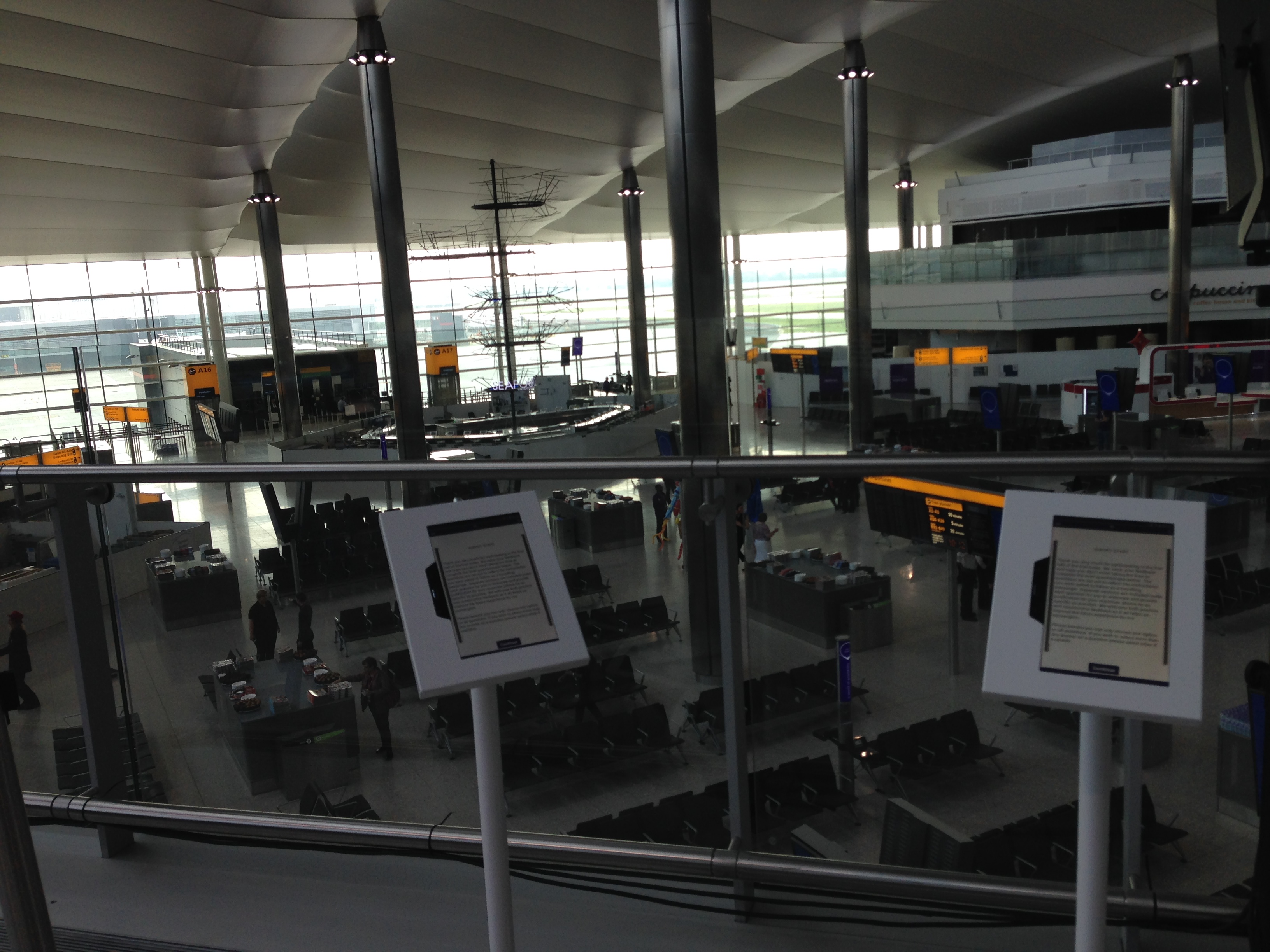
We headed off in search of our boarding gate. Yes you know it – it’s the furthest gate to get to. Truly it is. A long long way, up escalators, double backing on yourself at different levels, walkways and tunnels and eventually to this bank of departure gates. It all looked very pleasant and functional. I’m not sure if there’s enough seating if the airport departures were at full capacity but they must have done their sums. Also a word of warning for anyone with weak bladders, small children or elderly travel companions – there’s quite a distance between toilets so go when you have the chance!

It was minutes until our flight was called and we were going through.

Oh except we didn’t really get a flight to Bangkok or Taipei!

Once through the gate we get to swap our flight instructions for those of an arriving passenger. This time I’m a young(ish) woman and arriving into Terminal 2 on a flight from Warsaw. Our instructions are that the flight was meant to arrive into Terminal 1 but due to lack of gates arrived here and we were then to make our way through to Terminal 1 arrivals to continue our journey.

Simples……

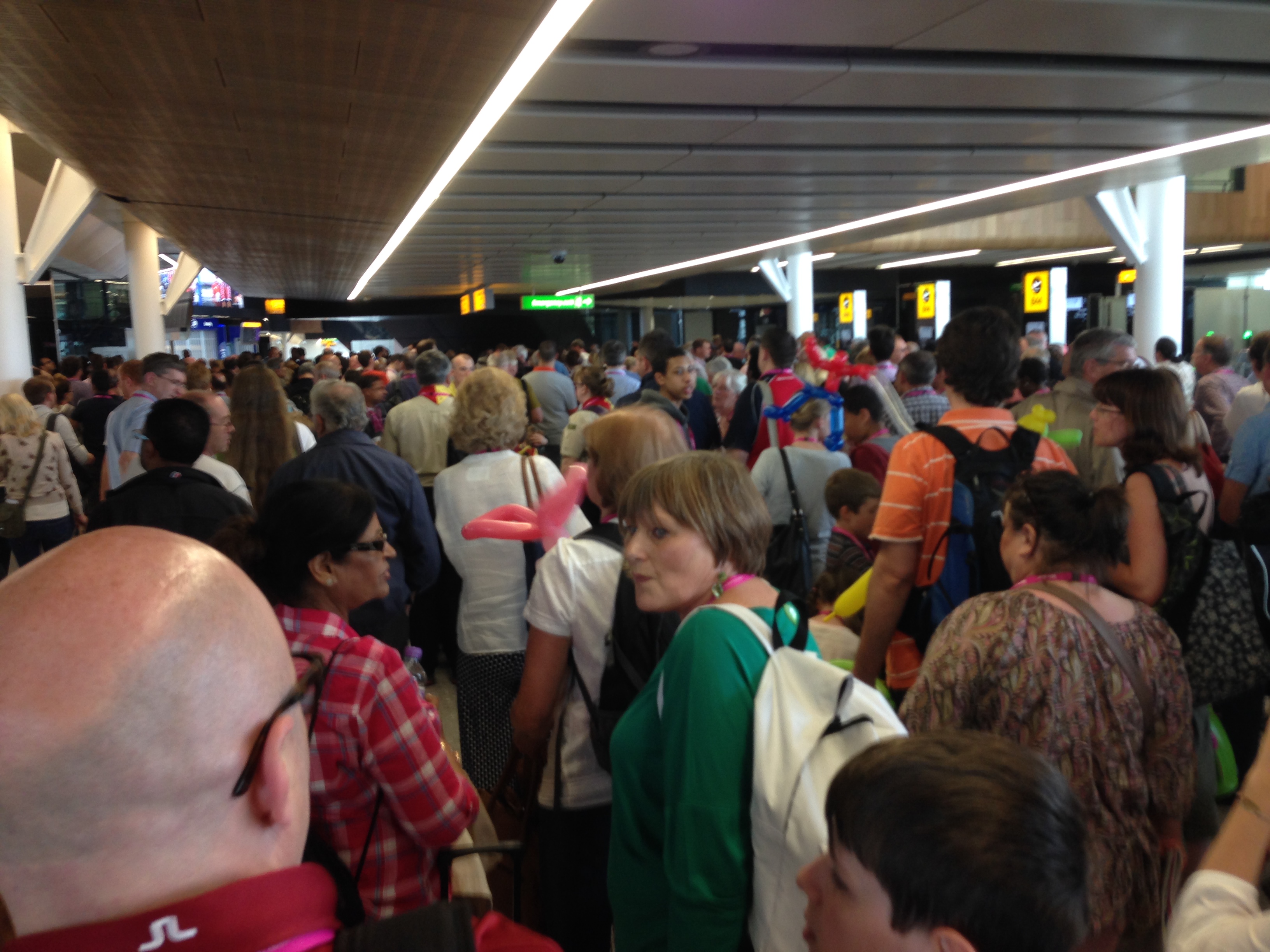
Or so we thought. Off we set. Down the escalators, along the passenger tunnel, round the corner, along travelators, following signs the whole way. Down another set of escalators and then we stop. There’s a queue. Quite a long queue and it goes around the corner in the tunnel. It’s getting hot down there. We’re not sure where we are. There’s no seats. It’s getting hotter. There’s no toilets. It’s getting hotter still. After quite a while a member of staff approaches our section of queue and advises us there’s an ‘incident’ and we’ll be moving along shortly. They then go further back up the queue and tell the same tale. Some time later, they return with others carrying bottles of water. Once again we’re advised that there’s an incident but this time we’re told that the firemen are dealing with it. Once again this message is told many times to differing parts of the queue. I make a comment that perhaps the PA system isn’t working in the passenger tunnel hence the individual Chinese whispers. All the time it’s getting hotter, people are now in search of floor space to sit down, some are getting worried that we’re cramped together in a passenger tunnel with nowhere to go but most of all it’s hot and we’re hungry (remember we didn’t have time to pick up our lunch).

IMG_5477Another chunk of time later we’re told that there’s one of the new air conditioning units has caught fire and although the fire is out, it is bellowing out pungent black smoke. This means that noone can get down the passenger tunnel and out of the location we’re being held in. Hmmm I think our testing may have found a flaw – surely there must be an alternate way out?

After another period of time we’re told that we’re going to be ushered back to the departure gates to await further instruction. Fine for a trial but in ‘real life’ you wouldn’t have arriving passengers mixing with departing passengers without going through security!

I won’t bore you with all the detail but suffice it to say that there was a lot of scurrying around by staff with perplexed faces and a few muttered swear words too. We were told to find a seat and then told we needed to evacuate the area and were once again bunched up waiting for an exit from this area, minutes later told to take a seat again. What a complete mess. Seriously, if this was the final ‘live trial’ I’m wondering what training has taken place or are the staff also ‘test volunteers’?

Soon we were again told we were on the move and OK to go. We went back down another set of stairs, apparently enroute back to the departure lounge. A long walk and several travelators, one of which came to a juddering halt with us on it. When we were all underground once more (different area to the last disaster) we came across two escalators and two lifts which would apparently take us back upstairs. Only one escalator and one lift were working…. eventually (yes you guessed it) the only escalator working stopped. We bunched up again, the staff member who was meant to be assisting us was heard to say “F’ing Hell”, an engineer turns up and attempts to reverse the escalator that isn’t running and fix the one that’s stopped. This takes yet more time and eventually although he gets both working in an upward direction, proceeds to only let groups of 20 or so people on to the escalators at each time.

It is quite some time later still that we find ourselves back in the departure lounge… and in search of that illusive lunch that we’d stupidly not queued for earlier!

IMG_5478

After stuffing a few bites of a sandwich we were on our way again. Back in character and as if arriving from Warsaw. We needed to get to passport control and then to head toward Terminal 1 arrivals area. When eventually we reach the passage way to the Terminal 1 arrivals, we’re greeted by security who advise us that the test member of staff has had to go elsewhere due to the fire.  There would be no further instruction scripts and that the trial has now ended early.

We headed for the exit. I was desperate to breathe air. We were stopped only briefly to have thrust in our hands a slip of paper with the url to provide feedback from today and our goody bags… or should I say a Terminal 2 umbrella and an empty Heathrow nylon bag. That’s all we got for the day… well apart from claustrophobia, heat exhaustion, tired feet and a feeling that we could have been doing something so much more interesting instead.

Bn16biaIYAA9477-2

So very very disappointed with the day. My observations were very simple:

The ‘bosses’ were there and shouting about Terminal 2 when it was going well… didn’t see them again later on.
If the passenger tunnel was the only route or arriving passengers at Terminal 2, what would happen if this event happened in normal business day? Or perhaps a passenger was taken ill in the tunnel? Surely there’s an alternate route?
How would it work if planes were constantly landing and disembarking yet more passengers into this tunnel?
Why did the staff not know how to communicate with the ‘passengers’?
Was there any communication amongst the staff to relay the procedure and manage the situation?
That’s a lot of dissatisfaction in return for an umbrella and nylon bag.

And finally… is it really going to open in a few weeks time?

Every Day in May

As one challenge ends another begins.

“Challenge yourself with something you know you could never do.
and what you’ll find is that you can overcome anything.”

“You must never limit your challenges… instead you must challenge your limits!!”

ec34c23fba5e8b0064071a0a31e6584f

Last year you may remember that I took part in this challenge. Partly, of course, to add a few ££ to the funds raised for Royal Marsden. The total amount raised through this challenge last year was over £24,000 – well done all!

BUT it was also to challenge myself. I’ve been suffering hugely with fatigue, headaches, visual migraines and this has all added in no small part to bouts of depression and frustration. My thought was that by signing up to this challenge I would HAVE to get out every day not matter what the weather and walk, cycle, run, row, skip, jump, swim etc 5km every single day in May. 5km isn’t far and is so achievable…. but added to the list above I’d also hurt my knee in that fall in Australia and had an ongoing pain issue with my ankles which was excruciating on some days.

I did it though. Some days were so much harder than others. As always the sense of personal achievement is so much more than swollen ankles, fatigue and headaches.

This year the challenge is the same. Sign up for 5km or 10km every day during the month of May. The charity chosen this year is Interact – a stroke charity that do amazing hands-on work with stoke sufferers. They send professional actors to read to people who have had a stroke; helping the brain to re-wire and piece together memories and make sense of life again. For many stroke victims, young and old, their freedom is curtailed by the results of their stroke meaning they may not be able to enjoy the May sunshine, parks, flowers and colour.

So please join me in signing up for this challenge. An ‘entry-fee’ of £15 will enter you into the challenge and add to the money raised for Interact. You can, of course, raise additional sponsorship for your challenge however if you choose simply to do the challenge, donate your entry fee and maybe recruit some friends and family to do it with you, the donation pot will be swelled that way.

Find out more about ‘Every Day in May‘ – we can all achieve it
Twitter: @everydayinmay & @InterActReading
Facebook: https://www.facebook.com/5k10keverydayinmay & https://www.facebook.com/pages/InterAct-Reading-Service

End of my Old Skool Challenge for Penny Brohn

Today was the end of my sponsored weightloss challenge. Read more about the challenge here.

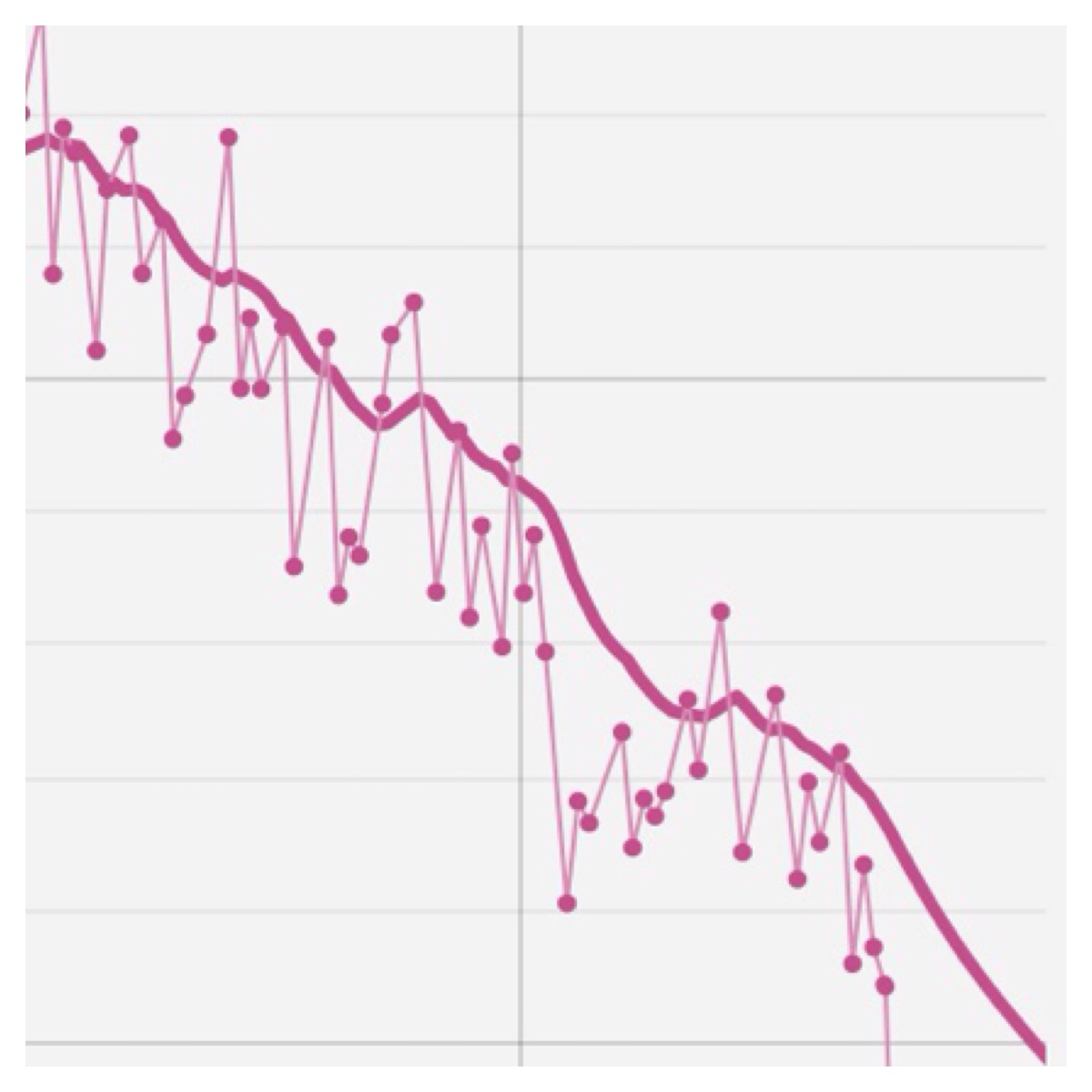
Drumroll please.  Total lost at the end of the challenge: 11.7kg which in ‘old money’ is 25.8lbs or 1.8st.  I’m pleased with what I’ve lost but tinged with a little disappointment that I didn’t manage to lose more.

I’m surprised that my ‘eat less and do more’ strategy together with the introduction of  juicing into my diet strategy and a week of juicing retreat that I’ve not lost more.

However I am super excited that my weightloss graph has continued to go down, albeit in small increments.

IMG_5106

Thank you to everyone who sponsored me during this period. I know that Penny Brohn Cancer Care will appreciate every penny you donate and put it to great use supporting people diagnosed with cancer through their wonderful services.

Miranda, Chickle, MrFraig – pledged 50p/kg = £5.85 each
= Total £17.55
FB, Jen, Dad, Chris, Roli, Pageboy, Kelly, Nancy, Leigh – pledge £1/kg = £11.70 each
= Total £105.30
Issy, Dunc & Polly – pledged £2/kg = £23.40 each
= Total £70.20
Rich – if only I’d done lbs!
JohnS and Viv – £20 each paid up and donated to PBCC

Total pledged/donated – £233.05

Could each of you please donate your pledged amount directly to Penny Brohn Cancer Care? Either online at https://support.pennybrohn.org/singledonation or send a cheque payable to Penny Brohn Cancer Care, Chapel Pill Lane, Pill, Bristol, BS20 0HH

The amount of £233.05 raised will:

  • pay for a one day retreat at the Centre;
  • very nearly the whole cost of someone attending a Living Well Residential course;
  • 11 meals for people attending a course;
  • 8 hours of guided meditation and relaxation at the Centre;
  • nearly 5 people to attend a Taste of Bristol Approach course;
  • 9 people to attend a cookery/nutrition demonstration/session;
  • …and a whole heap more.

Seriously. Thank you. I know first hand the benefit of the services offered at Penny Brohn.

For those of you that said they’d sponsor me later…now’s your time! Please make a donation direct to Penny Brohn using the info above. 😉


Me… I’m going to continue with the diet strategy but in doing this I have learnt so much about ‘healthy’ eating and more particularly juicing. I’ll keep you posted x

Juicing and Sponsored Diet Update

Well there’s good news and not so good news.

The good news is that the juicing diet definitely works.  I had a weigh-in on Day 5 of the 7 day juicing plan and I’d lost the 3.4kg which (according to Google) is 7.49lbs.   Brilliant stuff and I thought wisely that should I continue to juice for the final 2 days that I’d drop even more.

In all honesty I probably did.  Friday morning when I was rushing around I certainly was feeling slimmer, my skin was great and my energy levels were increased too.  I weighed-in on quickly and have just done the calculations – a slight rise since Day 5 – but still a loss of 2.8kg on the plan.  So if I’d been following it to the letter for the past 2 days why hadn’t I lost any weight.  This may be Too Much Information for some of you… but even though it’s just juice and even though there’s nothing bad in it and even though I may be pee’ing a lot… there’s no roughage or fibre in the diet… if you know what I mean!

I’m hoping with some sensible eating of 1 meal a day (containing fibre!) and balancing this with juices twice a day that I can maintain a steady weightloss from here on it and retain the benefits of skin feeling great and better energy levels.  Depending on how this works out with planning, purchasing and making the juices as part of every day, I may change to the 5.2 diet but using only juicing on my 2 days.

The ‘not so good news’ is that on Friday I headed up to Norfolk for a weekend of partying and celebrating a friend’s 50th birthday…. this morning’s weigh-in isn’t so good!

As for my sponsored diet, there’s more weight lost which means more funds raised for the fabulous Penny Brohn Cancer Centre in Bristol.  It may not be much but every penny counts and I know they’ll put it to great use to support both people with a cancer diagnosis and those carers and supporters who also need their services.  So if you’ve not yet sponsored me, add your pledge to the post I’m Going Old Skool.


Haven – Fulham

This afternoon I was invited to an event at the Haven in Fulham.

image001-3

During my journey I never contacted the Haven as I believed it was solely for people affected by breast cancer.  I understand it was once, but not anymore, not totally.  Great news for people affected by cancer to have another resource nearby to help them through and beyond a diagnosis.

The Haven is located just behind Harwood Road in Fulham, a few minutes walk from Fulham Broadway tube.  Housed in converted church which from the first moment of entry, feels comfortable and calm.  3423994_c6b1af15The interior of the ground floor hosts a reception area, a seated area and then on a slightly higher platform another seated area with plenty of sofas, a small kitchen on one side for people to get a warm cup of tea and the other side plenty of information leaflets, computers and books.  I understand that there are four floors in total in which there are a great number of consultation rooms, treatment rooms, a large group room and another for exercises.

The kitchen serves great delicious and healthy food at lunches on Monday to Wednesdays.  There are nutritionists available to offer advice and whom also run courses and phone consultations to those who want advice.

I was pleased to hear this evening that they are now open late on a Wednesday evening for people to drop into the Centre.  Whilst I understand that it’s hard to staff cancer Centres in the evening and weekends, I feel it’s imperative that more centres are available to those who are working or perhaps have children that means they’re unable to get away during the working day.

I was also pleased to hear the services are now being offered to people diagnosed with other cancers, other than breast cancer.

If you would like support or information, do have a look at the services offered at the Haven.

They also have centres in Hereford and Leeds with another one opening in Wessex.

London Focus Group on Research Strategy

Following on from the “Your Say, Your Day, Your CRUK” event, I was invited to attend a Research Strategy day at Cancer Research’s head office.  Cancer Research are running a number of these smaller events around the country (each one with approx 8 people) following on from a number of points raised from the Your Say Your Day event. Well done Cancer Research for following this up.

The purpose of creating a research strategy is to bring forward the day when all cancers are cured.  However in order to fund all the research it would take an inordinate amount of money and way more (sadly) than Cancer Research have access to from all the mammouth fundraising efforts of you all.  This sadly means that not everything can be funded and research has to be ‘put on hold’ or simply not undertaken.  Inevitably this means difficult decisions based on so many factors.

Cancer Research have four main objectives in their research strategy which in brief are:

  1. Reducing risks of developing cancer.
  2. Diagnosing cancer earlier.
  3. Developing new treatments.
  4. Improving cancer treatments.

Each of these objectives were discussed in length at our meeting.  It was a great opportunity for each of us to add our own voice, experience and opinion as to the impact and importance of each of these objectives, in our minds.

Throughout the day there was a lively discussion.  For those of us affected by rare and rarer cancers it also gave us the opportunity to ensure that these were not forgotten in the discussions and included in the objectives.  Over 53% of all cancers fall within the classification of rare or rarer cancers however these are often not in the public eye as there are many cancers but only a minor number of people with each cancer so their ‘voice’ is quieter.

We discussed the emotional impact of cancer, particularly with reference to funding or working with parties looking at the psychoncological aspects.

Discussed was the ‘topical’ conversation of collecting data for BRCA 1 & 2 as to outcomes and how many chose mastectomy -v- lifestyle/surgery.

The EPIC study – where over 500m people from 10 countries have been recruited to research into diet and nutrition with reference to chronic conditions including cancer.

Our group, after lengthy discussion, thought that lifestyle research should be undertaken collaboratively with other charities, organisations, NHS England.  We felt that by working on a larger project across boundaries there would be more access to specific patients and carers able to provide research data and feedback before during and after diagnosis.

With reference to Objective 2 about early diagnosis, a question was raised “Do we find early diagnostic tests for cancers that are curable?”.  A difficult question to answer.  Logically, of course, so that noone needs be diagnosed and can live cancer free.  Logic would also say though that as not every research project can be funded, should the money not be spent on a cancer where there is no cure?

With reference to Objectives 3 and 4, there was a very lively discussion.  Where there are some treatments already should we develop new treatments?  Clearly a difficult one however logically (oooh logic eh?) medicine and technology is always improving, so why shouldn’t there be advancements are simply because of improved technology.  Just because something works it doesn’t mean that there may be a less toxic chemo or less invasive surgery?

One of the many aspects we looked at with reference to this was not only the survival statistics but the length of survival, quality of life and mortality rates.  Each of these have a slightly different bent to them but as people affected by cancer, we all said that actually quality of life was essential in surviving.  Therefore some surgeries which mean that a persons lifestyle is inhibited in such a way to make it ‘difficult to live’ may not be the best option (for some).

We also said that we appreciated Cancer Research (like any organisation) needs to make an impact.  We often, within business, talk of ‘quick wins’ and I guess for many within cancer research, this might be seen as an easy solution, not overly complex, perhaps for a ‘popular’ cancer or a project that perhaps doesn’t take long to complete.

We discussed the possibility of Cancer Research’s involvement in surgical trials.  Could they be carried out in a way that each one would be comparable and thereby determine an advancement in treatment?  This is a difficult one as we know that as humans we have different skills and perhaps are better at one thing than another and indeed each patient is different too.

Discussed during the day was also the Genomics England project.  Worth reading and understanding a little more, if you don’t already know about it.

We were given £350m each (in monopoly money!) and asked to consider how we would allocate the funds within the four objective areas.

Those of us with a voice for rare and rarer cancers were also keen to ensure the addition of monies being ringfenced for rare and rarer cancers.  The main reason simply being that the time required to recruit patients or obtain tumour samples takes much longer due to there being fewer of each available.  We wanted to ensure that the funds, although allocated for a project in Year 1, would be available for an extended period of time, should the project not be able to begin until the data had been gathered.

As part of the focus group, we were handed a pack of post-it notes.  On the wall was a series of points which marked the different stages of the research cycle.  We were asked to use the post-it notes to write our concerns, feedback, thoughts, etc on each of these stages and more particularly where we believe patients, carers, advocates should be involved in the discussions AND decisions of Cancer Research’s Strategy and how the monies raised by the public is to be spent.

A terrifically interesting day and I do hope our voices and opinion will be considered and valued by Cancer Research.

Building Careers in Clinical Research Conference

This conference is held annually for nurses and health care professionals to understand about clinical research as part of their career path, network and share ideas and good practice.

Conference Agenda – Clinfield Conference

Clinical research nurses are historically an under recognised group within the healthcare setting.  However their work is invaluable to advancing medical research and patient understanding to available treatments.  The skills of clinical research nurses are so often under-utilised within mainstream clinical practice and the research agenda but offer so much.   One the main discussions at the conference therefore is to look at the broader agenda and look at where we can each promote the invaluable work that the clinical teams do.

My invitation to participate in the conference came to me because of my involvement as a patient advocate/representative with Imperial College Hospital.

Throughout the day’s conference there was an overwhelming enthusiasm for spreading the word about clinical research.  For better understanding about what clinical research actually is and what is available at the bedside together with what is being developed in the lab.

Certainly I have been aware that there isn’t enough information nor knowledge available to patients nor also a practical matter of fact guidance to what clinical research truly is.  As patients we there is a need (in most of us) to know that research is being undertaken to advance medical care.  To know that there are changes that may benefit us or those who travel the road behind us.  To know that involvement in a trial will not leave us like the Northwick Park ‘Elephant Man’ drug trial.  To know that participation in research may mean simply completing a survey of questions every few months or having your bloods analysed regularly.  It’s not always about a taking a new drug!

What I discovered from this conference was that it wasn’t only the patients who didn’t fully understand clinical research – it’s also the doctors and nurses in clinical settings.  I guess it’s understandable that a GP might not be able to keep up with all the ‘new’ research.  Less understandable for doctors and nurses in a hospital environment but still possible.

This is why it’s critical that ‘clinical research’ is something that is taught in medical school as progress.  That there is an easily accessible, searchable and functional database of trials available to all.  That the trials in the database are up to date and have contact details of who’s in charge and how to participate.

It’s also critical that there are trained clinical research staff available for consultation with patients and colleagues alike.  These staff members to have a voice at MDT settings so that all staff are aware of their role and expertise.  They should also span the gaps between primary and secondary health care settings.  Referrals of patients are sent to them to have research explained fully to them and how they may participate.  They should also, with training, be able to dispel any myths about elephant man etc and to encourage the positive impact of clinical research.

In addition the role of a clinical nurse specialist doesn’t have to be a full-time role.  There were  a number of speakers who told us of how they had embraced their clinical role in addition to research.  As a midwife, as a nurse, as a lab clinician… perhaps this is one of the best solutions so that they’re able to bring both practical and research experience to each case.

An excellent conference and certainly there was a great deal discussed for me to consider in my many networks and patient advocate involvement roles.  Below are a few bullet points:

  • Historically clinical research has been under recognised in healthcare.
  • Clinical research skills are under-utilised in main stream clinical practice and research agenda.
  • Need to look at a broader agenda.
  • Need to promote the invaluable work that the clinical teams do.
  • More multi-professional education and training needs
  • Research, translation and innovation
  • Through research we bring some certainty in an uncertain NHS world
  • A larger impact on health is from ‘public health’ rather than ‘medical health’ – need to re-balance
  • Gaps between primary and secondary health care.  Closer integrated working practices are needed.  New ‘Pioneer Program’
  • Targets are not the same as outcomes
  • Patient Centred culture
  • RCP – Circle of Patient Centred Care
  • RCP – Future Hospital Commission 2013 diagram
  • Competencies and appraisals for research nurses should change and be updated in methodology
  • We don’t do enough to raise awareness of clinical trials
  • Need more clinical research training provided to clinicians so they’re able to speak with patients
  • More accurate information on hospital trust websites and other websites i.e. charities, local authorities etc
  • PALS should receive training too
  • Everyone should be aware of ‘We do clinical research
  • National Institute for Health Research Clinical Trials
  • Involvement in research benefits patients but also hospital trusts – financially and with reputation
  • Managers and senior colleagues should support staff in training and research recruitment practices
  • Work with the media and charities to send ‘good messages’ about research not just dramatic headlines
  • Other healthcare professionals including pharmacies should be involved and aware of clinical research.
  • Always feedback results (good and bad), send thank you’s to those involved and offer further involvement
  • What do clinical nurses do?
  • Read Kerry Stott’s blogs about clinical trials
  • We Nurses‘ website  and also twitter @wenurses

“To find your mission in life,” author Frederic Buechner is quoted as saying, “is to discover the intersection between your heart’s deep gladness and the world’s deep hunger.”

Research changed my life

“If we are serious about patient choice and patients having a partnership with clinicans, then we have to be serious about raising patient awareness of clinical research opportunities.”